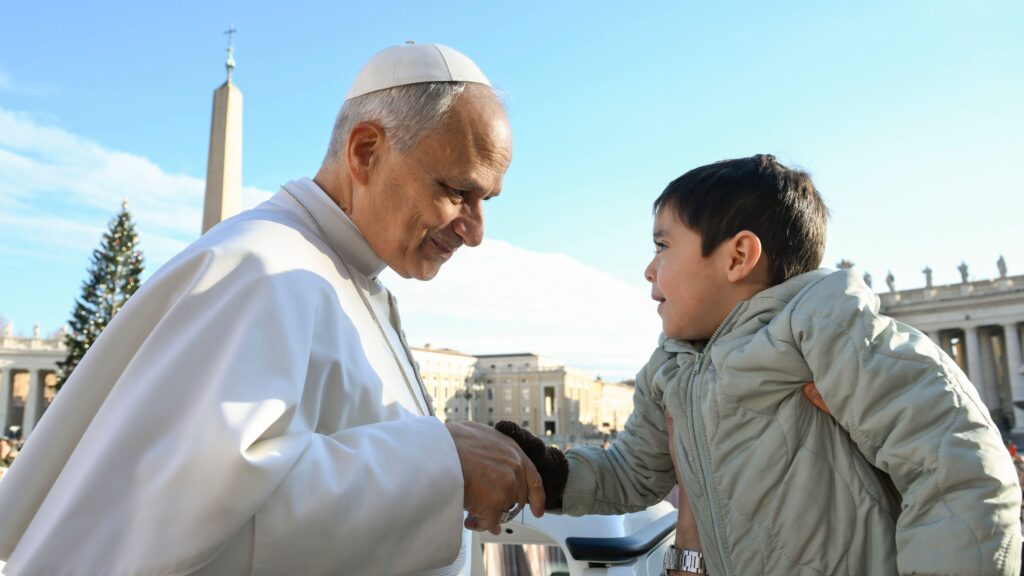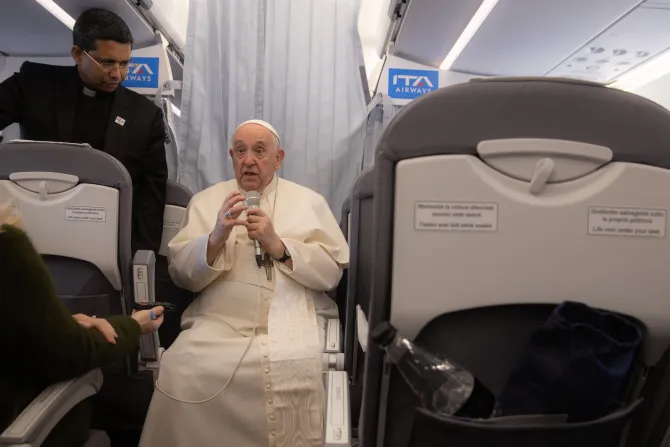
Pope Francis said on board the papal plane on Sunday that he did not lose consciousness before his hospitalization at the end of March, which was for “strong and acute pneumonia” in his lower lungs.
“What I had was a severe illness at the end of the Wednesday audience,” he said on April 30, during his return flight from a three-day trip to Budapest, Hungary.
Asked about the state of his health during the in-flight press conference, the 86-year-old pope said he had felt bad on March 29 and went to lie down instead of eating lunch.
“I didn’t lose consciousness,” he explained, noting that he developed a high fever and at 3 p.m., his doctor took him to the hospital for “acute and strong pneumonia, the lower part of the lungs.”
Pope Francis spent three nights in Rome’s Gemelli Hospital March 29–April 1.
A statement from the Holy See Press Office said the pope had been diagnosed with bronchitis and that his condition improved after receiving antibiotic infusion therapy.
“The body responded well to the treatment. Thank God,” Francis said Sunday.
Bronchitis and pneumonia are both infections of the lungs. Bronchitis is an infection in the bronchial tubes, while pneumonia is an infection in the alveoli, or air sacs of the lungs.
Pope Francis was asked about his health in the context of his planned upcoming travels, in particular to Lisbon, Portugal, at the beginning of August for World Youth Day.
The pope said a doctor checked him out the day before his trip to Budapest to make sure all was well for him to travel.
The trip to Lisbon is on “for the time being,” he added. “And then there is the trip to Marseilles, [France], then there is the trip to Mongolia.”
The question came at the end of a trip that saw the pope follow a much more relaxed schedule than previous travels he has undertaken — with only two public speeches per day.
The pope used both a wheelchair and a cane to move around.
Pope Francis’ visit to Budapest included meetings with President Katalin Novák and Prime Minister Viktor Orbán. He also spent time with visually impaired children, young adults, and clergy. On the morning of April 30, he celebrated Mass for 50,000 people gathered in and around Kossuth Lajos Square.
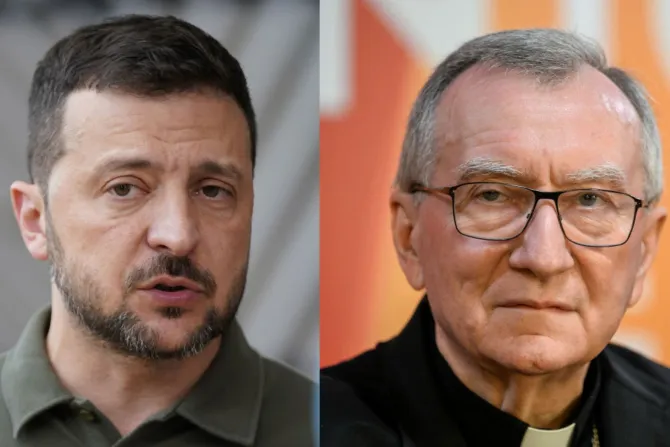
During the in-flight presser, a journalist asked Pope Francis if he thinks the Vatican will be able to help Ukraine retrieve children taken to Russia, as he was asked to do during a recent meeting with Ukraine’s prime minister.
“I think so, because the Holy See brokered some of the prisoner exchange situations through embassies,” he said.
“I think it can go well, that is also important. At least the Holy See is willing to do that because it’s right, it’s a just thing and we have to help…
“We have to help,” he added, so that it does not become “a casus belli.”
The pope was asked about his meeting with Orbán and the closure of the Balkan migrant route at Hungary’s border, and whether his meeting with Russian Orthodox Metropolitan Archbishop Hilarion in Budapest on April 29 could open up a path to peace talks with Vladimir Putin.
“I believe that peace is always made by opening channels. Never can peace be made by closure,” he said.
The pope said ecumenism is about maintaining relationships. “We have an outstretched hand with everyone, even receiving the hand of God.”
He added that while he has only spoken with Patriarch Kirill of Moscow once, he is “in connection” with him through an Italian bishop who knows the Russian environment well and who comes to brief him on it.
“The relationship with the Russians is mainly with this ambassador [of Russia to the Holy See],” he said, with whom there is a good relationship.
“Everyone is interested in the road to peace,” he continued. “I am willing to do whatever needs to be done. Even now there is a mission going on, but it is not public yet.”
On migration, Pope Francis said Europe needs to tackle the issue, because “there are five countries that suffer the most: Cyprus, Greece, Malta, Italy, Spain.”
“Europe is not taking charge of that, of a fair distribution of migrants,” he said.
Another problem in Europe, he said, are the low birth rates in some of the same countries with a high influx of immigrants, like Italy and Spain. These countries are also seeing many of their young professionals leave for other countries, he pointed out.
Referencing Pope Francis’ gift last year of three fragments of Parthenon sculptures from the Vatican Museums to the Greek Orthodox archbishop of Athens, a journalist asked if he was considering returning to indigenous groups in Canada artifacts taken during colonization.
Francis called to mind the Seventh Commandment and its directive to not steal before calling his decision to give back the Parthenon sculptures “a correct gesture.”
“But there has to be discernment either way,” he added.
He said the Vatican has agreed to return indigenous objects to Canada and that he believes the process is underway.
He also encouraged returning stolen objects. “This is good for everyone. It’s so that you don’t get used to putting your hand in other people’s pockets,” he said.