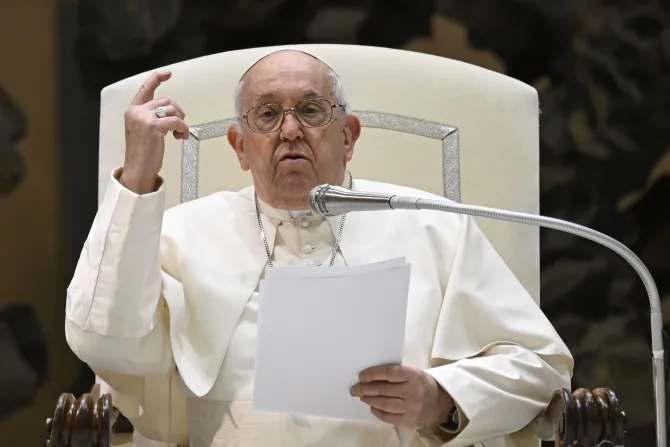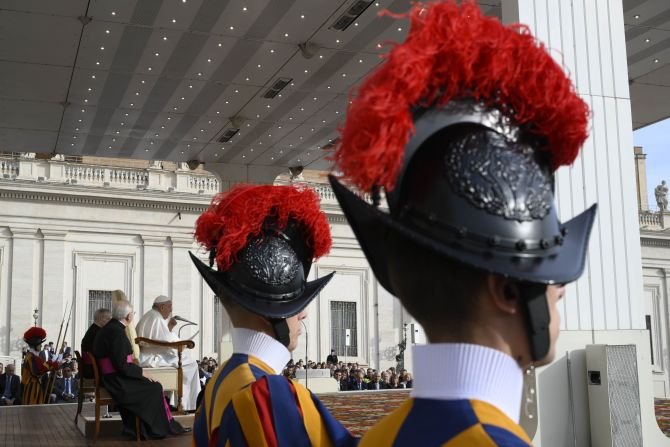
Pope Francis drew upon the example of St. Charles de Foucauld during his general audience Wednesday in his ongoing catechesis on apostolic zeal to stress the importance of centering our lives on Jesus.
At the end of his remarks at his weekly general audience in St. Peter’s Square Oct. 18, the pope called for peace in the Middle East and announced that Oct. 27 has been designated as a day of prayer and fasting.
Before the assembled faithful, the pope said the “first step” for evangelization and conversion is putting “Jesus at the center of one’s heart.”
The pope, however, admonished that “we risk talking about ourselves, our group, a morality, or, even worse, a set of rules, but not about Jesus, his love, his mercy.”
He added, in unscripted remarks: “I see this in some new movements that are arising: They talk about their vision of humanity, they talk about their spirituality and they feel they are on a new path… But why don’t you talk about Jesus? They talk about many things, about organization, about spiritual paths, but they don’t know how to talk about Jesus.”

Epitomizing this love for the Eucharist was St. Charles de Foucauld, who was canonized by Pope Francis in 2022. Born in 1858, he dedicated his life to missionary work in the Sahara, living and working among the Tuareg people (a subgroup of Berber people).
After serving in the French cavalry, he went on to become a Trappist, going to serve the poor in Syria, an experience that had a profound impact on him and helped define his understanding of poverty. He later discerned out of the Trappists and went to Palestine, where he went to live close to the Poor Clares.
“It is in Nazareth that he realizes he must be formed in the school of Christ. He experiences an intense relationship with him, spends long hours reading the Gospels, and feels like his little brother. And as he gets to know Jesus, the desire to make Jesus known arises in him,” the pope said.
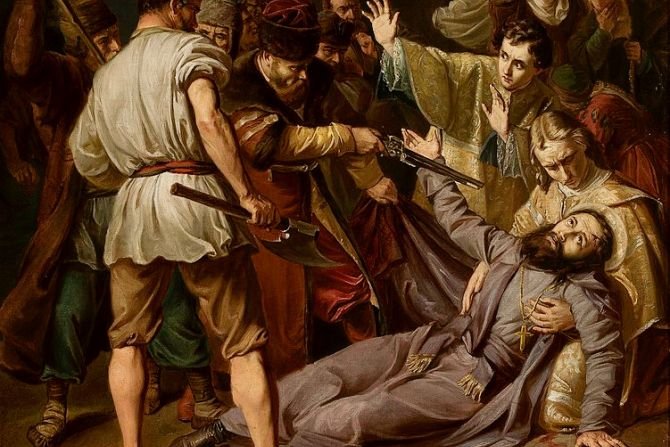
It was this time in Palestine that provided him with the inspiration to write his prolific works, including “Letters from the Desert,” “Hope in the Gospels,” and “Meditations of a Hermit.” These writings became the essence of his spiritual legacy, inspiring the formation of numerous future religious congregations. He was assassinated in 1916 at his hermitage in Tamanghasset in southern Algeria after being kidnapped by an armed tribal group associated with the Senussi Bedouins.
Pope Francis closed his 2020 encyclical on fraternity and social action Fratelli Tutti with a reflection on the saint, writing: “Blessed Charles directed his ideal of total surrender to God towards an identification with the poor, abandoned in the depths of the African desert. In that setting, he expressed his desire to feel himself a brother to every human being, and asked a friend to ‘pray to God that I truly be the brother of all.’ He wanted to be, in the end, ‘the universal brother.’ Yet only by identifying with the least did he come at last to be the brother of all. May God inspire that dream in each one of us.”

Pope Francis, in today’s catechism, noted that while de Foucauld lived “a youth far from God” he converted “by accepting the grace of God’s forgiveness in confession.” He was someone who “drawing upon his intense experience of God, made a journey of transformation towards feeling a brother to all,” the pope said, quoting Fratelli Tutti.
In contrast to the life of de Foucauld, the pope lamented the loss of Eucharistic devotion today. “I am convinced that we have lost the sense of adoration; we must take it up again, starting with us consecrated people, the bishops, the priests, the nuns, and all the consecrated people. ‘Wasting’ time in front of the tabernacle, to take up again the sense of adoration,” the pope said in an unscripted remark.
The pope presented the life of de Foucauld as an antidote to this tendency, saying that we “by kneeling and welcoming the action of the Spirit, who always inspires new ways to engage, meet, listen and dialogue, always in collaboration and trust, always in communion with the Church and pastors.”
“Every Christian is an apostle,” the pope said, quoting de Foucauld. In this way, he continued, “Charles foreshadows the times of Vatican Council II. He intuits the importance of the laity and understands that the proclamation of the Gospel is up to the entire people of God.”
The Holy Father concluded Wednesday’s general audience by renewing his appeal for peace in the Holy Land. “My thoughts turn to Palestine and Israel. Victims are increasing and the situation in Gaza is desperate. Please do everything possible to avoid a humanitarian catastrophe,” the pope pleaded.
He added: “War does not solve any problem… It increases hatred and multiplies revenge. War erases the future; it erases the future.”
In calling for a day of prayer and fasting , the pope invited members of other faiths to join an interfaith prayer vigil for peace on Oct. 27 at 6 p.m. in St. Peter’s Square.
The article was originally published on Catholic News Agency.