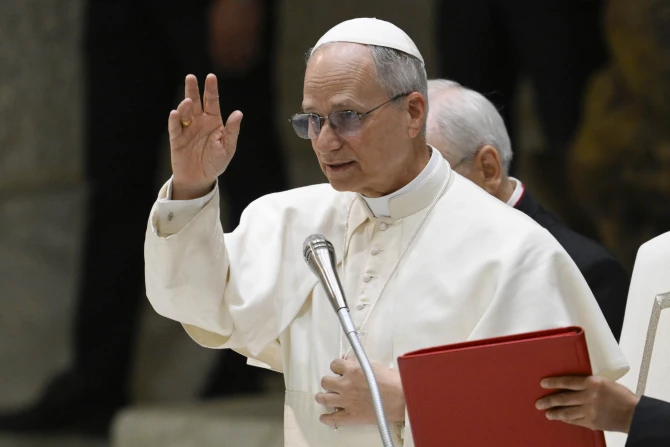
Pope Leo XIV urged members of the Centesimus Annus Pro Pontifice Foundation to embrace Catholic social doctrine as a path beyond polarization on Saturday, May 17, at the Vatican.
SIGN UP FOR OUR NEWSLETTER HERE
Good morning everyone!
Dear brothers and sisters, welcome!
I thank the President and members of the Centesimus Annus Pro Pontifice Foundation, and I greet all of you who are taking part in this annual International Conference and General Assembly.
The theme of this year’s Conference – “Overcoming Polarizations and Rebuilding Global Governance: The Ethical Foundations” – speaks to us of the deepest purpose of the Church’s social doctrine as a contribution to peace and dialogue in the service of building bridges of universal fraternity. Especially in this Easter season, we realize that the Risen Lord always goes before us, even at times when injustice and death seem to prevail. Let us help one another, as I said on the evening of my election, “to build bridges through dialogue and encounter, joining together as one people, always at peace.” This is not something that happens by chance, but is rather an active and continuous interplay of grace and freedom, one that our meeting today seeks to respect and support.
Pope Leo XIII, who lived in an age of momentous and disruptive change, sought to promote peace by encouraging social dialogue between capital and labour, technology and human intelligence, and different political cultures and nations. Pope Francis spoke of a “polycrisis” in describing the dramatic nature of our own age, marked by wars, climate change, growing inequalities, forced and contested migration, stigmatized poverty, disruptive technological innovations, job insecurity and precarious labour rights (Message to Participants in the General Assembly of the Pontifical Academy for Life, 3 March 2025). On such important issues, the Church’s social doctrine is called to provide insights that facilitate dialogue between science and conscience, and thus make an essential contribution to better understanding, hope and peace.
This doctrine helps us to realize that more important than our problems or eventual solutions is the way we approach them, guided by criteria of discernment, sound ethical principles and openness to God’s grace.
You have the opportunity to show that the Church’s social doctrine, with its specific anthropological approach, seeks to encourage genuine engagement with social issues. It does not claim to possess a monopoly on truth, either in its analysis of problems or its proposal of concrete solutions. Where social questions are concerned, knowing how best to approach them is more important than providing immediate responses to why things happen or how to deal with them. The aim is to learn how to confront problems, for these are always different, since every generation is new, and faces new challenges, dreams and questions.
This is a fundamental aspect of our attempts to build a “culture of encounter” through dialogue and social friendship. For many of our contemporaries, the words “dialogue” and “doctrine” can seem incompatible. Perhaps when we hear the word “doctrine,” we tend to think of a set of ideas belonging to a religion. The word itself makes us feel less disposed to reflect, call things into question or seek new alternatives.
In the case of the Church’s social doctrine, we need to make clear that the word “doctrine” has another, more positive meaning, without which dialogue itself would be meaningless. “Doctrine” can be a synonym of “science,” “discipline” and “knowledge.” Understood in this way, doctrine appears as the product of research, and hence of hypotheses, discussions, progress and setbacks, all aimed at conveying a reliable, organized and systematic body of knowledge about a given issue. Consequently, a doctrine is not the same as an opinion, but is rather a common, collective and even multidisciplinary pursuit of truth.
“Indoctrination” is immoral. It stifles critical judgement and undermines the sacred freedom of respect for conscience, even if erroneous. It resists new notions and rejects movement, change or the evolution of ideas in the face of new problems. “Doctrine,” on the other hand, as a serious, serene and rigorous discourse, aims to teach us primarily how to approach problems and, even more importantly, how to approach people. It also helps us to make prudential judgements when confronted with challenges. Seriousness, rigour and serenity are what we must learn from every doctrine, including the Church’s social doctrine.
In the context of the ongoing digital revolution, we must rediscover, emphasize and cultivate our duty to train others in critical thinking, countering temptations to the contrary, which can also be found in ecclesial circles. There is so little dialogue around us; shouting often replaces it, not infrequently in the form of fake news and irrational arguments proposed by a few loud voices. Deeper reflection and study are essential, as well as a commitment to encounter and listen to the poor, who are a treasure for the Church and for humanity. Their viewpoints, though often disregarded, are vital if we are to see the world through God’s eyes. Those born and raised far from the centers of power should not merely be taught the Church’s social doctrine; they should also be recognized as carrying it forward and putting it into practice. Individuals committed to the betterment of society, popular movements and the various Catholic workers’ groups are an expression of those existential peripheries where hope endures and springs anew. I urge you to let the voice of the poor be heard.
Dear friends, as the Second Vatican Council states, “in every age, the Church carries the responsibility of reading the signs of the times and of interpreting them in the light of the Gospel, if she is to carry out her task. In language intelligible to every generation, she should be able to answer the ever-recurring questions which people ask about the meaning of this present life and of the life to come, and how one is related to the other” (Gaudium et Spes, 4).
I invite you, then, to participate actively and creatively in this discernment process, and thus contribute, with all of God’s people, to the development of the Church’s social doctrine in this age of significant social changes, listening to everyone and engaging in dialogue with all. In our day, there is a widespread thirst for justice, a desire for authentic fatherhood and motherhood, a profound longing for spirituality, especially among young people and the marginalized, who do not always find effective means of making their needs known. There is a growing demand for the Church’s social doctrine, to which we need to respond.
I thank all of you for your commitment and for your prayers for my ministry, and I cordially bless you and your families, and all that you do. Thank you!
This article was originally published on Catholic News Agency.