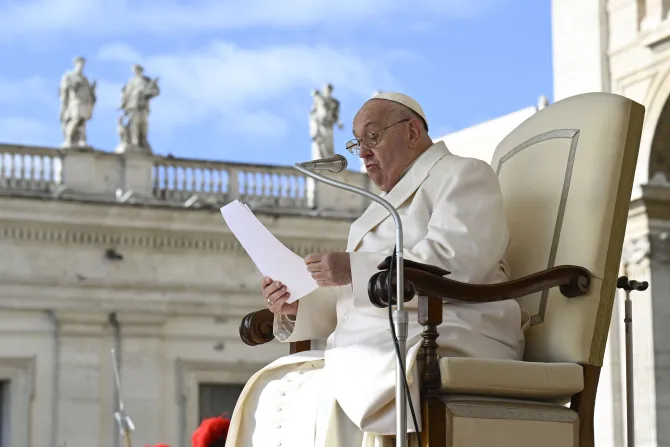
Pope Francis on Wednesday opened a new chapter in his ongoing catechetical series on virtues by pivoting to a reflection on the three theological virtues — faith, hope, and charity — which he noted form the key pillars of Christian life.
The Holy Father bolstered his analysis by looking to the legacy of St. John Paul II.
“Looking at his life, we can see what man can achieve by accepting and developing within himself the gifts of God: faith, hope, and charity,” the pope said to the faithful gathered in St. Peter’s Square.
Saturday will mark the 10th anniversary of St. John Paul II’s canonization.
“Remain faithful to his legacy. Promote life and do not be deceived by the culture of death. Through his intercession, we ask God for the gift of peace for which he, as pope, has worked so hard.”
The pope framed his predecessor’s legacy within the context of the three theological virtues, which he characterized as the “fundamental attributes” of a Christian life and “the great antidote to self-sufficiency.”
“The Christian is never alone,” the pope said. “He does good not because of a titanic effort of personal commitment but because, as a humble disciple, he walks behind the master, Jesus.”
Harkening back to his previous reflections on the four cardinal virtues — prudence, justice, fortitude, and temperance — Pope Francis noted while they “constitute the ‘hinge’ of a good life,” it is the three theological virtues that lead Christians “toward the fullness of life,” as they are “received and lived out in relationship with God.”
But the pope stressed that the four cardinal virtues were not “replaced” by Christianity but instead “enhanced, purified, and integrated.”
The pope stressed that living a life predicated upon the theological virtues forms a firewall against the vices, namely pride, which can “spoil a whole life marked by goodness.”
The pope asked: “A person may have performed a mountain of good deeds, may have reaped accolades and praise, but if he has done all this only for himself, to exalt himself, can he still call himself a virtuous person?”
But the Holy Father reminded the faithful: “If we open our hearts to the Holy Spirit, he revives the theological virtues in us. If we have lost confidence, God reopens us to faith; if we are discouraged, God awakens hope in us; if our heart is hardened, God softens it with his love.”
At the end of the audience, Pope Francis renewed his appeal for peace for the “tormented” Ukraine, as well as in Myanmar, and in Israel and Palestine, repeating his regular refrain: “War is always a defeat.”
This article was originally published on Catholic News Agency.