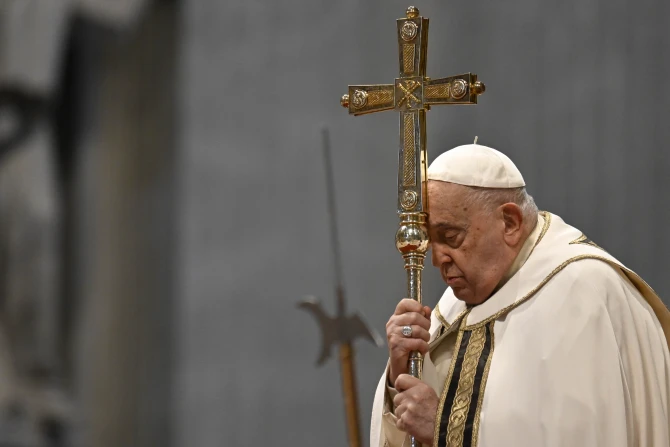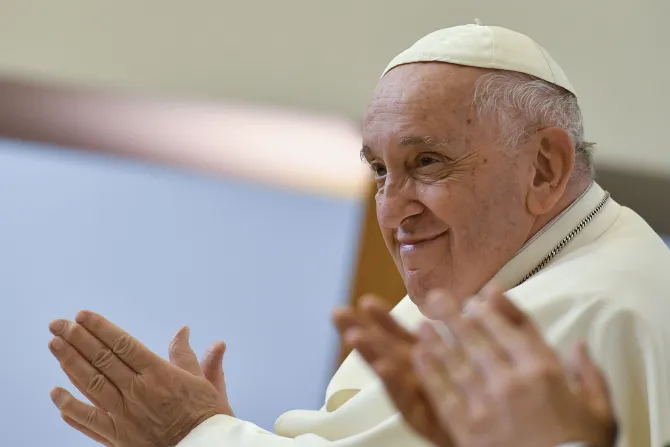
Speaking at a Catholic university in Hungary on Sunday, Pope Francis warned of the risk of technological domination and the threat it poses to culture and to our human ecology.
He also spoke about the false freedoms offered by both communism and consumerism, and encouraged people to seek out Christ’s truth.
On April 30 the pope addressed approximately 250 people, including 30 students, from the Faculty of Information Technology and Bionics at the Pázmány Péter Catholic University in Budapest.
The visit marked the final meeting in Francis’ three-day trip to Hungary’s capital.
In his speech, Pope Francis made extensive reference to the 20th-century intellectual, Romano Guardini, a Catholic priest, theologian, and philosopher, and the author of the book “Letters from Lake Como: Explorations in Technology and the Human Race.”
“Guardini did not demonize technology, which improves life and communication and brings many advantages, but he warned of the risk that it might end up controlling, if not dominating, our lives,” Pope Francis said.
The priest, he added, “foresaw a great threat: ‘[in that case] we lose all the inner contact that we might have derived from a sense of proportion and the following of natural forms. We become inwardly devoid of form, proportion, and direction. We arbitrarily fix our goals and force the mastered powers of nature to bring them to fulfillment.’”
Francis said Guardini “left posterity with a troubling question, ‘What will become of life if it is delivered up to the power of this dominion?’”
“A system of machines is engulfing life… Can life retain its living character in this system?” Guardini asked in one of the letters in his book. “Can life retain its ‘living’ character?” the pope repeated. “This is a question that is proper to ask, particularly in this place, which is a center of research into information technology and the bionic sciences.”
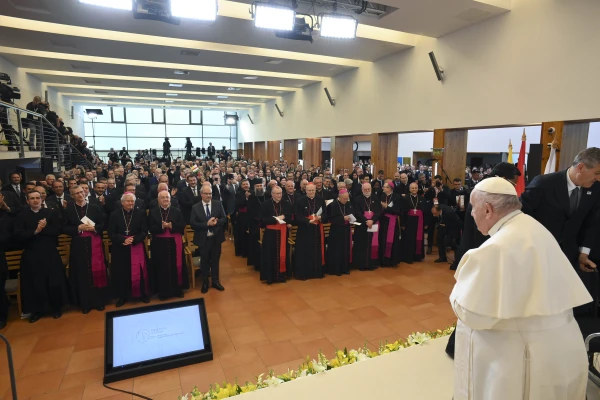
Pázmány Péter Catholic University is a private Catholic university founded in the 17th century. It is one of Hungary’s oldest educational institutions.
The Faculty of Information Technology and Bionics “is unique in Hungarian higher education” for training IT engineers in the human sciences, especially genetics, the nervous system, and the immune system, according to the university’s website.
At the university, Pope Francis also warned of the “false notion of freedom” offered by the ideologies of communism and consumerism.
He quoted Jesus’ words that “the truth will make you free” and said “communism offered a ‘freedom’ that was restricted, limited from without, determined by someone else.”
“Consumerism,” instead, he added, “promises a hedonistic, conformist, libertine ‘freedom’ that enslaves people to consumption and to material objects.”
The way forward, Pope Francis said, is truth: “The key to accessing this truth is a form of knowledge that is never detached from love, a knowledge that is relational, humble and open, concrete and communal, courageous and constructive. That is what universities are called to cultivate and faith is called to nurture.”
Francis also pointed out the increasing isolation of people immersed in social media, while being less and less “social,” and who “often resort, as if in a vicious circle, to the consolations of technology to fill their interior emptiness.”
“Living at a frenzied pace, prey to a ruthless capitalism, they become painfully conscious of their vulnerability in a society where outward speed goes hand in hand with inward fragility,” he said.
The pope added that he did not want to encourage pessimism but to reflect on the “hubris of pride and power denounced at the dawn of European culture by the poet Homer, which the technocratic paradigm exacerbates, and threatens, through a certain use of algorithms, to further destabilize our human ecology.”
The pope in his speech also addressed the importance of culture, which he described as “the ‘cultivation’ of our humanity and its foundational relationships: with the transcendent, with society, with history, and with creation.”
He said the 1907 novel “The Lord of the World,” by Robert Hugh Benson, “was to some degree prophetic in its description of a future dominated by technology, where everything is made bland and uniform in the name of progress, and a new ‘humanitarianism’ is proclaimed, canceling diversity, suppressing the distinctiveness of peoples and abolishing religion.”
“Opposed ideologies merge and an ideological colonization prevails, as humanity, in a world run by machines, is gradually diminished and social bonds are weakened,” he said.
“In the technically advanced yet grim world described by Benson, with its increasingly listless and passive populace, it appears obvious that the sick should be ignored, euthanasia practiced and languages and cultures abolished, in order to achieve a universal peace that is nothing else than an oppression based on the imposition of a consensus.”
The pope said one of the messages he wanted to leave the university students and faculty with was the famous maxim “know thyself.”
“What do those words mean: Know thyself? They counsel us to be able to recognize our limitations and, consequently, to curb the presumption of self-sufficiency,” he said. “Technocratic thinking pursues a progress that admits no limits, yet flesh and blood human beings are fragile, and it is precisely by experiencing this, that they come to realize their dependence on God and their connectedness to others and to creation.”
Pope Francis’ visit to Budapest included meetings with President Katalin Novák and Prime Minister Viktor Orbán. He also spent time with visually impaired children, young adults, and clergy. On the morning of April 30, he celebrated Mass for 50,000 people gathered in and around Kossuth Lajos Square.