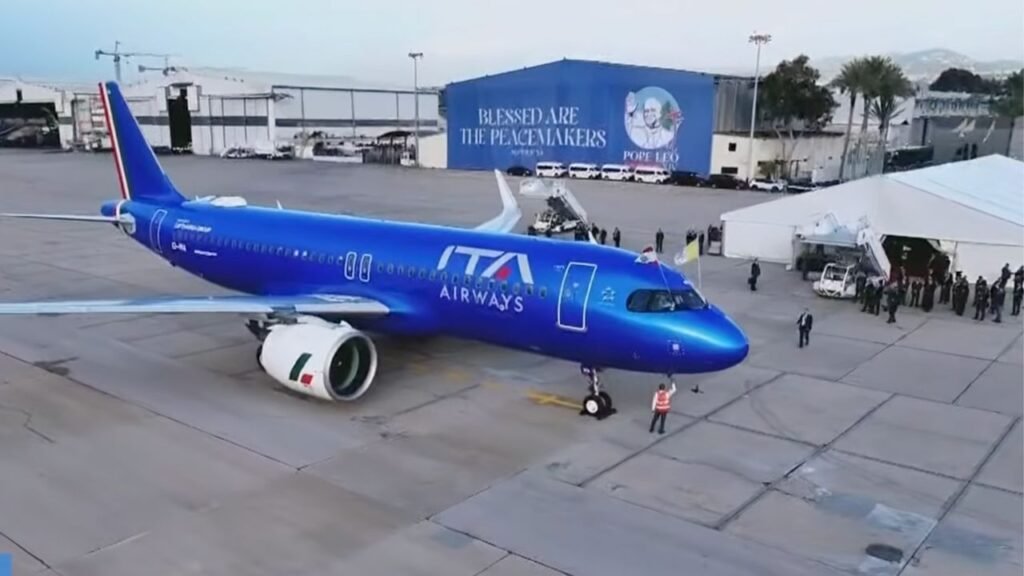
The sky over Lebanon — once dominated by missile exchanges and relentless air raids during the 2023–2024 conflict between Hezbollah and Israel — opened Sunday not to warplanes, but to the aircraft carrying Pope Leo XIV. Touching down in the Land of the Cedars, the Holy Father begins a mission to preach the Gospel of peace to a nation long wounded by conflict and instability.
Fighting along Lebanon’s southern border reignited in October 2023 as a spillover of the Gaza war. Hezbollah, a Shia militia supported by Iran and formed after the 1982 Israeli invasion of Lebanon, became the principal actor in the renewed confrontation with Israel. Although a fragile agreement in late November 2024 reduced hostilities, intermittent violence has continued, and the ceasefire remains uncertain until United Nations Resolution 1701 — requiring Hezbollah’s withdrawal north of the Litani River — is fully implemented.
After landing in Beirut, the pope’s motorcade was scheduled to travel toward the presidential palace through one of the most politically sensitive areas in the country. Dahieh, the Hezbollah stronghold in southern Beirut, has endured heavy bombardment and a series of assassinations over the past year. Hezbollah’s longtime secretary-general Hassan Nasrallah and his potential successor Hashem Safieddin were killed in separate strikes in 2024. As recently as Nov. 23, an Israeli air raid in the suburb killed a local commander and five others and wounded 28.
Despite the tensions, several Shia clerics have publicly welcomed Pope Leo’s visit, and Dahieh’s municipalities have invited residents to greet him along the motorcade route.
Lebanon’s wounds extend beyond its most recent conflict. Years of political paralysis and economic collapse have left the country deeply weakened. Mass protests erupted in 2019 against corruption and sectarianism, while the COVID-19 pandemic and the catastrophic Beirut port explosion in August 2020 compounded the suffering.
Historically a crossroads between Christianity and Islam, Lebanon remains a mosaic of communities bound together by a shared but fragile national identity. Christians — including Maronites, Greek Orthodox, Melkite Catholics, and Armenians — continue to play a vital role in cultural and social life, even as emigration and instability have reduced their numbers.
Lebanon’s confessional political system, established during the French Mandate and formalized in the unwritten National Pact of 1943, divided power among the country’s religious communities. While intended to preserve coexistence, the arrangement also entrenched sectarian rivalry. The Lebanese Civil War (1975–1990), fueled by the Arab–Israeli conflict and the massive influx of Palestinian refugees, left an estimated 150,000 dead and reshaped the country’s political landscape.
The Ta’if Agreement of 1989 ended the war by rebalancing power between Christians and Muslims and curbing the authority of the Maronite presidency. But it did not resolve the underlying challenges of corruption, foreign interference, and sectarian fragmentation. Syrian troops, deployed as peace guarantors, remained until 2005.
Today, the Land of the Cedars remains a delicate patchwork of identities, hopes, and unresolved tensions. Into this complex and wounded landscape, Pope Leo arrives as a pilgrim of peace, offering a message of reconciliation and renewal for a country longing for stability and a future grounded in justice and mutual trust.
Follow all EWTN News coverage of Pope Leo’s First Apostolic Trip here.
This article was originally published on CNA.