Skip to content

Pope Leo XIV gives advice for living with hope in a ‘troubled era’

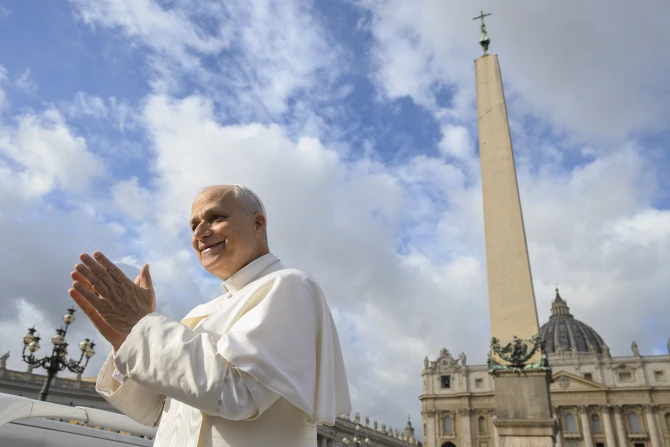
Pope Leo XIV claps with pilgrims during an audience for the Jubilee of Hope in St. Peter's Square on Oct. 25, 2025. | Credit: Vatican Media.

Pope Leo XIV on Saturday said the key to living in a difficult time, when the Church’s teachings are often challenged, is to embrace the hope that is “not knowing.” 

“As pilgrims of hope, we must view our troubled times in the light of the resurrection,” the pope said in an audience with jubilee pilgrims in St. Peter’s Square Oct. 25.

Leo brought attention to Nicholas of Cusa — a Catholic cardinal and theologian from Germany, who lived in the 15th century — as a model for how to live one’s faith “during a turbulent era that involved serious spiritual divisions.”

The pope described Nicholas of Cusa as “a great thinker and servant of unity” who “can teach us that hoping is also ‘not knowing.’”

“As St. Paul writes, ‘How can one hope for what one already sees?’” Leo said. “Nicholas of Cusa could not see the unity of the Church, shaken by opposing currents and divided between East and West. He could not see peace in the world and among religions, at a time when Christianity felt threatened from outside.”

But instead of living in fear like many of his contemporaries, Nicholas chose to associate with those who had hope, the pontiff explained.

Nicholas, Leo said, “understood that there are opposites to be held together, that God is a mystery in which what is in tension finds unity. Nicholas knew that he did not know, and so he understood reality better and better. What a great gift for the Church! What a call to renewal of the heart! Here are his teachings: make space, hold opposites together, hope for what is not yet seen.”

Pope Leo said the Church is experiencing the same thing today: questions challenging the Church’s teaching, from young people, from the poor, from women, from those without a voice or who are different from the majority.

“We are in a blessed time: so many questions!” he said. “The Church becomes an expert in humanity if it walks with humanity and has the echo of its questions in its heart.”

“To hope is not to know,” Leo underlined. “We do not already have the answers to all the questions. But we have Jesus. We follow Jesus. And so we hope for what we do not yet see.”

This article was originally published on Catholic News Agency.

Receive the most important news from EWTN Vatican via WhatsApp. It has become increasingly difficult to see Catholic news on social media. Subscribe to our free channel today

Share

Would you like to receive the latest updates on the Pope and the Vatican

Receive articles and updates from our EWTN Newsletter.

More news related to this article

Pope Francis as diplomat: the principles that have guided his 10-year-old pontificate

In his public diplomatic efforts in the war in Ukraine, Pope Francis has repeatedly said that he is

Discovering Prayer: A Journey of Faith During the Jubilee Year

The topic of prayer is explored in depth, discussing personal experiences, struggles, and the profound transformation that comes through a sincere relationship with God.

Future Portuguese cardinal on WYD: ‘We don’t want to convert the young people to Christ’

“We don’t want to convert the young people to Christ or to the Catholic Church or anything like that at all,” said Bishop Américo Aguiar, the head of World Youth Day (WYD) Lisbon 2023 who will be created a cardinal by Pope Francis in September.

Pope Leo XIV brings about unity in the Syro-Malabar Church

The Holy See Press Office has published a series of decisions by Pope Leo XIV to bring about unity in the Syro-Malabar Church of India, which has been at serious risk of schism in recent years due to liturgical disputes.

Pope Francis: Forgiveness is the cure that heals ‘the poisons of resentment’

Think of someone who has hurt you and ask God for the strength to forgive that person, Pope

Bishop Álvarez: ‘I Always Believed In My Liberation And What Sustained Me Was Prayer’

In an exclusive interview, persecuted Nicaraguan Bishop Rolando Álvarez, bishop of Matagalpa and apostolic administrator of Estelí, shared with EWTN News his experience one year after his release and arrival in Rome.

LIVE
FROM THE VATICAN

Be present live on EWTNVatican.com