COMMENTARY: There is a calmness in the Holy Father’s remarks that sends a message to combatants to back away from the liturgical cliff and start thinking more unitively.
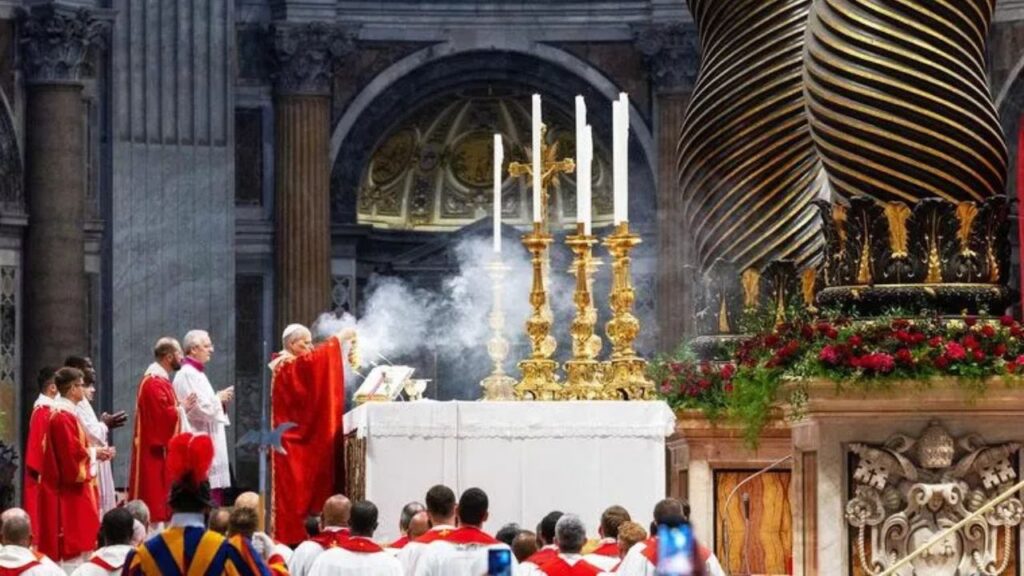
At his general audience Aug. 26, Pope Leo XIV reflected upon Sacrosanctum Concilium, the Second Vatican Council’s document on liturgy, offering his most detailed catechesis yet on the liturgical reforms implemented by Pope Paul VI and the so-called Novus Ordo.
His comments have now been parsed from several quarters looking for clues as to what direction he will go when it comes to the contentious issues swirling in the so-called “liturgy wars.”
I think the overall message he delivered is typical of his style so far. His words are cautious but clear, making it known that the Catholic Church is not going to veer under his watch in any direction that will undermine its unity. Nor does he give any indication that big changes to liturgical practice are in our future. As such, like so much else in this young pontificate, there is a calmness in his remarks that I think is deliberately chosen to send the message that folks need to back away from the liturgical cliff and start thinking in more sober ways.
Pope Leo said absolutely nothing about the traditional Latin Mass, and he gave no hint of any kind that he is on the verge of abrogating Traditionis Custodes, Pope Francis’ apostolic letter that placed strong restrictions on its celebration. Nor did he mention the earlier motu proprio of Pope Benedict XVI, Summorum Pontificum, which liberalized access to the older rite of the Mass and which Pope Francis then overturned.
Therefore, those who sought in his remarks a rousing affirmation of either approach were most likely disappointed. Some might argue that if his goal is to calm the waters and promote ecclesial unity, this strategy of ignoring the elephant in the living room may work in the short run, but at some point the issue will force his hand and he will have to lay his cards on the table.
But if one reads his remarks carefully, there is one point that cannot be avoided, and it is a point that will not make many of the so-called traditionalists happy. Namely, the Mass of Paul VI is here to stay, there is nothing essentially wrong with it, it does indeed evince a continuity with tradition, and it faithfully implements the liturgical principles articulated at the Council. What will happen to the traditional Latin Mass he does not say. But what he does say is that the Mass of Paul VI is not going away as the normative form of the Mass, and that all other considerations are subordinate to that simple fact.
All that said, central to his effort at calming the waters is his affirmation that the Mass of Paul VI is in full accord with the tradition of the Church and that it does indeed embody many of the reforms called for by the Council. He states:
The future Pope Saint Paul VI affirmed that the faithful ‘cannot and must no longer remain silent and passive. Their physical presence cannot be reconciled with their spiritual absence.’
The similarity between these statements and those which would appear in no. 48 of the Conciliar Constitution is evident: ‘The Church … earnestly desires that Christ’s faithful, when present at this mystery of faith, should not be there as strangers or silent spectators.’
The emphasis in Leo’s remarks is that the Council understood that a general reform of the liturgy was necessary to increase active participation by the laity in the Mass. The laity must not be “silent and passive” as if they are mere “spectators” of a clerical event within which they play only a minimal role. There is a clear allusion here to the fact that the pre-conciliar liturgy did foster such silent passivity and that the laity really were quite often mere spectators.
Many critics of the reform bristle at such remarks and point out that silent contemplation at Mass is a form of active participation, and therefore the accusation that the TLM fostered passivity is a straw man. And even though there is some truth in this observation, it is overly abstract and ignores the historical reality in the practice of many pre-conciliar parishes, where it was common for the laity to pursue various private devotions during Mass or to sit quietly and passively waiting for the time to go to Communion.
There is, in other words, a reason why there was a strong liturgical movement within the Church long before the Council. And that movement was spearheaded by many popes and theologians and was not in any way a wild-eyed liberal attempt to undermine the Mass.
Pope Leo makes this clear in his remarks and notes the many modifications to the Mass that had already been implemented by previous popes:
Moreover, the desire for a ‘general reform’ did not come about suddenly, but had been evident in the actions of successive Popes since the beginning of the twentieth century, in keeping with the demands of the Liturgical Movement. The assertion that the faithful should not attend celebrations ‘as strangers or silent spectators’ had already been raised in Pope Pius XI’s Apostolic Constitution Divini Cultus.
Furthermore, one may recall Pius XII’s interventions regarding the ordering of the rites of Holy Week, which he rescheduled to the hours corresponding to the events of Easter, after they had for centuries been brought forward to the morning hours. Nor should it be forgotten that Saint John XXIII regarded it necessary to simplify the rubrics of the Breviary and the Missal, approving this with the motu proprio Rubricarum Instructum of 25 July 1960, in which he referred the proposal of fundamental principles for a reform of the liturgy.
This observation of Leo’s then leads him to a critical conclusion:
The liturgical reform promoted by the Second Vatican Council is thus firmly rooted in the living tradition of the Church. A correct understanding of it also enables us to reject the abuses that occurred in certain sectors of the Church during the post-Conciliar period, and which, unfortunately, still occur from time to time today, where some of the principles underlying the reform itself have been taken to extremes or misunderstood.
Many will disagree with this conclusion. They will point to the loss of the Council’s call for Gregorian chant and Latin to retain a “pride of place” in the Mass as an indication that the new Mass was not a truly faithful implementation of the Council. They will agree with Leo that “abuses” did emerge in liturgical practice after the Council, but argue that these abuses were made almost inevitable by the abundance of opportunities within the new rubrics for clerical “creativity” to run amok.
These are important criticisms, not to be taken lightly. Indeed, no less a light than Pope Benedict was also critical of some aspects of the liturgical reform. And even Pope Leo affirms that certain liturgical abuses still take place today. Furthermore, if the centuries-old Tridentine Mass could be altered in such radical ways, then why can we not also admit that the Mass of Paul VI, a mere 57 years old, is open to further reform, as many “reform of the reform” theologians have proposed?
Nevertheless, it is important to note what Pope Leo does not say. He does not say that a further reform of the reform is out of the question. He does not say that the implementation of the new Mass was perfect and that there is now no room in the Church for the old Mass. But what he is saying, and I agree with him, is that the new Mass is perfectly orthodox, in line with the tradition, in line with the conciliar call for a reformed liturgy, and is the ordinary form of the Mass for 99% of the world’s Catholics. And so any fantasy-camp thinking that it is in need of being replaced is just a hopeless enterprise.
The Mass of Paul VI was not the product of Freemason infiltration or of a secret desire to make it Protestant. It is the Mass of the One, Holy, Catholic and Apostolic Church, promulgated by one pope and reaffirmed by several others. It is orthodox and filled with the graces needed for salvation, and not in spite of itself, but because of its altogether laudable turn to the vernacular and to the active participation of the faithful.
That is the message of Pope Leo. And it is a message we all need to heed.
This article was originally published by National Catholic Register.