EDITORIAL: Why is Pope Leo stressing this issue so prominently at the very beginning of his pontificate — and what can we conclude about the approach he intends to take in addressing it?
SIGN UP FOR OUR NEWSLETTER HERE
When Pope Leo XIV disclosed the primary reason for his choice of papal name two days after his historic May 8 election, it was no major surprise.
As many observers had already guessed, the first American pope in Church history wanted to communicate his continuity with Pope Leo XIII, who is best known for the “social justice” teachings in his famous 1891 encyclical Rerum Novarum. But what was unexpected is the direct way Leo linked his papal name selection to the challenge that artificial intelligence poses for contemporary humanity.
In case anybody missed this transparent tip about a central priority of his unfolding papacy, the new Holy Father referenced the AI issue again in his first public meeting at the Vatican with journalists who had covered the papal conclave.
Why is Pope Leo stressing this issue so prominently at the very beginning of his pontificate — and what can we conclude about the approach he intends to take in addressing it?
First and foremost, it’s because he foresees AI’s potential to fundamentally rework human societies, in a similar way to how the Industrial Revolution upended the social order during Leo XIII’s time.
In particular, our new Pope is concerned that artificial intelligence, if misapplied, will privilege only the rich and powerful and turn out to be profoundly damaging for vast numbers of workers, whose jobs are at risk because of AI’s capacity to displace them, and for other groups that are denied their fair share of the enormous wealth and opportunities AI has the potential to generate.
Pope Leo is hardly alone in expressing this concern. The same day as he highlighted AI’s challenges to journalists, The Wall Street Journal published an article that quoted a CEO who warned his employees in April that “AI is coming for your jobs. Heck, it’s coming for my job too.”
Only a few days into Leo’s pontificate, it would be foolish in the extreme to try to map out the details of what he might communicate about engagement with AI. What can be safely said is that in his general approach, he intends to emulate the constructive methodology the last Leo modelled with respect to the havoc the earliest decades of the Industrial Revolution inflicted on working families and other disadvantaged social groups.
While Rerum Novarum equally rejected the polar extremes of unrestrained capitalism and of confiscatory socialism, Leo XIII did not condemn industrialization in general, unlike some of the more reactionary voices of his era. Instead, he insisted the new social order must be infused with Christian truth, to humanize the fundamental economic changes that were underway and place their benefits at the service of the equal dignity of every human person.
The latest Leo similarly intends to engage with our rapidly changing postindustrial world, to humanize the widespread introduction of artificial intelligence through a creative encounter with the divine intelligence of the Gospel of Jesus.
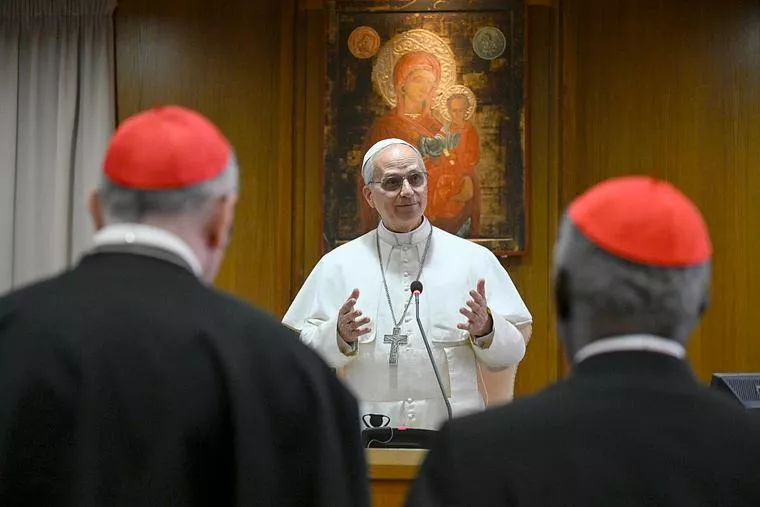
As Leo told the College of Cardinals on May 10, “In our own day, the Church offers to everyone the treasury of her social teaching in response to another industrial revolution and to developments in the field of artificial intelligence that pose new challenges for the defense of human dignity, justice and labor.”
Some additional observations about Leo’s character, and his choice of papal name, also seem germane in this context. From the moment he stepped out on the balcony of St. Peter’s Basilica, addressing the vast crowd gathered in the square below and the world beyond with his first words “Peace be with you all,” the newly elected Pope’s profound calmness has been striking.
And like most Americans, he’s probably inclined toward finding concrete and pragmatic solutions to problems whenever possible.
A third thing to bear in mind is the literal meaning of Leo in English: As the Holy Father knew when he made his choice, it means “lion,” and lions symbolize both strength and courage.
Practicality, calmness, courage and strength. That’s a powerful quartet of positive attributes for addressing the challenges of AI — and indeed for all of the immense evangelical mission that’s now been entrusted by God to the stewardship of the Church’s first U.S.-born pope.
This article was originally published on NCRegister.
HOW TO SEE THE HOLY FATHER POPE LEO XIV: EWTN TRAVEL JUBILEE APP