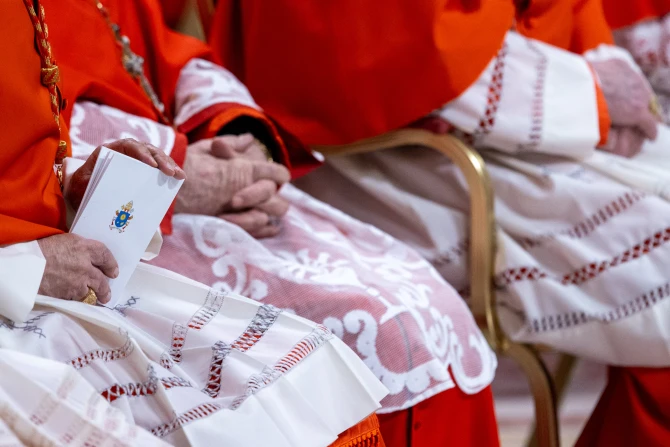
Pope Leo XIV is planning to convene an extraordinary consistory of cardinals in early January, the theme of which is not yet known.
In a brief communication sent to cardinals on Nov. 6 and obtained by the National Catholic Register, CNA’s sister news partner, on Friday, the Vatican Secretariat of State said that “Holy Father Leo XIV has in mind to convene an extraordinary consistory for the days of Jan. 7 and 8, 2026.”
“In due course, the dean of the College of Cardinals will send to Your Eminence the relevant letter with further details,” the note continued, before ending: “With profound reverence, coordinating office of the Secretariat of State.”
When the Register asked Holy See Press Office Director Matteo Bruni about the communication on Friday, he said the press office had not yet publicly “confirmed its existence” and that he did not think an announcement of such an event would be made “that far ahead.”
As well as the topic remaining unknown, it is also not yet certain if all cardinals have been notified of the planned gathering.
Extraordinary consistories are usually special gatherings of all cardinals, convened by the pope to discuss matters of “particular needs of the Church” or highly important issues requiring broad consultation among the world’s cardinals.
News of the meeting comes after cardinals at this year’s conclave complained about a lack of meetings and collegiality under Pope Francis.
Held behind closed doors, the last extraordinary consistory at the Vatican took place on Aug. 29-30, 2022, under Pope Francis. Its purpose was to bring all the cardinals together to discuss the implementation and meaning of the new apostolic constitution for the Roman Curia, titled Praedicate Evangelium. The meeting also focused on the reforms of Church governance and the Roman Curia.
During that consistory, cardinals received an official report on the curial reform and then broke into language groups to debate the practical consequences and underlying principles of the new constitution before reuniting for a concluding summary discussion. The format was a departure from previous consistories, modeled instead on synodality.
Pope Francis also used the opportunity to hold a consistory of new cardinals at the same time, although it is unlikely that will be Pope Leo’s intention, as the College of Cardinals already has 128 cardinal-electors, well over the advised limit of 120.
Prior to that extraordinary consistory, a more famous one was held on Feb. 20-21, 2014, also under Pope Francis. That gathering brought together all the cardinals to reflect on the theme of the family and was intended to provide guidance and theological foundations for a Synod on the Family, which was held later in 2014 and again in 2015.
That extraordinary consistory notably featured a controversial address by Cardinal Walter Kasper in which the German theologian launched what became known as the “Kasper Proposal” that would open the door to a “pastoral solution” for some civilly remarried divorcees to be able to receive holy Communion. The proposal, which attracted considerable criticism and controversy, significantly influenced the synod proceedings, and a form of the Kasper Proposal was included in Pope Francis’ 2016 postsynodal apostolic exhortation Amoris Laetitia. A number of cardinals rose to criticize Kasper’s intervention, according to reports.
That was the only extraordinary consistory of the College of Cardinals under Francis at which members were permitted to speak freely on any topic they wished. At subsequent such consistories, in February 2015and the later one in August 2022, interventions were limited to certain subjects.
Prior to Francis, Pope John Paul II convened six extraordinary consistories, three of which discussed issues pertaining to curial reform and the Holy See’s financial situation. The other three gatherings covered present-day threats to life, the proclamation of Christ as sole savior, and the threat of sects (1991); preparation for the 2000 Jubilee (1994); and the Church’s prospects in the third millennium in light of Novo Millennio Ineunte (2001), John Paul II’s apostolic letter outlining the Church’s priorities for the millennium.
Benedict XVI held no formal extraordinary consistories during his pontificate, instead choosing to hold all-day meetings the day before consistories of new cardinals.
This story was first published by the National Catholic Register, CNA’s sister news partner, and has been adapted by CNA.