At Mass in Madrid’s Plaza de Cibeles, the pope called Spain’s centuries-old Eucharistic devotion “a school of faith” for the present and future.
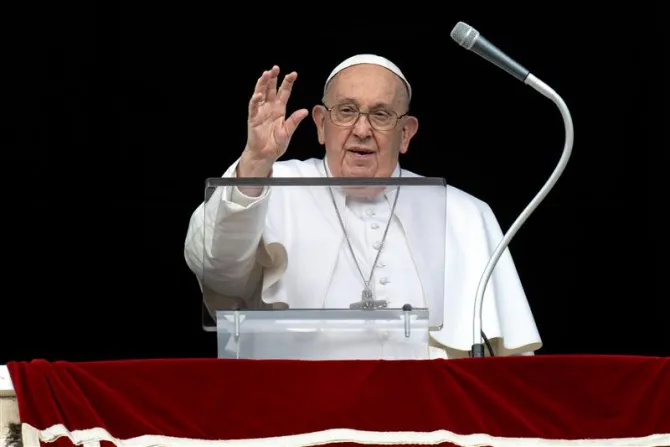
Madrid, Spain, June 7, 2026 — Pope Leo XIV on Sunday called on Spain to renew its historic Eucharistic faith, warning that the country’s centuries-old religious traditions must not become “a museum of the past to be visited” but remain “a school of faith from which to draw even today.”
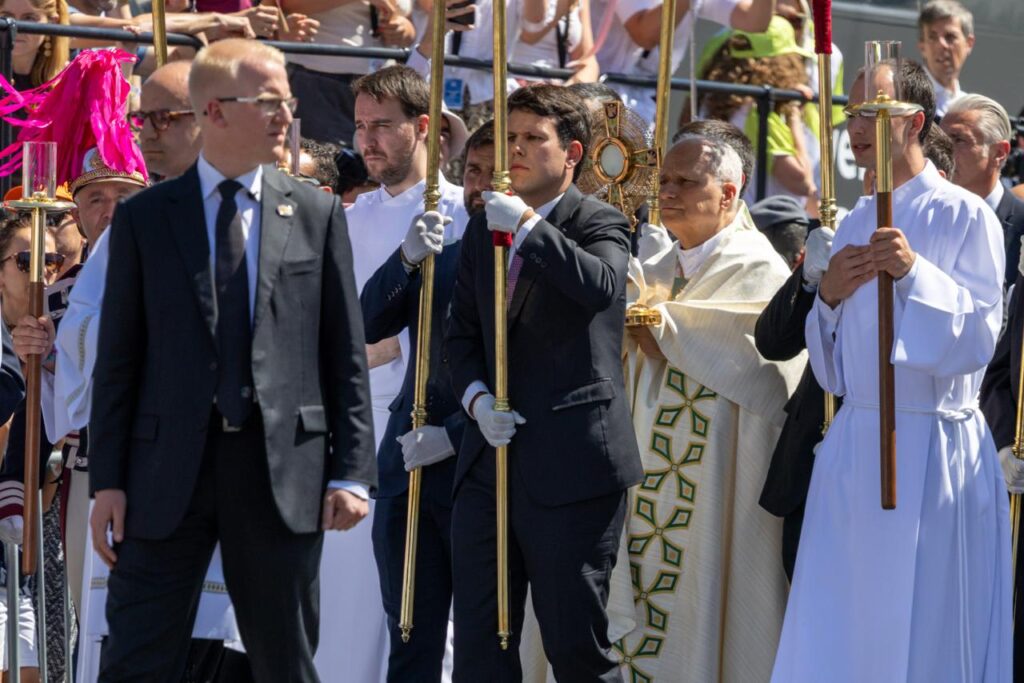
The pope made the appeal while presiding over Mass, a procession, and Eucharistic blessing for the solemnity of Corpus Christi in Madrid’s Plaza de Cibeles, one of the Spanish capital’s most emblematic sites.
“As I begin my visit to Spain, it is with a heart filled with joy that I preside over this celebration on the Solemnity of Corpus Christi,” the pope said in his homily.
Corpus Christi has deep roots in Spain and throughout the Catholic world. The feast originated after the efforts of St. Juliana of Cornillon, a Belgian religious sister who promoted a liturgical celebration dedicated to the Blessed Sacrament. Pope Urban IV confirmed the feast for the universal Church in 1264, and within decades it had reached the Iberian Peninsula. King Alfonso X, known as “the Wise,” took part in a Corpus Christi celebration in Toledo in 1280.
Over the centuries, the tradition became firmly established in Spain, making the country one of the great centers of Eucharistic devotion. During the period of the Council of Trent, when the real presence of Christ in the Eucharist was contested in parts of Europe, Spanish popular piety continued to exalt it through processions, music, art, and public expressions of faith.
In Madrid, Pope Leo said Corpus Christi is “more than just another celebration on the liturgical calendar.”
“It is a way of returning to the heart of the faith to renew our love and fidelity to God,” he said.
“The solemn processions held on this day have for centuries shaped the piety, art, music, architecture and life of the Spanish people,” the pope continued. “Even today, they still express and manifest the spiritual sentiments of this country through the beauty and elegance of the floral carpets, the altars erected in the streets, the carefully crafted monstrances and stands, the hymns and the liturgical vestments.”
The setting itself added a striking backdrop to the celebration. Plaza de Cibeles, crowned by the statue of the Roman goddess in a chariot drawn by lions, is known internationally as the place where Real Madrid celebrates its titles. On Sunday, however, the square’s focus was Christ in the Eucharist.
One participant joked that with Pope Leo XIV in Madrid, the Spanish capital had three lions.
The pope said the Corpus Christi procession is not “an exhibition, a remnant of folklore or a simple display of beauty.”
“It is a profession of faith in the presence of the risen Lord, who is alive and continues to walk among us, who becomes bread to satiate our hunger for life, and visits the recesses of our hearts and history, even those shrouded in darkness,” he said.
The procession route, about 600 meters along Calle de Alcalá, one of Madrid’s central thoroughfares, was adorned with 16 floral carpets — eight on each side — made with more than 30,000 carnations. Numerous faithful joined the pope, including many boys and girls who had recently received their first Communion.
Pope Leo said the procession reveals that Christ “is not confined to the church, but comes out to meet us.”
“Jesus travels the streets, crosses the squares and visits our neighborhoods, dwelling in the settings of our daily lives,” he said. “He is a God who is close to us, who walks with his people, the Lord of history.”
The pope also connected Corpus Christi with charity, noting that the Church in Spain has long associated the solemnity with the Day for Charity.
“The Christ who processes through the streets in the monstrance is the same one who identifies with the poor, the downtrodden, those who are alone and forsaken,” he said.
“It is not merely a matter of bringing out the monstrance,” Pope Leo emphasized, “but of allowing ourselves to be brought out of our selfishness and indifference, of a comfortable, private faith, so as to respond to his invitation to conversion, to change our perspective, and to welcome his presence which transforms us and makes us builders of a new world.”
Among the faithful who took part in the celebration was Sister Maribel, a member of the Monastic Family of Bethlehem, whose community is opening a convent in Huelva.
Speaking with emotion, she summed up her experience to ACI Prensa: “I loved everything. It was extraordinary. I need to read and reread and pray with the Holy Father’s homily. It was very intense. Above all, I leave with the motto ‘Lift up your gaze.’ I don’t know — it is a phrase that encompasses life and every detail.”
The pope said the historical memory of Spain’s Corpus Christi processions “is not confined to wistful nostalgia.”
“Instead, it stands as an invitation in the present moment, in our daily lives, in our relationships, in society, and in the building of the future,” he said.
That, he added, is the task facing Spain today and tomorrow: “to ensure that the religiosity which has shaped and defined this country for centuries is not a museum of the past to be visited, but a school of faith from which to draw even today.”
The pope described that school of faith as one that “teaches us to kneel before God and before our neighbor, because no one can kneel before the Lord and despise their brother.”
It is also, he said, “a school that teaches us of the gratitude of love that becomes a gift, so that it may flow among us and break the chains of all selfishness.”
From the Eucharist, he continued, Catholics learn “that God is a real presence and that we too are called to be present in the realities and challenges of society, not shying away, but personally committing ourselves to the building of the common good.”
Pope Leo also recalled St. Manuel González García, the Spanish bishop known as “the bishop of the abandoned tabernacle.”
“His life reminds us that the Eucharist should be honored not only during great celebrations or on special occasions, but also through the silent fidelity of those who accompany the Lord with a humble and quiet friendship that is nourished day by day,” the pope said.
The pope also cited St. John of the Cross, recalling that while imprisoned in harsh conditions in Toledo around the time of Corpus Christi in 1578, the Spanish mystic recognized the hidden presence of the Lord even in darkness.
“The Eucharistic Jesus is ‘that eternal spring that is hidden’ — a spring that flows and quenches thirst, yet without blinding, without imposing itself through outward power, without presenting itself in a spectacular way,” the pope said.
Pope Leo closed by urging the faithful to return to Christ in the Eucharist with “sincere love.”
“Let us open ourselves to the encounter with him, let us allow him to quench the thirst of our hearts, so that we may then go forth into the paths of life and history, bringing to the people this stream of fresh water, a stream of love, peace, justice and joy,” he said.
“Let us drink anew from this Eucharistic spring, which does not enclose us in private devotion, but sends us out to refresh our brothers and sisters, our families, the poor, the suffering, and those who have lost hope,” the pope said. “Eucharistic grace transforms us and makes us protagonists of the transformation of history, a sign of hope for those we meet.”
“May the Lord Jesus, present in the Eucharist, transform you into bread that is broken, given, and offered,” he concluded, “so that a life of fullness may spring forth for you, for your families, and for your country.”
Follow the LIVE updates from EWTN News for Pope Leo’s Trip in Spain.
This story was first published by ACI Prensa, the Spanish-language sister service of EWTN News. It has been translated and adapted by EWTN News English.