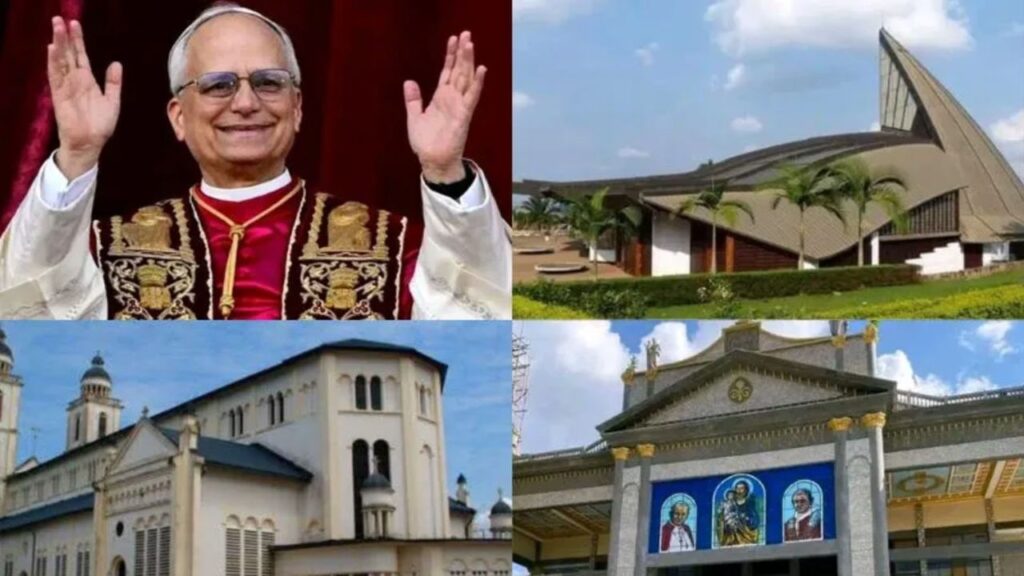
After concluding the first leg of his African apostolic journey in Algeria, Pope Leo XIV travels on Wednesday to Cameroon.
After concluding the first leg of his African apostolic journey in Algeria, Pope Leo XIV travels to Cameroon from April 15–18. In the Central African nation, the Holy Father is set to visit the capital, Yaoundé, and the metropolitan sees of Bamenda and Douala.
If Algeria represents the Church as a small minority navigating a Muslim-majority society, Cameroon presents a different ecclesial landscape. The Catholic Church there is demographically significant, institutionally entrenched, socially influential, and politically attentive.
Cameroon stands not only as the second stop on the Holy Father’s African itinerary but also as a microcosm of the contemporary African Catholic experience — complex, vibrant, and consequential.
Here are eight things to know about the Church in Cameroon and what is expected of Pope Leoʼs visit:
1. It has a significant and growing Catholic population.
Cameroon’s population is religiously diverse, made up of Christians, Muslims, and practitioners of African traditional religions. Within the Christian bloc, Catholics constitute one of the largest denominations. Current estimates place Catholics at roughly 30% to 35% of the national population, translating into several million Catholics.
This scale gives the Catholic Church measurable public presence. Parishes are numerous, Catholic diocesan structures are well developed, and lay movements are active across urban and rural areas. The Church is not a marginal actor; it is a central stakeholder in national life.
Growth trends remain steady rather than explosive. Unlike some East African contexts where Catholic numbers have surged, Cameroon’s expansion is incremental and closely tied to demographic growth. Nonetheless, vocations to the priesthood and Institutes of Consecrated Life and Societies of Apostolic Life (ICLSAL) continue at levels that sustain ecclesial institutions.
In Cameroon, Pope Leo XIV will encounter a people of God neither defensive nor peripheral but fully embedded in national society.
2. It has a robust ecclesiastical structure and metropolitan sees.
The Catholic Church in Cameroon is organized into five ecclesiastical provinces, each headed by a metropolitan archbishop. These include Yaoundé, Bamenda, Douala, Garoua, and Bertoua.
The Archdiocese of Yaoundé serves the political capital and functions as a strategic center for Church-state engagement. Douala, the country’s economic hub, anchors the Littoral region and reflects the Church’s engagement with commerce, urbanization, and migration.
Bamenda, in the Anglophone Northwest Region, carries particular pastoral and political weight due to ongoing instability in that part of the country. Garoua Archdiocese is in the north of the country, while Bertoua Archdiocese is in the east.
The bishops collectively operate through the National Episcopal Conference of Cameroon, which regularly issues pastoral letters on social, political, and moral issues.
Pope Leo XIV’s decision to visit three metropolitan sees signals a recognition of Cameroon’s regional diversity and ecclesial complexity.
3. The Church in Cameroon has deep historical roots.
Catholic missionary activity in Cameroon dates to the late 19th century, particularly under German colonial administration and later French and British rule. Missionaries established schools, clinics, and parishes that became foundational to local communities.
Over time, ecclesial leadership transitioned from missionary congregations to Indigenous clergy. Today, Cameroonian Catholic bishops and priests lead the Church across the country, and missionary institutes have shifted toward collaboration rather than control.
This historical trajectory — from missionary implantation to local ownership — has shaped a confident Church. Catholic institutions in education and health care are not peripheral supplements; they are pillars of national infrastructure.
The historical memory of missionary sacrifice and local perseverance still informs Catholic identity in Cameroon. Papal visits are therefore received not as external interventions but as moments of communion within an already mature ecclesial body.
4. The Church leads in education and health.
Few institutions in Cameroon rival the Catholic Church in educational reach. Catholic primary and secondary schools are widespread, often regarded for discipline and academic performance. The Church also sponsors tertiary institutions and teacher training colleges.
Health care is similarly significant. Catholic hospitals and clinics serve urban centers and remote areas alike. In regions where public health systems are strained, Catholic Church-run facilities frequently fill service gaps.
This social footprint gives the Catholic Church influence but also responsibility. It must negotiate regulatory frameworks, maintain quality standards, and manage financial sustainability.
This also means that papal messaging on social justice, youth formation, and health care ethics resonates concretely rather than abstractly.
In Cameroon, the Church’s credibility is measured as much by service delivery as by liturgical vitality.
5. Catholic leaders play a role in political and social realities.
Cameroon’s Catholic bishops have consistently engaged in public discourse on governance, elections, corruption, and national unity. Pastoral letters issued around electoral cycles often emphasize transparency, accountability, and peaceful participation.
This engagement places the Church in a delicate position. While she does not function as a political party, she operates as a moral voice. Her statements can attract both public support and governmental scrutiny.
The Anglophone crisis in the northwest and southwest regions — marked by tension between separatist groups and state forces — has intensified the Church’s mediating role. Bishops in affected regions, particularly in Bamenda, have appealed for dialogue and protection of civilians.
Pope Leo XIV’s visit to Bamenda is therefore not merely ceremonial. It unfolds against a backdrop of social fragility and political complexity. Any public remarks in that region will be closely analyzed for diplomatic nuance.
6. The Cameroon Church sees many religious vocations.
Cameroon is considered one of the more fruitful Churches in central Africa in terms of religious vocations. Major seminaries in the country train diocesan clergy, and religious congregations attract local candidates.
The presence of Indigenous clergy has allowed the Church to contextualize liturgy, catechesis, and pastoral strategy. Inculturation — integrating elements of local culture within Catholic worship and life — has developed within the framework permitted by universal Church norms.
However, vocations also present governance challenges: ensuring adequate formation, preventing clericalism, and addressing global concerns about safeguarding and accountability. As elsewhere, the Cameroonian Church must navigate expectations of transparency and ethical leadership.
A papal visit often includes meetings with clergy and religious. In Cameroon, such encounters are likely to reinforce standards of pastoral responsibility and ecclesial communion.
7. The Church here enjoys linguistic, cultural, and religious pluralism.
Cameroon is frequently described as “Africa in miniature” due to its linguistic and cultural diversity. The country officially operates in both French and English, with numerous Indigenous languages in daily use.
This diversity shapes ecclesial life. The Church must minister across Francophone and Anglophone regions, urban and rural contexts, and varied ethnic identities. Liturgies may incorporate local languages and music while maintaining doctrinal unity.
Religiously, Cameroon is pluralistic. Alongside Catholics are Protestants, Pentecostals, Muslims, and adherents of traditional religions. Inter-Christian competition — particularly with rapidly growing Pentecostal movements — poses pastoral challenges. The Catholic Church must articulate its identity in an environment where charismatic worship and prosperity preaching attract large followings.
Interreligious coexistence with Muslim communities, particularly in northern regions, remains a factor in national stability. The Church has often collaborated with Muslim leaders to promote peace and counter extremism.
For Pope Leo XIV, this pluralistic setting requires calibrated messaging — affirming Catholic identity without undermining interreligious harmony.
8. Cameroon hosted a previous papal visit.
In 2009, Pope Benedict XVI visited Cameroon, marking a major ecclesial event that included the promulgation of the Instrumentum Laboris for the Second Synod for Africa. That visit reinforced Cameroon’s role within the continental Church.
Pope Leo XIV’s 2026 journey will inevitably be compared with past papal engagements. Expectations will be shaped by memory: large public liturgies, strong doctrinal messages, and calls for ethical governance.
This story was first published on March 12, 2026, by ACI Africa, the sister service of EWTN News in Africa, and has been updated.