Pope Leo XIV on Thursday lamented that today’s youth must deal with “relativism,” “emotional instability,” and “superficiality,” although he called for transforming these challenges of the contemporary age into “springboards.”
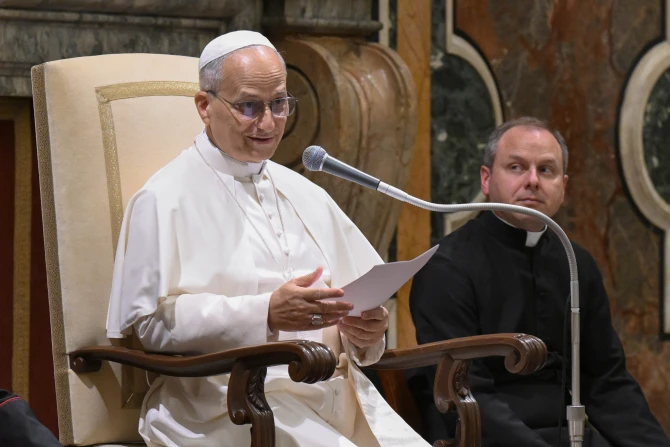
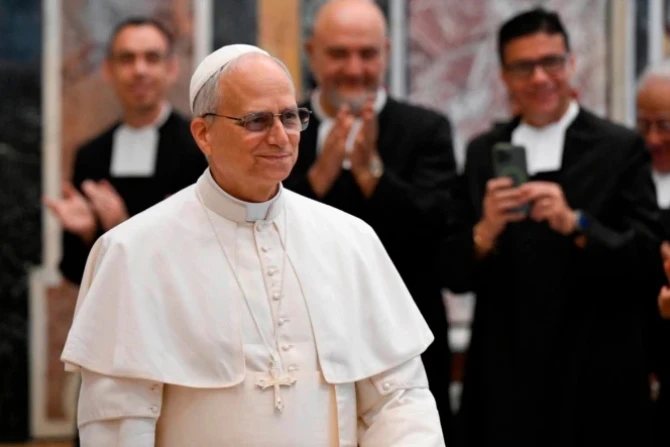
The pontiff received the Brothers of the Christian Schools, founded by St. John Baptist de La Salle, on May 15 at the Vatican. He reminded them of the importance of experiencing teaching as a “ministry and mission” to help young people give their best according to God’s plan.
In his address, he listed the obstacles facing the younger generations: “Think of the isolation caused by rampant relational models increasingly marked by superficiality, individualism, and emotional instability; the spread of patterns of thought weakened by relativism; and the prevalence of rhythms and lifestyles in which there is not enough room for listening, reflection, and dialogue, at school, in the family, and sometimes among peers themselves, with consequent loneliness.”
These “demanding challenges,” he noted, must become “springboards” to “develop tools and adopt new languages to continue to touch the hearts of pupils, helping them and spurring them on to face every obstacle with courage in order to give the best of themselves in life, according to God’s plan.”
At the meeting, which took place against the backdrop of two special anniversaries: the third centenary of the promulgation of the bull In Apostolicae Dignitatis Solio, with which Benedict XIII approved the order and its rule (Jan. 26, 1725), and the 75th anniversary of Pius XII’s proclamation of St. John Baptist de La Salle as patron saint of educators (1950).
“Young people of our time, like those of every age, are a volcano of life, energy, sentiments, and ideas. It can be seen from the wonderful things they are able to do, in so many fields. However, they also need help in order for this great wealth to grow in harmony and to overcome what, albeit in a different way to the past, can still hinder their healthy development,” he stated.
The American pontiff praised their presence, which continues to bring “the freshness of a rich and vast educational entity,” and focused in his address on the ministry and missionary dimension of teaching.
He thus quoted St. John Baptist de La Salle, who responded to the plea of a layman, Adrian Nyel, who was struggling to keep his schools for the poor going.
“Your founder recognized in his request for help a sign of God; he accepted the challenge and set to work. Thus, beyond his own intentions and expectations, he brought to life a new teaching system: that of the Christian Schools, free and open to everyone,” the pope stated.
The pontiff also highlighted in his speech La Salle’s ability to respond creatively to the many difficulties of his time, also “venturing onto new and often unexplored paths,” and appreciated that this French saint and educator launched the “pedagogical revolution” of teaching directed at the entire class rather than individual students.
Another innovative element introduced by La Salle was “the adoption of French as the language of instruction; Sunday lessons, in which even young people forced to work on weekdays were able to participate; and the involvement of families in the school curriculum.”
This entire legacy, he emphasized, should serve as a model for today’s educators.
Under this premise, teacher training should be based on that principle so dear to La Salle: “teaching lived as ministry and mission, as [a form of consecrated life] in the Church.”
Leo XIV also recalled the principle of “evangelizing by educating and educating by evangelizing,” ultimately emphasizing the importance of “synergy” among all the “formative components.”
Finally, he urged that “fruitful paths of holiness” be fostered and promoted among young people.
This story was first published by ACI Prensa, CNA’s Spanish-language news partner. It has been translated and adapted by CNA.