The pope highlighted the role of laypeople and religious in shaping Catholic social teaching and called for formation in public life rooted in solidarity, justice, and peace.
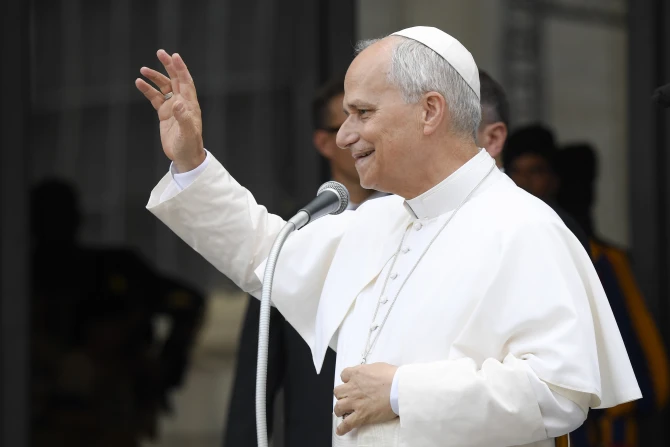
Pope Leo XIV on Friday highlighted the contributions of laypeople and religious who helped shape Catholic social teaching and embodied “a Church forging ahead in new directions.”
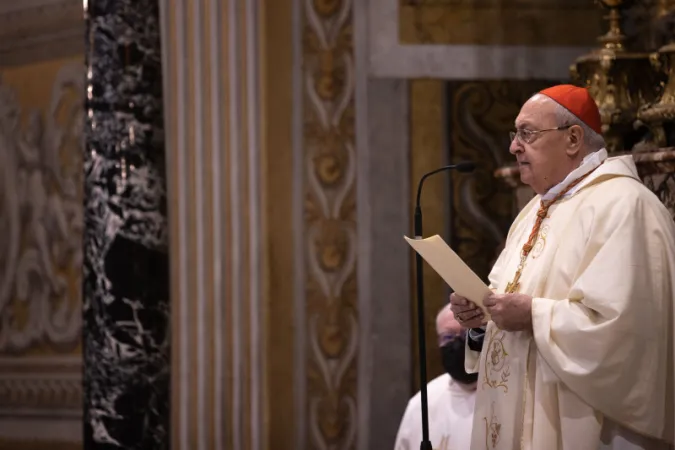
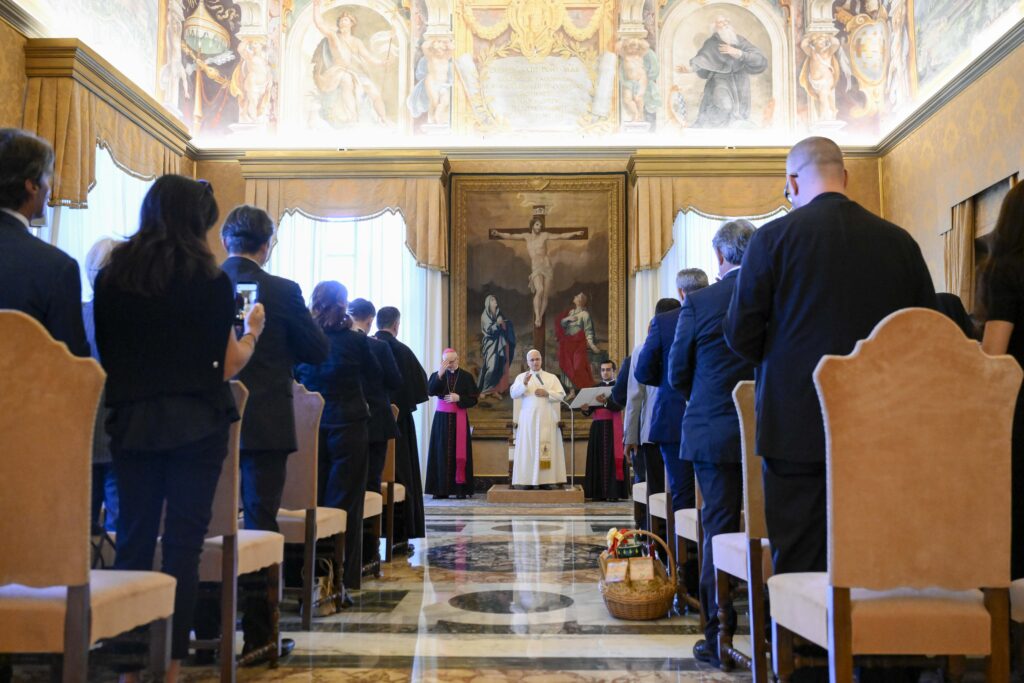
During a Sept. 18 audience with approximately 50 members of the Leo XIV International Study Center, the pope described Christian humanism as “a vision open to the Creator” that fosters fraternal relationships. He said Catholic social teaching emerged from that same humanist tradition.
“The Church’s social doctrine also emerged from this matrix,” Leo said in the Vatican’s Consistory Hall. “Its analysis of Christian revelation in the context of modern social, labor, economic, and cultural issues would not have been possible without the contribution of the laity, men and women alike, who grappled with the great issues of their time.”
“At their side were those men and women religious who embodied a Church forging ahead in new directions,” he said, quoting his apostolic exhortation Dilexi Te.
The research, educational, and cultural institution was founded within the Order of St. Augustine in October 2025 and is dedicated to studying the life and magisterium of Pope Leo XIV.
“The epochal change we are now undergoing makes even more necessary a constant interaction between the faithful and the Church’s magisterium, between ordinary citizens and experts, between individuals and institutions,” the pope said.
During the audience, Leo encouraged the center’s members to promote formation directed toward public engagement and service to society.
“At the cost of swimming against the tide, your mission of hope consists of promoting, in Italy and throughout the world, formation for public and political life conceived as a service to the common good, responsibility towards the community, and the building of relationships based on solidarity, justice, and peace,” he said.
Established as an organization in Italy’s “third sector” in December 2025, the center seeks to promote reflection on Catholic social teaching and its application to contemporary challenges.
A civilization of love
Leo expressed his appreciation for the Augustinian initiative, stressing “the importance of reflection and critical thinking in building a civilization of love, to which the social doctrine of the Church has much to offer.”
The pope also praised the center’s commitment to dialogue with universities, academic institutions, public bodies, civil society organizations, ecclesial institutions, and networks of associations in an effort to foster cooperation and exchange at both the national and international levels.
In that context, he highlighted its collaboration with the Theological Faculty of Central Italy and the Pontifical Patristic Institute Augustinianum.
“The key lies in walking together, always, without closing the door to encounter even with those who are different and seem to think, speak, or act differently,” he said.
A humanism open to peace
Leo also emphasized the symbolic significance of Florence as the home of the new study center.
The choice of the city, he explained, is “an invitation to draw inspiration from the values of humanism, a vision open to the Creator and, for that very reason, one that builds fraternal relationships.”
“It is not wars, but the weaving of peace and just balances that produces civilization, with the active participation of all the social and cultural components of an open society,” he said.
Political formation as an answer to resignation
Leo expressed his hope that the center would foster dialogue and prepare new generations to participate in public life.
“May your study center promote this exercise, which requires pioneers and facilitators, especially when forms of mistrust and resignation threaten to prevail,” he said.
The pope called the center’s work “the opposite of resignation” and urged it to promote public and political service grounded in responsibility for the community and the common good.
St. Augustine and love as a force for renewal
In the final part of his address, Leo underscored the relevance of Augustinian thought to the challenges facing the contemporary world.
Augustinian reflection, he said, has “much to offer in this regard within today’s international context, for an understanding of love as the principle of renewal in personal, economic, and political life.”
“Love binds in order to liberate, unites in order to generate, and commits in order to build,” he said.
The pope also cited his encyclical Magnifica Humanitas: “We view history in the light of the crucified and risen Lord … We do not consider the present as a predetermined fate, but an opportunity for personal and collective conversion.”
Finally, he encouraged the center’s members to become witnesses to God’s quiet action in history.
“Yes, be experts in God’s newness: not that which dazzles with speed and efficiency, but that which he works silently, freeing the old world from its dead ends and opening up paths along which we may journey together, toward his city,” he said.
This story was first published by ACI Prensa, the Spanish-language sister service of EWTN News. It has been translated and adapted by EWTN News English.