From the finger of St. Thomas to the arm of St. Jude to the miraculous blood of St. Januarius and the Shroud of Turin, the Catholic Church is home to a plethora of relics. To an outsider, the tradition of venerating relics may seem strange; however, the roots of the practice are found in Scripture as well as in the ancient tradition of the Church.
Below are 10 of the most asked questions pertaining to relics and their veneration.
What is a relic?
A relic is a physical object that had a direct association with a saint or with Jesus Christ. The word relic derives from the Latin word “relinquere,” which means “to abandon or leave behind.”
What are the different classes of relics?
Traditionally, relics can be broken down into three classes: first, second, and third.
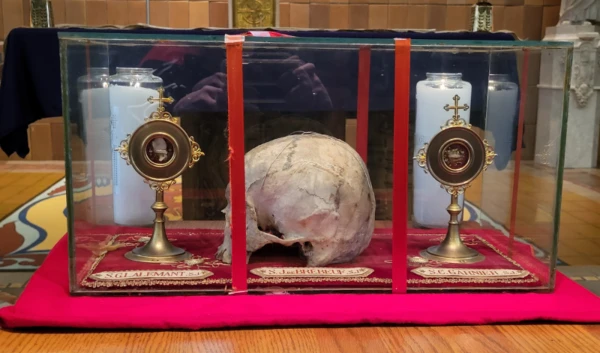
First-class relics are the body or fragments of the body of a saint, such as pieces of bone or flesh. An example of a first-class relic would be the skull of St. Thomas Aquinas or the bone of St. Jude Thaddeus. Pieces of the cross on which Jesus was crucified are also considered first-class relics.
A second-class relic is an item that a saint touched or owned, such as a shirt or book, or fragments of these items.
Third-class relics are items that a saint has touched or items that have been touched to a first-, second-, or another third-class relic. For example, touching the first-class relic of St. Bernadette Soubirous’ bones with your own personal rosary would make your rosary a third-class relic.
Additionally, a 2017 decree on relics identified the difference between “significant” and “nonsignificant” relics.
The decree defines a significant relic as “the body of the blesseds and of the saints or notable parts of the bodies themselves or the sum total of the ashes obtained by their cremation.”
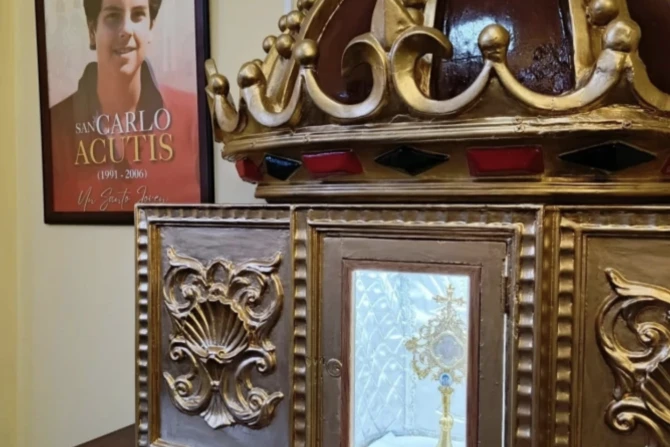
These relics are preserved in properly-sealed urns and are to be kept in places that guarantee their safety and respect their sacredness.
“Little fragments of the body of the blesseds and of the saints as well as objects that have come in direct contact with their person are considered nonsignificant relics,” the decree states.
These are also preserved in sealed cases “and honored with a religious spirit, avoiding every type of superstition and illicit trade.”
How are relics authenticated?
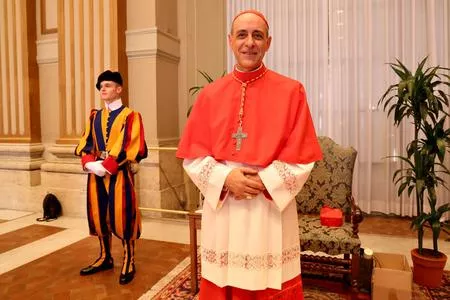
The process of authenticating a first- or second-class relic begins with the certification from a bishop or cardinal. In many cases the relics belong to the diocese to which the saint belonged.
Then, especially for first-class relics, the item must be scientifically proven to be human remains along with other criteria. This is done to ensure that fake relics are not being venerated by the faithful.
There is no process for formally recognizing third-class relics.
Why do Catholics venerate relics?
Catholics venerate the relics of saints as a way to honor the saint’s inspiring way of life and bold faith. As Catholics, we strive to become saints ourselves and are encouraged to imitate the lives of the saints in our own daily lives.
St. Jerome, a great biblical scholar, said: “We do not worship relics, we do not adore them, for fear that we should bow down to the creature rather than to the creator. But we venerate the relics of the martyrs in order the better to adore him whose martyrs they are” (“Ad Riparium,” i, P.L., XXII, 907).
The veneration of relics is a Catholic practice of honoring the extraordinary work God did in a person’s life — a person who has achieved the highest level of holiness in the Catholic Church.
Is relic veneration biblical?
Yes. There are several instances in the Bible where individuals are healed by touching an item.
In 2 Kings 13:20-21, the corpse of a man is touched to the bones of the prophet Elisha and the man comes back to life. In Matthew 9:20-22, the hemorrhaging woman is healed by touching the hem of Jesus’ cloak. People were healed and evil spirits were driven out when handkerchiefs from the apostle Paul were placed on these individuals as is written in Acts of the Apostles 19:11-12.
Can relics perform miracles?
It is important to understand that while relics may be used in many miracles that are mentioned, the Catholic Church does not believe that the relic itself causes the miracle; God alone does. The relic is the vehicle through which God may work, but God is the cause for the healing.
Any good that comes about through a relic is God’s doing. But the fact that God chooses to use the relics of saints to work healing and miracles tells us that he wants to draw our attention to the saints as “models and intercessors” (Catechism of the Catholic Church, 828).
Is it OK to own a relic?
Ideally a relic should be kept in a church or shrine where it can be made available for public veneration. However, the Church does not forbid the possession of relics by laypeople. They may even be kept in homes. Additionally, the Church no longer issues relics to individuals — not even clergy. The Church will only issue relics to churches, shrines, and oratories.
Can I buy or sell relics?
According to canon law of the Catholic Church, the sale of first- and second-class relics is strictly forbidden. Relics can only be given away by their owners, and some very significant relics, such as a heart, arm, etc., cannot be given away without the permission of the Vatican.
Where can I see or venerate relics?
Relics are housed all over the world in different churches and shrines. For example, the Basilica of the Sacred Heart in Notre Dame, Indiana, is home to an estimated 1,200 relics. In Venice, Italy, St. Mark’s Basilica houses the relics of St. Mark the Evangelist. Catholics can venerate relics of the true cross at the Basilica of the Holy Cross in Jerusalem in Rome.
Relics will also go on tour to churches across cities throughout the world in order for the faithful to have an opportunity to venerate them.
Are there relics of Jesus or Mary?
There are no first-class relics of the Blessed Virgin Mary. The Catholic Church teaches that Mary was assumed body and soul into heaven. However, the most well-known second-class relic that is believed to have been Mary’s is her veil, which is kept in Chartres Cathedral in France.
The case is similar for Jesus. While there are no bodily relics of Christ, who rose from the dead and ascended into heaven, there are fragments of the true cross, a fragment of the holy manger in which Jesus was placed after he was born, and fragments of black-and-white stone that are said to be from the pillar on which he was scourged.
SIGN UP FOR OUR NEWSLETTER HERE
This article was originally published on Catholic News Agency.