Visiting a parish in Rome, the pope preached on the Transfiguration and Abraham’s journey of faith.
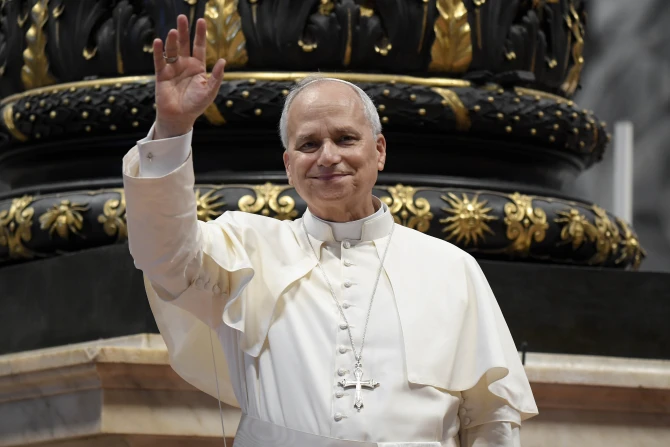
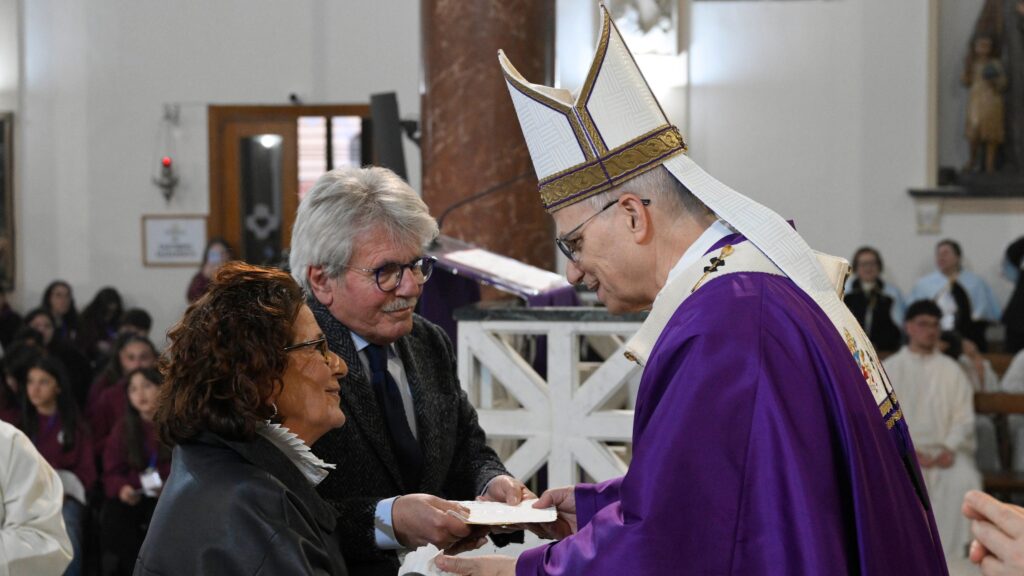
Pope Leo XIV spent Sunday afternoon with parishioners in Rome’s Quarticciolo neighborhood, meeting young people and families touched by addiction before celebrating Mass and urging Catholics to embrace what he called “the logic of unconditional love.”
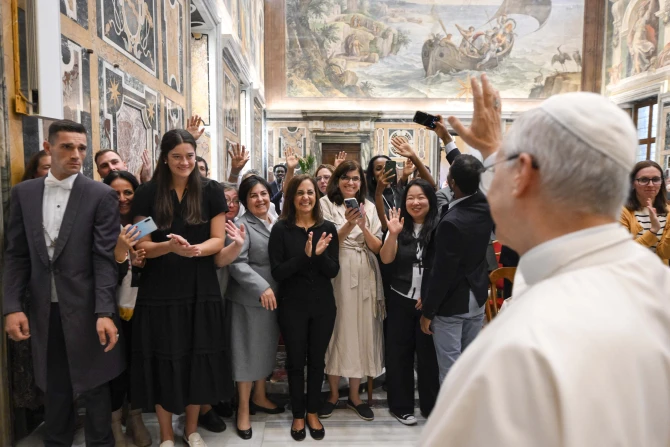
The pope arrived shortly before 4 p.m. at the Parish of the Ascension of Our Lord Jesus Christ and was welcomed by Cardinal Baldassare Reina, the vicar general of the Diocese of Rome, along with the parish pastor and faithful gathered in the courtyard of the oratory.
Leo began by greeting parishioners one by one and then sat down with young people involved in a local initiative known as “Magis.” A message painted on a wall captured the tone of the visit: “Those who love go forward.” One young person described the group’s identity as “fraternity” as the pope exchanged gifts and embraced members of the community.
In remarks during the encounter, Leo spoke of his concern about the conflict in the Middle East, mentioning children killed in the war in Gaza. He also pointed to a local crisis closer to home: drug abuse that, he said, continues to wound the Quarticciolo area. The visit included time with the sick and elderly, as well as mothers of people struggling with addiction, reflecting the neighborhood’s hardships and hopes.
During Mass, the pontiff’s homily turned to the Transfiguration and to Abraham, whom he held up as a model for believers learning to trust God on an uncertain path.
“With Abraham, each of us can recognize ourselves on a journey,” he said, describing life as a road that requires confidence in God’s word — and sometimes the courage to “leave everything.” The temptation, he warned, is to treat uncertainty as something to escape, instead of a place where God’s promise can be discovered.
“It happens every day — because the world thinks this way — that we measure everything, we strain to keep everything under control,” Leo said. “But in this way we lose the chance to discover the true treasure, the precious pearl … which God has hidden in our field as a surprise.”
Reflecting on the disciples and the road to Jerusalem, the pope said their lesson was that true blessing comes only by moving beyond self-protection and accepting what Jesus reveals in the Eucharist: the willingness to offer one’s life for others.
Sunday worship, he added, is not an interruption of that mission but a rest stop that re-centers the journey. The Lord gathers his people, he said, to strengthen them “not to stop and not to change direction.”
Leo also returned to St. Peter’s impulse to “stop” and “control” events — a way of thinking he said can resemble clinging to a dream. The Transfiguration, he said, points instead to the destination: “a new world” filled with light, with the human and divine face of Christ.
For that reason, he told parishioners, the essential task is to listen to Jesus.
“He travels with us, even today, to teach us in this city the logic of unconditional love,” the pope said, calling believers to lay down the defensive posture that can become “an offense.” “Let us listen to him … to become light of the world — beginning with the neighborhood where we live.”
The pope said the Gospel also entrusts the parish with a concrete mission in a place facing “numerous and complex problems”: to cultivate a gaze of faith that “transfigures everything with hope,” and to put “passion, sharing, and creativity” into circulation as a way of tending the neighborhood’s wounds.
He cited the parish’s motto, “Let’s build community,” urging an open-armed welcome “to everyone, truly everyone.” He also highlighted the “Magis” program, linking it to St. Ignatius of Loyola’s call to seek the “more” — a challenge to young people to reject mediocrity and choose a courageous, authentic life rooted in Jesus Christ.
“When we realize that so many things around us are not right, sometimes we start to ask: Does what we’re doing even make sense?” Leo said, warning against discouragement. “It is precisely in the face of the mystery of evil that we must bear witness to our identity as Christians,” he said, by making God’s kingdom visible in the places and times where believers live.
Father Daniele Canali, the parish priest, said the visit was the third by a pope to the community: St. John XXIII came on March 3, 1963, and St. John Paul II visited on Feb. 3, 1980.
Quarticciolo, on Rome’s eastern outskirts, developed as a public housing project between 1939 and 1940 and later became a center of Resistance activity during World War II. The parish was established in 1948, the church completed in 1954, and today it is entrusted to the Dehonians, the Priests of the Sacred Heart founded by Léon Dehon.
This story was first published by ACI Stampa, the Italian-language sister service of EWTN News, and has been translated and adapted by EWTN News English.