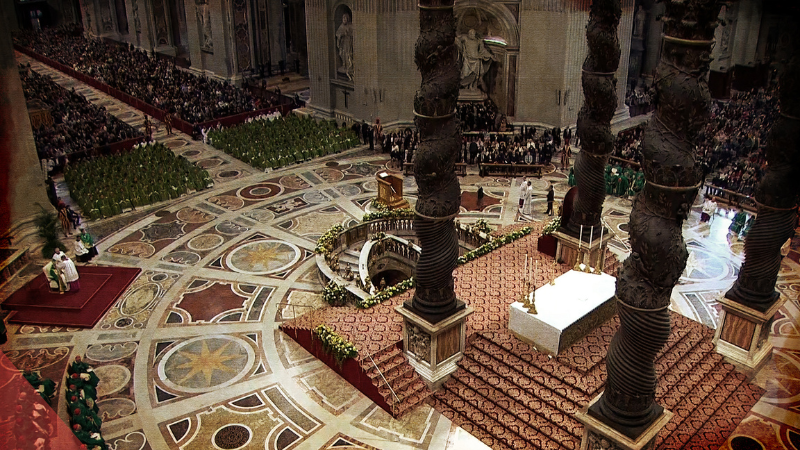
In keeping with a centuries-old tradition that follows the election of every pontiff, a mosaic bearing the portrait of Pope Leo XIV has now been installed in the Papal Basilica of Saint Paul Outside the Walls. The work has taken its place in the right nave of the basilica, beside the portrait of Pope Francis, at a height of roughly 43 feet above the floor. There, it joins the visual procession of all 266 popes, beginning with Saint Peter, lining the basilica’s walls.
This tradition dates back to the fifth century, during the pontificate of Pope Saint Leo the Great, and continues to serve as a visible reminder of apostolic succession and continuity within the Church.
From Canvas to Mosaic: A Living Tradition
The portraits of the popes were not always created in mosaic form. As Fr. Roberto Regoli, professor at the Pontifical Gregorian University, explains, they were originally oil paintings on canvas or wood, later hung in the basilica’s naves.
“The mosaics of Saint Paul, which originated under Pope Leo the Great,” Fr. Regoli notes, “lasted until 1823, when a great fire destroyed the entire basilica and only about twenty were preserved. Among these is the mosaic portrait of Saint Peter.”
He adds that although mosaic is a demanding technique, “in terms of preservation it has proven very successful,” which is why it remains in use today.
Thousands of Tesserae, One Image
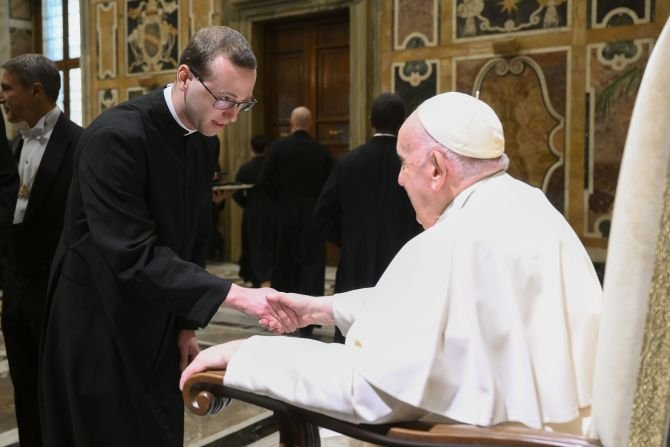
The newly installed mosaic tondo measures more than four feet in diameter and weighs over 300 pounds. It was recently presented to Pope Leo XIV, who expressed his appreciation for the work. The portrait was created from a painted preparatory sketch by Master Rodolfo Papa at the Vatican Mosaic Studio.
According to Paolo Di Buono, head of the Vatican Mosaic Studio, the piece was assembled using more than 15,000 tesserae, set with the traditional oil-based mastic long used by Vatican mosaicists. As he explains, it is “…the same one that has been used for centuries in the tradition of studying Vatican mosaics. The same mastic that was used to apply the mosaics in St. Peter’s Basilica.”
Capturing the Pope’s likeness required extraordinary precision. Di Buono emphasizes that the face alone contains immense detail, noting the use of “…an enormous number of enamel tesserae, precisely because even just in the face there are hundreds of shades of flesh tones that were used to replicate the complexion of the Holy Father.”
The mosaic was completed in time for Vespers on the Feast of the Conversion of Saint Paul, celebrated on January 25, adding a new chapter to a visual tradition that continues to link the present pontificate with the Church’s earliest history.
Adapted by Jacob Stein. Produced by Magdalena Wolinksa-Riedi; Camera by Fabio Gonnella; Video edited by Gianluca Gangemi.