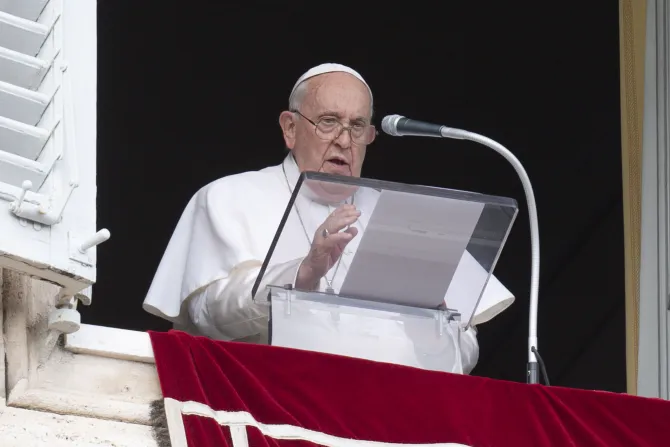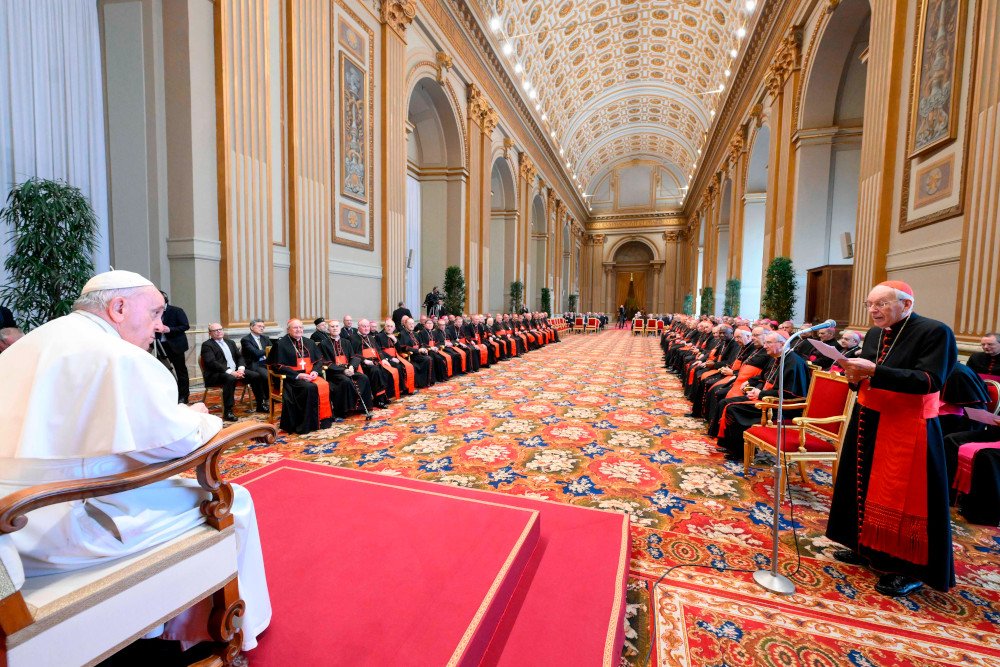
Pope Francis warned the Roman Curia on Thursday that they need to be vigilant in the face of temptation by “elegant demons” and “the evil that quietly lurks among us.”
In his annual Christmas address to the cardinals who work in Vatican offices on Dec. 22, the pope said that there is a temptation for those who serve“at the heart of the Church” to think that they are “better than others, no longer in need of conversion.”
“Yet we are in greater danger than all others, because we are beset by the ‘elegant demon,’ who does not make a loud entrance, but comes with flowers in his hand,” Pope Francis said.
The pope underlined that “it is not enough to condemn evil, including the evil that quietly lurks among us.”
“We need to respond by choosing to be converted,” he said.
“Mere condemnation can give the illusion that we have solved the problem, whereas what really counts is making the changes that will ensure that we no longer allow ourselves to be imprisoned by evil ways of thinking, which are often those of this world.”
Pope Francis added that one of the most helpful virtues to aid in temptation is “the virtue of vigilance.”
He said that evil can “change its tactics, to become more insidious, to find new disguises that will be hard for us to see through.”
Quoting Jesus’ words in the Gospel of Luke, the pope said that when an unclean spirit has gone out of a person the spirit returns and brings “seven other spirits more evil than itself.”
Pope Francis explained that “the tempter always comes back, and he comes back in disguise.”
“Our initial conversion follows a certain pattern: the evil that we acknowledge and try to uproot from our lives does indeed leave us, but we would be naïve to think that it will long be gone. In short order, it comes back under a new guise. Before it appeared rough and violent, now it shows up as elegant and refined,” he said.
“Permit me to use the expression … these ‘elegant demons’ … enter smoothly, without our even being conscious of them. Only the daily practice of the examination of conscience can enable us to be aware of them,” the pope added.
Pope Francis has often used his annual December address, held in the Vatican’s gilded Hall of Benediction, to offer his frank perspective on the state of the Roman Curia.
In 2014, he famously diagnosed 15 spiritual “diseases” afflicting the Curia, including careerism and idolizing superiors. In 2020, the pope used the word “crisis” 44 times in his speech and called the Church to renewal.
In his 2022 Christmas greetings, Pope Francis returned to the theme of “conversion” again and again, including in reference to the recent 60th anniversary of the opening of the Second Vatican Council.
“What was the Council if not a great moment of conversion for the entire Church? As Saint John XXIII observed: ‘The Gospel does not change; it is we who begin to understand it more fully.’ The conversion that the Council sparked was an effort to understand the Gospel more fully and to make it relevant, living and effective in our time,” he said.
Pope Francis added that “the error of trying to crystallize the message of Jesus in a single, perennially valid form” is contrary to conversion.
“True heresy consists not only in preaching another gospel (cf. Gal 1:9), as Saint Paul told us, but also in ceasing to translate its message into today’s language and ways of thinking, which is precisely what the Apostle of the Gentiles did,” he said.
“To preserve means to keep alive and not to imprison the message of Christ.”
The pope also highlighted the plight of “war-torn Ukraine” and the many ongoing conflicts in different parts of the world.
“Anguished as we are by the spread of wars and violence, we can and must make our own contribution to peace by striving to uproot from our hearts all hatred and resentment towards the brothers and sisters with whom we live,” he said.
Following his custom, Pope Francis gave Vatican officials books as a gift, including “The Life of Jesus,” written by Andrea Tornielli, the editorial director for the Vatican’s Dicastery for Communication.
The pope’s speech to the Roman Curia and his following Christmas greetings to employees of Vatican City State were the last audiences on his public schedule before he is scheduled to preside over “Midnight Mass” at 7:30 p.m. on Christmas Eve in St. Peter’s Basilica.
“God became a Child, and that Child, once grown, let himself be nailed on a cross. There is nothing weaker than one who is crucified, yet that weakness became the demonstration of God’s supreme power. In forgiveness, God’s power is always at work. May gratitude, conversion, and peace thus be the gifts of this Christmas,” Pope Francis said.