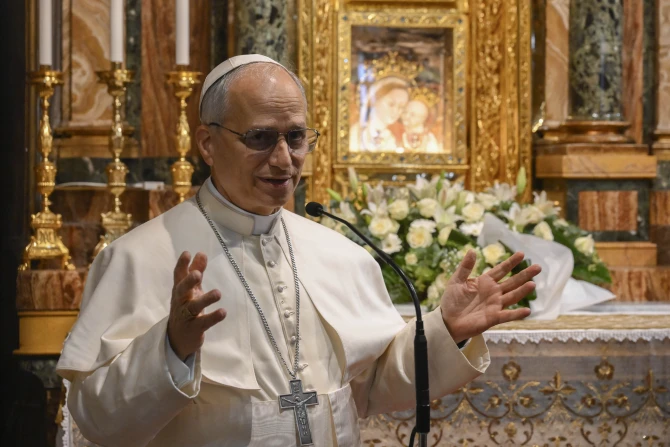
Pope Leo XIV is now granting apostolic blessings to the faithful around the world, a spiritual gesture that can be officially requested through the Vatican’s Apostolic Almoner’s Office.
FIND THE POPE’S BIOGRAPHY HERE
These blessings, printed on parchment, are a well-established tradition in the Catholic Church and are available for significant moments in Christian life such as the sacraments of baptism, confirmation, and marriage.
As indicated on the website of the Vatican Apostolic Almoner’s Office, the procedure for obtaining an apostolic blessing can be completed in two ways: in person at the offices of this department or through an online form.
Those who choose the in-person method should go to the offices located within Vatican City, entering through the Porta di Sant’Anna, to the right of the colonnade in St. Peter’s Square. Office hours are Mondays, Wednesdays, Fridays, and Saturdays from 8:30 a.m. to 1:30 p.m. and Tuesdays and Thursdays from 8:30 a.m. to 5:30 p.m. local time.
For those not in Rome, the digital process is equally accessible. Through the official website of the Apostolic Almoner’s Office — the only authorized site for this purpose — applicants must follow several steps.
The first step is to select the occasion for which the blessing is being requested (such as a baptism, marriage, or anniversary); then, choose the style of parchment; then, enter the information that should appear on the document; and finally, register the applicant, choose the delivery method (local pickup in Rome or shipping via DHL Express), and make a donation by credit card (only Visa and MasterCard are accepted).
The requested information includes the full name of the recipient(s) of the blessing, the specific occasion, the date and location of the event (in the case of sacraments or anniversaries), as well as the sender’s complete address, email address, and phone number. The system also allows users to open a personal account for future requests. Once the transaction is confirmed, the Apostolic Almoner’s Office will send a confirmation email with the estimated delivery or pickup date.
The processing time for the request is approximately 25 days if picked up at the Vatican office and 30 days for international deliveries. The cost of the parchment ranges between 20 and 30 euros ($23-$34), depending on the style, plus shipping costs, which vary depending on the destination, from 15 euros ($17) for destinations within Italy to 40 euros ($45) if sent to Africa.
It is worth noting that, after deducting the processing and shipping costs, all proceeds go entirely to the charitable works carried out by this office in the name of the pope to help those most in need.
Regarding valid occasions for requesting the apostolic blessing, the almoner’s office establishes strict criteria. They are granted for sacraments such as baptism, first Communion, confirmation, marriage, ordination to the priesthood or permanent diaconate, and religious profession.
They are also available for significant anniversaries of these occasions and for birthdays marking decades or particularly significant ages (such as 18, 30, 75, or even 100 years). In some cases, such as wedding anniversaries or birthdays, the applicant is asked to provide a “declaration of suitability” attesting that the recipients are practicing Catholics.
Applications by regular mail, fax, or email are not accepted, and any requests made outside of authorized channels will be automatically rejected.
Obtaining an apostolic blessing is not only a symbolic gesture of communion with the successor of Peter but also direct support for the charitable works the pontiff carries out on behalf of the entire Church.
SIGN UP FOR OUR NEWSLETTER HERE
This story was first published by ACI Prensa, CNA’s Spanish-language news partner. It has been translated and adapted by CNA.