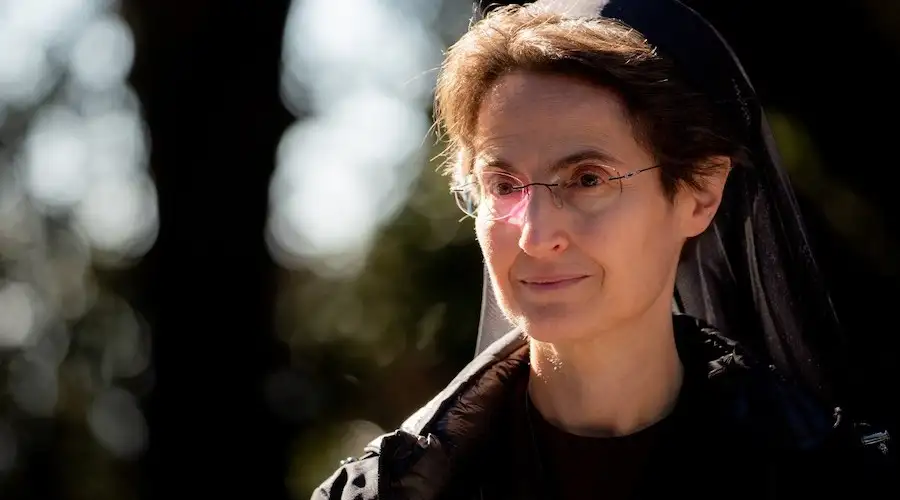
Sister Raffaella Petrini, the second in command at the Vatican, reflected on the role of women in the Church for the future and their contribution due to their innate gifts, including caring for others. The Franciscan nun, who holds a degree in Political Science, has been the Secretary General of the Governorate of the Vatican City since 2021, making her the highest-ranking woman in the management of the Holy See.
On International Women’s Day, Sister Raffaella gave a lecture at the University of the Holy Cross in Rome, where she spoke about the role of women in the future of the Church. According to her, “women who hold high positions, inside and outside the Church, are called today to exercise their freedom to carry out the tasks that Pope Francis attributes to every leader: to care for the weak and to put the dignity of the person at the center of every decision.”
Competition or Solidarity?
For Sister Raffaella, the leadership dilemma proposes, as explained by the Polish philosopher Zygmunt Bauman, “a fundamental choice that both men and women must make: the choice between competition or solidarity.”
During the last pontificates, particularly with Pope Francis, the sister highlighted that “women have been offered the opportunity to express freedom more concretely.”
To understand it, Sister Rafaella proposed “three guiding dimensions” based on her experience within the Vatican Governorate.
Firstly, she highlighted the awareness of diversity, explaining that “women are not better or worse than men. We are different, and even complementary.”
“In fact, women represent innate gifts linked to their structural capacity to care for others, coupled with their ability to bring forth new life through motherhood. They also represent change and transformation, protection of vulnerability, sacrifice, and the ability to relate to others,” she said.
In this regard, she indicated that women can, thanks to their ability to care for people, “offer an essential contribution to the promotion of an atmosphere of serenity and mutual respect.”
Moreover, she argued that the effectiveness of the functioning of any organizational system “cannot be evaluated solely on the basis of quantitative growth and results, but above all in terms of the virtue of its development, which involves the transformation of the structure and the improvement of the quality of life for people.”
Similarly, she highlighted the importance of a sense of community within any institution and “awareness of a common fragility that requires support.”
In this sense, the nun emphasized the need to promote “the vision of work lived as a vocation” and clarified that although care is not something exclusive to women, “it is an alternative attitude that complements the traditionally male orientation towards justice.”
Sister Petrini also stated that women can make a great contribution, not only to improving the necessary efficiency in all organizations but also to achieving what is called “social friendship.”
Brief biography
Sister Raffaella was born in Rome on January 15, 1969. She studied Political Science at the Libera Università Internazionale degli Studi Guido Carli and obtained her doctorate at the Pontifical University of St. Thomas Aquinas (the Angelicum), where she currently teaches. She was an official of the Congregation for the Evangelization from 2005 until her appointment as Secretary General of the Governorate of the Vatican City in November 2021.