On his first trip abroad as pope, Pope Leo XIV chose a destination that physically and culturally lies between continents: Turkey. The visit opened in Ankara, the country’s capital, where he honored the founder of modern Turkey, Mustafa Kemal Atatürk, at his mausoleum before meeting with political officials at the Presidential Palace.
There, Pope Leo urged the country to embrace its unique vocation as a connector of civilizations. “Indeed, a society is alive if it has a plurality, for what makes it a civil society are the bridges that link its people together.”
President Recep Tayyip Erdoğan emphasized religious coexistence and reiterated support for a Palestinian state. Pope Leo praised Turkey’s diversity and encouraged stronger protection for women and families—an especially pointed message following Turkey’s withdrawal from the Istanbul Convention.
While the pope met officials in Ankara, Istanbul’s Christian community prepared for his arrival. The Basilica of Saint Anthony of Padua, the largest Catholic church in the city, welcomes not only Christians but also many Muslims seeking prayer and spiritual guidance.
Fr. Michal Sabatura, OFM, Superior of the Franciscans at Saint Anthony Church, explained:
“This is a Jubilee church, and our Christian community here is very small. In Turkey, about ninety percent of people are Muslims.”
He added: “They come with their problems… They have a deep faith and for one reason or another they are drawn here… Our community is small and often unseen. This visit lets Turks notice that Christians are here, in this city and in Turkey.” Many Christians cannot travel to Rome, he noted, making the pope’s visit especially meaningful: “We live here as neighbours who respect one another.”
The community has also endured tragedy: last year two terrorists opened fire at another Franciscan church, killing a Turkish friend of the parish before their weapons jammed.
Turkey has only about 33,000 Catholics in a population of more than 85 million, mostly Sunni Muslim. Many expressed joy as they awaited Pope Leo: “A moment of encouragement… a beautiful celebration, indeed, a blessing for us all.”
At the Cathedral of the Holy Spirit, Pope Leo thanked priests, religious, and lay workers, reminding them their mission is not power but presence—“a little leaven” in society.
Outside central Istanbul, the Little Sisters of the Poor prepared to welcome the pope to their home for the elderly.
Sister Margueritte, the director, explained that “we are looking after poor, elderly persons who have maybe very meagre pension… So we bring them to our home here and we try to make it their own home.”
Another sister added the challenges of being a Catholic institution in Turkey:
“We cannot do what we want… we cannot share our faith with others… but in our own ways we try to help them… We stay with them.”
Sister Margueritte emphasized the spirit behind their mission. “It must be done in a Christ-like spirit – with humility, with service, with gentleness, with understanding…”
The pope then traveled by helicopter to İznik, ancient Nicaea, for the 1,700th anniversary of the First Council of Nicaea, where the Nicene Creed was first articulated.
Expert Przemysław Szewczyk noted the significance of the pope’s chosen prayer site. “This very celebration of Nicaea in the basilica of a martyr is a reminder that Christians in the East pay a very high price… Leo is not coming to the imperial palace… but comes to the tomb of a martyr… to pay homage to all those who gave their lives for the faith.”
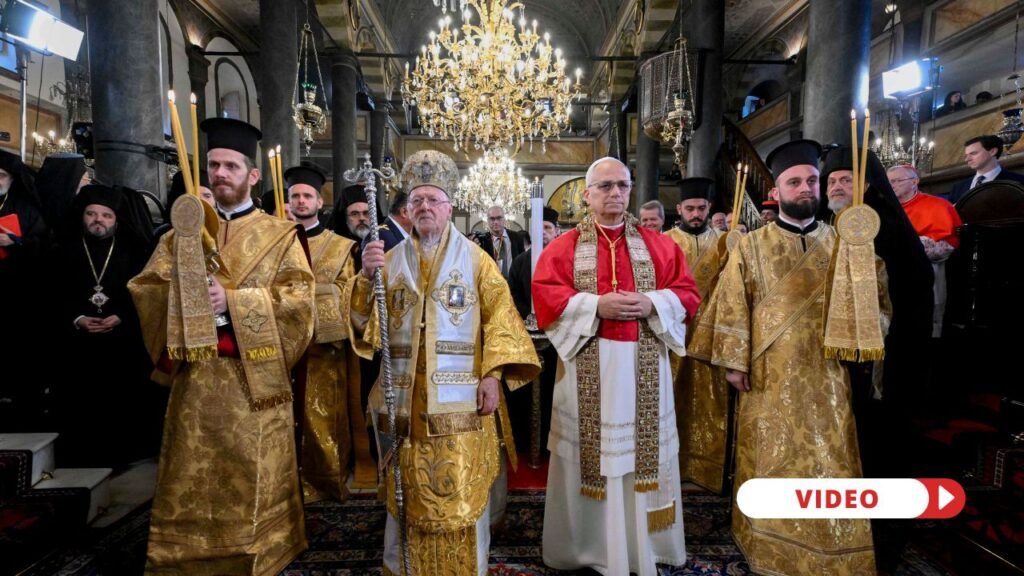
Beside Ecumenical Patriarch Bartholomew, Pope Leo prayed for restored unity between Catholics and Orthodox Christians. The leaders signed a Joint Declaration, reaffirming their commitment to healing division and rejecting any invocation of God’s name to justify violence.
The following day, Pope Leo continued the tradition of his predecessors by entering Istanbul’s Blue Mosque, removing his shoes in respect for the Muslim majority. However, unlike previous popes, he did not pause for a visible moment of prayer, though invited.
The Vatican later stated he experienced the visit “in a spirit of contemplation and listening.”
The visit concluded with a packed Mass at Istanbul’s Volkswagen Arena—the first time a pope has celebrated a public liturgy in such a venue in Turkey. Around 4,000 Catholics attended, demonstrating the community’s commitment despite its size.
Pope Leo highlighted Turkey’s four liturgical traditions—Latin, Armenian, Chaldean, and Syriac—as symbols of unity:
“Each one contributes its own spiritual, historical and ecclesial richness… a Catholicity that unites.”
Adapted by Jacob Stein