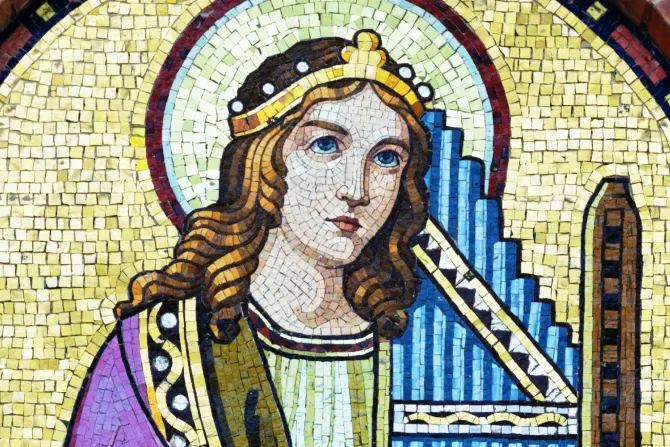
On November 22, the Catholic Church celebrates Saint Cecilia, the patron saint of musicians, whose life and death echo with miraculous events and enduring legacy. Saint Cecilia, who lived approximately between 180 and 230 AD, left an indelible mark not only in the realms of faith but also in the history of art and architecture.
Before her martyrdom, Saint Cecilia expressed a wish that her home be transformed into something extraordinary. This wish was later honored in a way that intertwined her legacy with the history of the Catholic Church.
According to accounts from “The Golden Legend,” a collection of hagiographies, Saint Cecilia faced a brutal trial of faith. She was condemned to die in a cauldron of boiling water within her own home. Miraculously, she emerged unscathed. Subsequently, an executioner attempted to decapitate her within the cauldron. Despite receiving three blows to the neck, she did not succumb instantly.
The narrative describes Saint Cecilia as emerging from this ordeal “half-dead and half-alive.” During the following three days, she distributed her wealth among the poor. She also made a request to Pope Saint Urban concerning those she had aided in their conversion journey and who were under her protection.
“I asked the Lord to grant me a three-day period to request your fatherhood to take care of all these people and to consecrate what was my house, turning it into a church,” she reportedly told the Successor of Peter.
Following her death, Pope Saint Urban buried her remains near the tombs of the bishops and transformed her home into a temple. In the 6th century, under the guidance of Saint Gregory the Great, her house was elevated to the status of a Primitive Basilica.
The Vatican’s Jubilee 2025 website recounts how Saint Cecilia appeared in a dream to Pope Paschal I (817-824) to reveal the location of her body in the catacombs of San Callixtus. This led to the construction of a new church in her honor, consecrated in 821 by Pope Paschal I.
As detailed on corazones.org, a website dedicated to the lives of saints, Pope Paschal I is believed to have transferred “the presumed relics” of Saint Cecilia to this new temple.
Today, over the original site of her house stands the Basilica of Saint Cecilia in Trastevere, Rome, as detailed by the Jubilee 2025 website. Her relics are preserved in the crypt of this basilica.
A significant event occurred in 1599 when Cardinal Sfondrati reopened Saint Cecilia’s tomb. Her body was found miraculously intact, dressed in white, with visible neck wounds. This discovery prompted the commissioning of sculptor Stefano Maderno to create a marble statue, replicating the exact position in which her body was found.
The story of Saint Cecilia transcends centuries, combining faith, art, and history in a narrative that continues to inspire and fascinate.