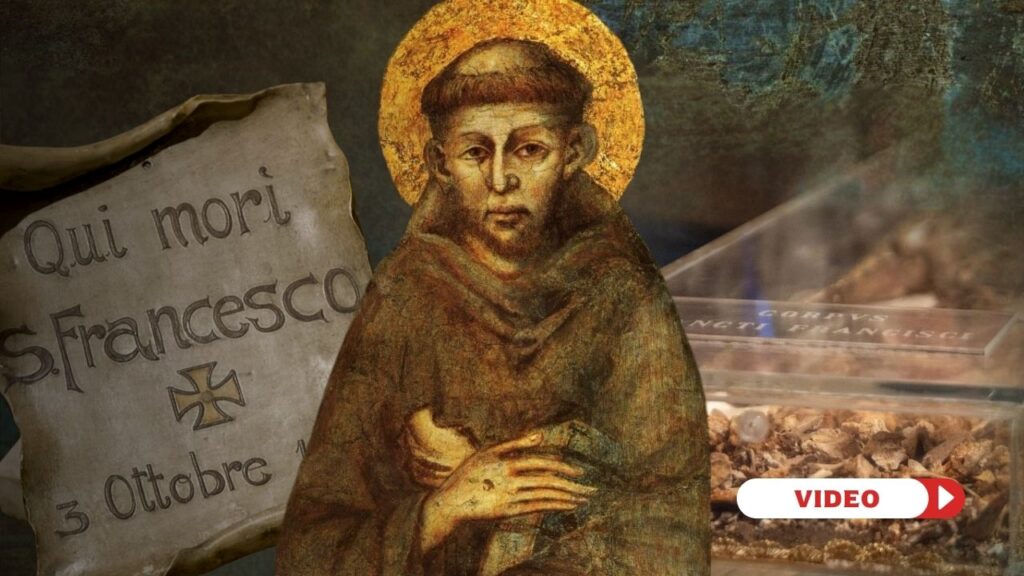
The Basilica of Santa Maria degli Angeli in Assisi shelters one of the most sacred places in the Christian world: the Porziuncola, the small chapel where Saint Francis understood his vocation and founded the Order of Friars Minor. Within the same basilica, however, stands another site that many pilgrims pass without noticing — the Chapel of the Transitus, where Francis died.
The Chapel Where Francis Took His Last Breath
Fr. Francesco Piloni, Provincial Minister of the Friars Minor of Umbria, explains the significance of this hidden place: “We are at the Chapel of the Transitus, the place where, on the evening of October 3rd, 1226, Francis completely surrendered himself to what he would call Sister Death. It is an absolutely important place, right beside the Porziuncola — and it is also the place where Francis chose to spend his final weeks. We know that until the summer of 1226 he had been staying at the bishop’s residence up in Assisi, but after the doctor visited him and gave him a deadline for his life, Francis wanted to return to the Porziuncola, the place where it all began.”
Each year, millions of pilgrims visit Santa Maria degli Angeli, one of Italy’s most frequented shrines. After Francis’ death in 1226, his body remained there only briefly. It was first transferred to the now non-existent church of St. George, and in 1230 to the newly constructed Basilica of Saint Francis in Assisi, where it has rested ever since.
The Rediscovery of the Saint
Centuries later, Francis’ tomb itself became the object of renewed attention. Fr. Marco Moroni, Custodian of the Sacred Convent of Assisi, recounts what happened in the 19th century: “The body of Francis was rediscovered in 1818, following excavations carried out here in the Basilica, in search of the sacred core around which this entire church was built — his tomb. At that point, a formal recognition took place, and the body of Francis was rearranged and restored to the same tomb where it had rested since 1230, and where it remains to this day.”
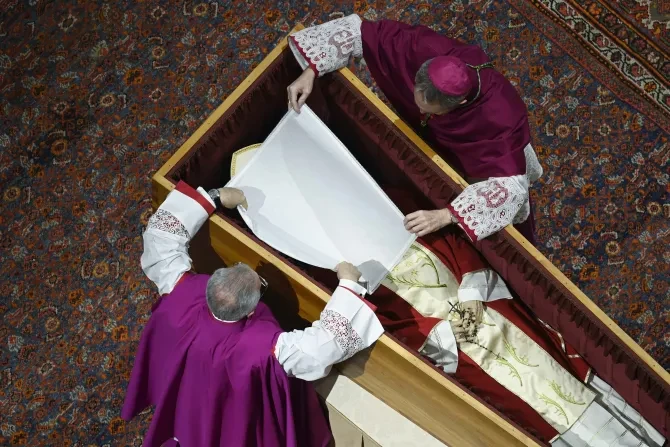
To mark the 800th anniversary of the saint’s death, February 21 became a historic day. The solemn exhumation of his remains took place in the morning, followed by the celebration of the translation and Vespers in the Lower Basilica, presided over by Cardinal Ángel Fernández Artime. Franciscan friars from around the world gathered first in private prayer before media cameras were allowed to enter.
Since 1978, the remains have been preserved in a plexiglass case. Oxygen was removed and replaced with helium to ensure optimal conservation conditions.
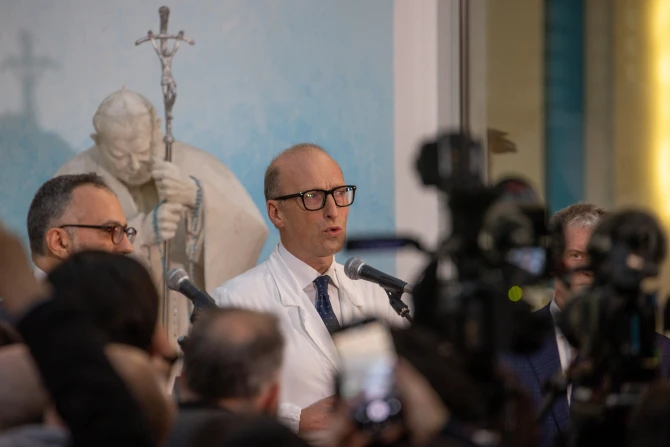
Fr. Moroni explained that experts had recommended periodic inspections: “Those who had carried out that operation had recommended that periodic inspections be conducted — not a full formal recognition, but simply a check to assess the condition of the remains: whether they were holding up, whether the bones were intact and not crumbling. And so it was, both in 1995, if I recall correctly, and again in 2015, when I happened to be here in Assisi — not in my current role, but simply as a friar of the community. That evening, together with all the friars of Assisi, we were given the opportunity to spend a few minutes beside the remains of Francis, close to the place where he normally rests. And I must say that perhaps it was precisely that experience which left me with a desire to share it with others. I lived it myself, and whenever I experience something truly beautiful, I find myself wanting as many people as possible to be able to share in that beauty.”
Pilgrims Encounter Francis
The public exposition of the remains has drawn extraordinary crowds. On the first day alone, 18,000 pilgrims arrived in Assisi. So far, more than 370,000 have registered to visit. Among them are youth groups, married couples, individual faithful, and even those who come simply out of curiosity.
When asked what Saint Francis represents to him, one pilgrim, Salvatore, responded emotionally: “Everything… Sorry.”
Assunta shared her gratitude: “An immense joy, an immense strength that he gives us year after year. We come to Saint Francis every year, and I always wondered if I would ever be able to see something more than just the tomb — and that wish has now been granted, to see his remains.”
Nicola reflected on the saint’s enduring relevance: “For me, Saint Francis represents a powerful example of humanity and of rediscovery — a return to essential, human values, stripped of everything superfluous. And it is precisely for this reason that he remains such an important and meaningful figure.”
For Michela, the closeness of the encounter was deeply moving: “It was a deeply moving experience, because we never expected to see him so closely. I imagined the case would be far away, at a distance from the faithful — and instead we passed right beside it. Being able to touch him, even without physically doing so, gives you an absolute sense of serenity.”
The remains of Saint Francis will remain on public display in Assisi until March 22, 2026. Access is free but requires registration through the official website sanfrancescovive.org, with liturgical celebrations and moments of prayer accompanying this extraordinary time of devotion.
Discover the Full Vaticano Episode Here
Adapted by Jacob Stein. Produced by Andrea Manna; Camera by Ilaria Chimenti