St. Anselm of Canterbury defended the Church, gave us an important proof for God’s existence and taught us why God became man.
The Church celebrates the feast of St. Anselm of Canterbury (c. 1033-1109) every year on April 21. Why is an 11th-century man important to us? Three reasons:
- He fought for the independence and reform of the Church;
- He gave us an important proof for God’s existence; and
- He explained the reason for the Incarnation.
Why St. Anselm “of Canterbury”?
St. Anselm of Canterbury was a seminal figure in the history and theology of the early Middle Ages. The appellation “of Canterbury” is because he was Archbishop of Canterbury in England, even though he was born in Aosta (a city in the far northeast of what is now Italy, not far from the Swiss border), and was serving as Abbot of Bec (a monastery in Normandy, France between Lisieux and Rouen) when the call for his transfer to Canterbury began.
I express that succession rather awkwardly as “when the call for his transfer to Canterbury began” because Anselm had no easy path to the See of Canterbury. The end of the 11th and beginning of the 12th centuries was a period in which the “investiture controversy” raged in England and other parts of Europe. In a nutshell, the “investiture controversy” was about whom would install a bishop: the pope or the king. Some kings of the time claimed the right to give a bishop his episcopal ring and crozier, which suggested his office came from the king and usually meant he was beholden to him.
Gregorian Reform
The “Gregorian Reform” of the period c. 1050-80, launched by Pope Gregory VII, had two goals:
- to reform the clergy morally (and they were badly in need of it — this is the time St. Peter Damian writes his influential Liber Gomorrhianus about clerical sodomy, nihil novi sub soli); and
- wresting the independence of the Church from civil rulers.
Anselm stood squarely with the Gregorian Reform, which was why he had to fight with English King William II along every step of his path to Canterbury, from his nomination to his efforts to receive the pallium. (Archbishops receive a special vestment, a “pallium” as a sign of their office in communion with the pope, which the pope traditionally “imposes.” Archbishops customarily went to Rome to receive the pallium — for a long time on June 29, the feast of Sts. Peter and Paul — and William would not permit the trip because he was playing neutral between the pope and an antipope claimant. Anselm was installed without the pallium. It was only later brought to England, but Anselm accepted it only from the papal legate, not the king.)
So Anselm stood for the Church being the Church and Peter being Peter, even at great personal suffering. At least William II was nominally Catholic. Future English kings, like Henry VIII, wanted not just to pick the Church’s bishops but to decide the Church’s faith and morals. Paradoxically, we live in a world in which countries whose leadership is explicitly atheist also claim the “right” to pick bishops. Nihil novi sub soli.
Ontological Proof of St. Anselm
Apart from his fight for the independence and reform of the Church (the Gregorian Reform of the 11th century and the Cluniac Reform that preceded it started cleaning up the Church internally while strengthening it externally), Anselm was a prolific philosopher and theologian. Two of his contributions in those areas merit special mention.
The first was his “ontological proof” for God. Some might ask today, “why do we need any proofs for God? Isn’t it just a matter of faith?” Well, no. As Catholics, we affirm that faith and reason go together. So faith also stands on at least certain rational presuppositions that result in the act of faith making at least some sense, at least being “reasonable.” St. Thomas Aquinas would later develop his five famous proofs for God’s existence, but the Angelic Doctor is about a century and a half in Anselm’s future.
Anselm’s proof is in some ways very simple. God is first of all “that than which nothing greater can be thought.” God is what we think of when we think of the greatest of greatness to the infinite degree. But then Anselm notes that what exists in reality is greater than what exists in the mind; therefore, that which “nothing greater can be thought” must exist. If it didn’t, one could obviously think of something greater, i.e., an existence “that which nothing greater can be thought.” That which nothing greater can be thought mustreally exist, insisted Anselm.
Anselm’s contribution to theology was found in his work, Cur Deus homo? (Why Did God Become Man?) His argument runs as follows. Sin is injustice. The degree of injustice is established by the one offended, i.e., the one treated unjustly. God is the one treated unjustly by sin. God is infinite. So sin is an infinite offense against God.
One who would repair an infinite injustice has to be infinite. But man is finite. (Let me add: man can kill himself spiritually but no suicide — physical or spiritual — can restore the life he destroyed).
So we have a conundrum. The injustice of sin is infinite. God, against whom the injustice is perpetrated, is infinite. Man, the perpetrator of the injustice, is finite. So how to repair the injustice (and put the human Humpty Dumpty back together again). The only way is a man who would be infinite, in other words, a man who was also God. Jesus Christ, “true God and true man.” So, Cur Deus homo? To redeem us from the futility into which we had cast ourselves by sin which we could not repair ourselves.
Clearly a thinker worth getting to know.
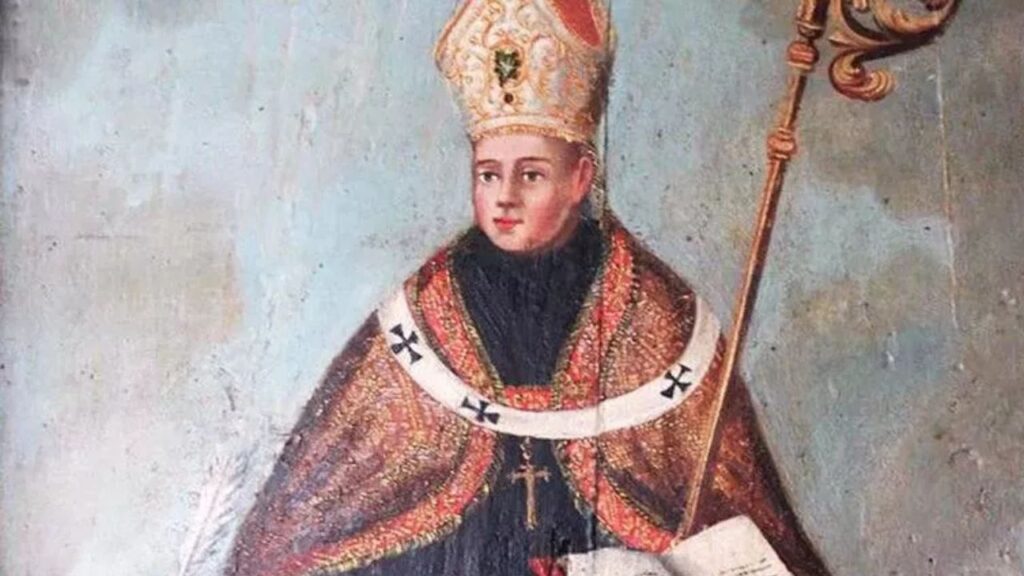
St. Anselm in Art
As far as I can tell, St. Anselm is not often depicted in art. One example in the United States is a statue carved in the walls of the National Shrine of the Basilica of the Immaculate Conception in Washington. It depicts Anselm in ways that illustrate the points in today’s essay. He is shown as a bishop, i.e., with miter (the bishop’s headdress), crozier (his staff), and the pallium (the band of cloth around his neck and hanging down in front — and back — with crosses on it). He is also shown with a book, which can indicate the Book of the Gospels, which he preached faithfully, and/or his own many writings, such as those discussed above.
This article was originally published on National Catholic Register.