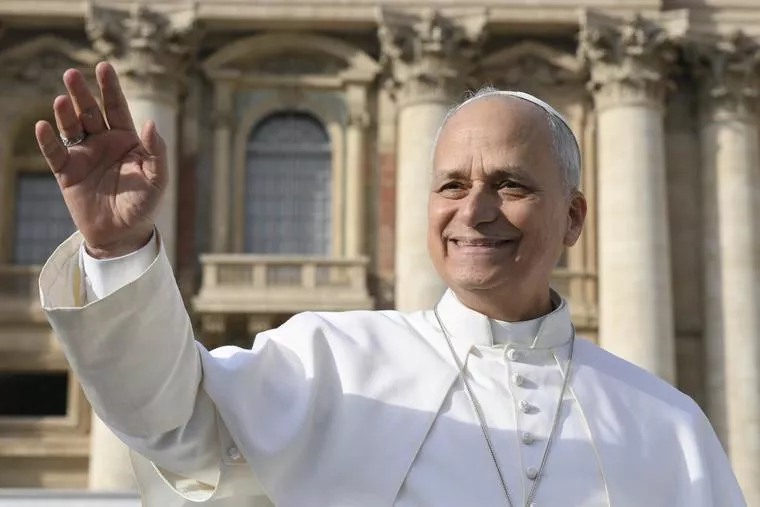
August 8th marked three months since Pope Leo XIV first appeared on the central balcony of the Vatican basilica after being elected the successor of St. Peter.
In that first urbi et orbi message, delivered on May 8, the Holy Father expressed the words that would mark the beginning of his pontificate: “I am an Augustinian, a son of St. Augustine, who once said, ‘With you I am a Christian, and for you I am a bishop.’ In this sense, all of us can journey together toward the homeland that God has prepared for us.”
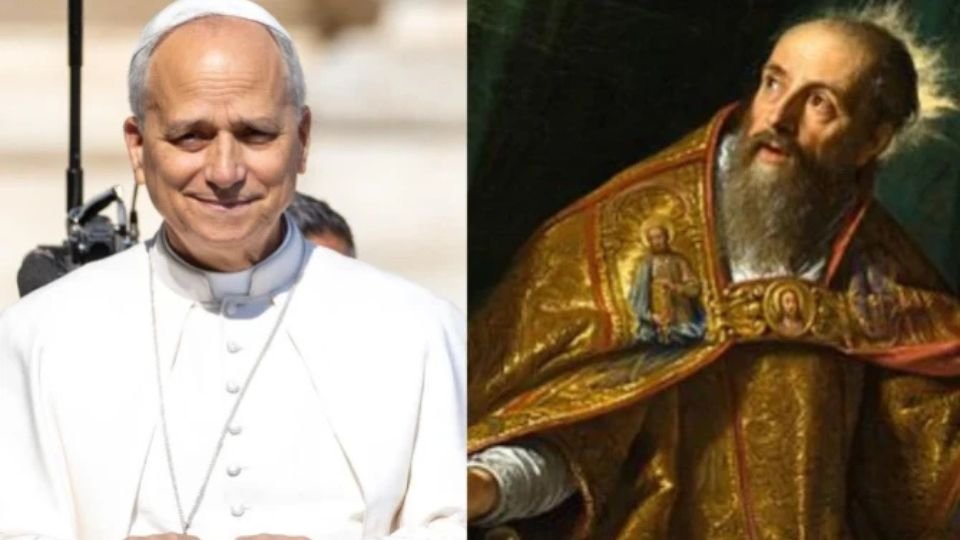
Over the last three months, Pope Leo has cited his spiritual father, St. Augustine, on multiple occasions, establishing a pastoral approach deeply rooted in the Augustinian tradition.
In messages about artificial intelligence and in speeches addressed to young people or pilgrims, Pope Leo XIV has taken every opportunity — through his speeches, audiences, and homilies — to offer valuable teachings inspired by St. Augustine of Hippo.
In most of his discourses, he has quoted one of the saint’s best-known works: “Confessions.” He did so in his homily during the Mass for the inauguration of his Petrine ministry, celebrated on May 18. He has also referred to other fundamental works by the bishop of Hippo, such as the “Commentary on the Psalms” and “The City of God.”
Unity in Christ
One of the recurring themes in Pope Leo XIV’s teaching during these first months has been the importance of unity in Christ. It is no coincidence that the Holy Father chose the motto “In Illo uno unum” (“In the One — that is Christ — we are one”), taken from St. Augustine, for his episcopal ministry.
During an audience with ecumenical delegations, the pope recalled that unity “has always been a constant concern of mine, as witnessed by the motto I chose for my episcopal ministry.”
“Our communion is realized to the extent that we meet in the Lord Jesus. The more faithful and obedient we are to him, the more united we are among ourselves. We Christians, then, are all called to pray and work together to reach this goal, step by step, which is and remains the work of the Holy Spirit,” the pope said on that occasion.
He has also made this call to unity in other contexts, such as in his message to the Pontifical Mission Societies, in which he recalled that “it is in the Trinity that all things find their unity. This dimension of our Christian life and mission is close to my heart,” noting that “Christ is our savior and in him we are one, a family of God, beyond the rich variety of our languages, cultures, and experiences.”
The heavenly homeland
“You have made us for yourself, [Lord], and our hearts are restless until they find rest in you” (“Confessions,” 1,1.1). This famous quote, which summarizes the core of Augustinian spirituality, has been cited by the Holy Father on more than one occasion, such as in his message to the International Federation of Catholic Universities.
Pope Leo XIV thus reminds us that human beings were created for God and that only in him can we find complete happiness.
In his message for the World Day of Migrants and Refugees, he emphasized the “pilgrim dimension” of the Church, “perpetually journeying toward her final homeland, sustained by a hope that is a theological virtue.”
He warned that “each time the Church gives in to the temptation of ‘sedentarization’ and ceases to be a ‘civitas peregrine,’ God’s people journeying toward the heavenly homeland (cf. Augustine, ‘De Civitate Dei,’ Books XIV-XVI), she ceases to be ‘in the world’ and becomes ‘of the world’ (cf. Jn 15:19).”
Addressing young people participating in an event in Medjugorje, he recalled an idea of St. Augustine, who “does not speak about the house of the Lord as a distant destination but rather announces the joy of a journey experienced together, as a pilgrim people.”
A faith lived with humility and compassion
In light of the parable of the good Samaritan, Pope Leo XIV exhorted the faithful in a homily delivered on July 13 in Castel Gandolfo to look at our neighbor “with the eyes of the heart.”
Quoting St. Augustine, he emphasized that “Jesus wanted to be known as our neighbor. Indeed, the Lord Jesus Christ makes us realize that he is the one who cared for the half-dead man beaten by robbers and left on the side of the road (‘De Doctrina Christiana,’ I, 30.33).”
In a June video message addressed to the youth of Chicago and the whole world, the Holy Father recalled that the saint of Hippo taught that “if we want the world to be a better place, we have to begin with ourselves, we have to begin with our own lives, our own hearts.”
Also, during the June 25 general audience, he recalled the words of St. Augustine in his work “Sermones,” in which he stated that “the crowd jostles, faith touches.”
“Every time we perform an act of faith addressed to Jesus, contact is established with him, and immediately his grace comes out from him. At times we are unaware of it, but in a secret and real way, grace reaches us and gradually transforms our life from within,” the Holy Father said.
SIGN UP FOR OUR NEWSLETTER HERE
This story was first published by ACI Prensa, CNA’s Spanish-language news partner. It has been translated and adapted by CNA.