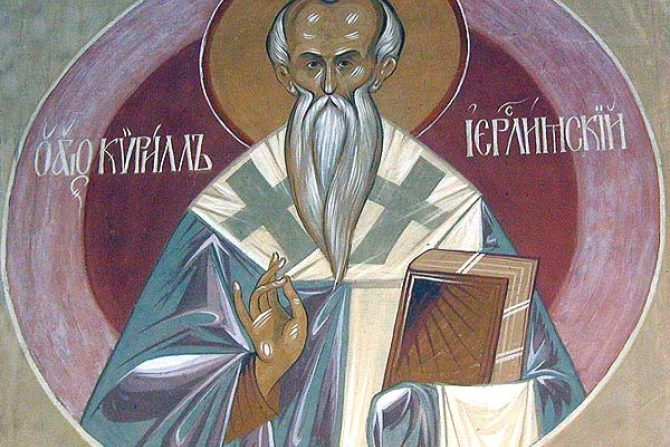
On March 18, the Catholic Church honors St. Cyril of Jerusalem, a fourth-century bishop and doctor of the Church whose writings are still regarded as masterful expressions of the Christian faith.
St. Cyril is also remembered for his exhaustive biblical knowledge and his endurance in the face of misunderstanding and opposition. Eastern Catholics and Eastern Orthodox Christians, who likewise celebrate him as a saint on March 18, also remember him on May 7 — the date of a miraculous apparition said to have occurred soon after his consecration as a bishop.
Cyril was most likely born in Jerusalem around the year 315, shortly after the legalization of Christianity throughout the Roman Empire.
Although that legalization put a stop to many of the persecutions that threatened the Church for two centuries, it indirectly gave rise to a number of internal controversies — both in regard to theology and to the jurisdiction of bishops — in which Cyril would find himself involved.
Cyril received an excellent education in classical Greek literature as well as in the Bible. He was ordained to the priesthood by Bishop Maximus of Jerusalem and succeeded him as bishop in 348.
During his early years as a bishop, most likely around 350, he delivered a series of lectures to new initiates of the Catholic Church. Twenty-four of the lectures have survived and are studied today.
In a 2007 general audience, Pope Benedict XVI praised the saint for providing an “integral” form of Christian instruction “involving body, soul, and spirit.” St. Cyril’s teaching, the pope said, “remains emblematic for the catechetical formation of Christians today.”
In 351, three years after Cyril became the bishop of Jerusalem, a large cross-shaped light appeared for several hours in the sky over the city — an event that many interpreted as a sign of the Church’s triumph over heresy. It could also, however, be understood as a sign of the suffering the new bishop would undergo in leading his flock.
Unlike many other Eastern bishops and priests of the fourth century, Cyril did not allow his classical learning to lead him away from believing in the full humanity and divinity of Christ.
However, the man who consecrated Cyril as a bishop, Archbishop Acacius of Caesarea, was an ally of the Arians, who claimed that Jesus was a creature and not God. Because of his connection to the archbishop, Cyril himself was unjustly suspected of heresy by many of his brother bishops.
But he also found himself at odds with Acacius, who claimed to have jurisdiction over the birthplace of the Church. Altogether, these disputes led to Cyril being exiled from Jerusalem three times in the course of 20 years, with his longest exile lasting more than a decade.
Eventually, however, the Eastern bishops came to acknowledge Cyril’s orthodoxy and legitimacy as a bishop — both of which they confirmed in a letter to the pope in Rome, in which they also expressed their admiration of his pastoral efforts.
In 381, St. Cyril participated in the Second Ecumenical Council, which condemned two different forms of Arianism and added statements about the Holy Spirit to the Nicene Creed of 325.
St. Cyril of Jerusalem died in 387 and was named a doctor of the Church by Pope Leo XIII in 1883.
This CNA story was first published in March 2011 and has been updated.