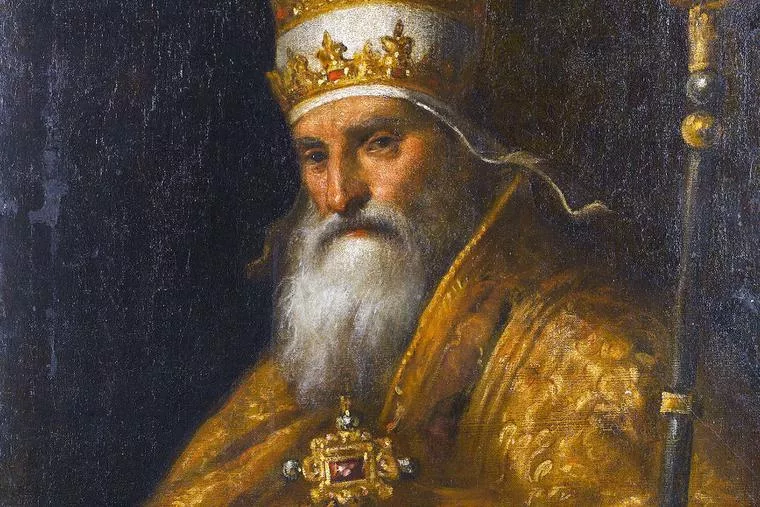
Michele Ghislieri, later St. Pius V, was born in Bosco, northern Italy, in 1504 and ordained a Dominican priest in 1528. Recognizing his holiness and learning, his community elected him prior four times.
During Pius’ lifetime, the Protestant ideas of Luther and Calvin were dissolving Catholic unity throughout Europe. In 1542, Pope Paul IV reorganized the Roman Inquisition to combat them and named Pius an inquisitor. In 1555, the newly elected Pope Pius IV made Pius bishop and later cardinal of Nepi and Sutri, a diocese near Rome, and general inquisitor of all Christendom (with authority over all other inquisitors).
Throughout his life, Pius devoted much time to prayer and practiced severe personal penances. He disliked public life and involvement in the governance of the Church, preferring the peace of the cloister, but relented when he saw that it was God’s will for his life. As a sign of his humility, as a cardinal and pope, Pius continued to wear the simple, white habit of the Dominican order, which began the tradition of popes wearing white.
He became Pope Pius V in 1566 through the influence of St. Charles Borromeo, cardinal of Milan, whose uncle was Pius IV. As pope, he was stern and rigorous in the enforcement of laws and morality. For the next six years of his pontificate, he undertook dramatic reforms, which remained dominant in the Church through Vatican II.
From the outset, Pius V was determined to rid the Church of the abuses and corruption and implement the decrees of the Council of Trent. He urged his cardinals to shun luxury and ambition and to lead exemplary Christian lives. He ordered bishops living in Rome to return to their dioceses and to fast and pray to end the heresies unleashed by the Protestant revolt.
When Emperor Maximilian joined with some cardinals in asking Pius V to end the requirement of celibacy for priests (the era had its own vocations crisis), he steadfastly refused. He also insisted that clergy wear clerical dress and religious habits as outward signs of their vocation.
During Pius V’s reign, the Catechism of the Council of Trent was completed, a new breviary was published, and sacred music was reformed. (Palestrina became choirmaster of the papal chapel.) Pius declared his fellow Dominican, St. Thomas Aquinas, a doctor of the Church and made St. Thomas’ Summa Theologica mandatory study at seminaries.
Despite frequent shortages in the papal treasury, Pius refused to take financial gifts for special dispensations (which had been commonplace with some predecessors). Once, when a bishop proposed a scheme to improve the Church’s finances, Pius refused, remarking: “Christianity can get along well enough with prayer and exemplary lives, and has no need of treasure.”
As a temporal ruler, Pius battled the crime and loose morals prevalent in Rome. He was often severe, frequently resorting to the use of corporal and capital punishment. For example, when a handful of unruly citizens knocked down a statue of Pope Paul IV (two popes before Pius V), and rolled it into the Tiber River, a horrified Pius ordered their execution.
Pius was greatly aided in renewing the spiritual life of Rome’s citizenry through the work of St. Philip Neri and other holy priests and religious.
While he had critics, Pius had many defenders as well. For example, the Spanish ambassador to Rome declared: “Rarely indeed in a pope has the monarch so given place to the priest. One thing only he has at heart, the salvation of souls. This is what determines his entire policy; on this he bases every service and reckons the value of every institution and act.”
Cardinal John Henry Newman would later write: “I do not deny that St. Pius V was stern and severe, as far as a heart burning and melted with divine love could be so … yet such energy and vigor as his were necessary for the times. He was a soldier of Christ in a time of insurrection and rebellion, when, in a spiritual sense, martial law was proclaimed.”
Pius V’s greatest challenge, however, came at the end of his pontificate. For centuries, Muslim Turks had threatened to conquer Christian Europe. In Pius’ time, the Turkish dominated the Mediterranean, plundering Christian towns and villages and slaughtering their inhabitants. Mahomet II boasted to the world he would soon top St. Peter’s dome with the Crescent Moon and wind the pope’s head in a turban.
Pius persuaded the European powers to lay aside their rivalries and join in a holy alliance against the Turks. As he prayed and fasted, the badly outnumbered Christian forces engaged the Turks at Lepanto. In one of the most remarkable naval victories in world history, the Turks were routed and Christendom saved.
The day of the victory — Oct. 7, 1571 — the pope was meeting in Rome with his advisers when he suddenly stopped, gazed out a window to the East, and wept for joy as he declared: “The Christian fleet is victorious!” Two weeks later, official word came to Rome that Pius was right. Muslim armies would never again threaten Europe.
Pius attributed the victory to the intercession of Our Lady, Queen of the Most Holy Rosary, and declared Oct. 7 a feast day in her honor. He died seven months later and was canonized in 1712.
Pius V is remembered in the liturgy on April 30.
This article was first published by the National Catholic Register, CNA’s sister news partner, and is reprinted here on CNA with permission.
This article was originally published on Catholic News Agency.