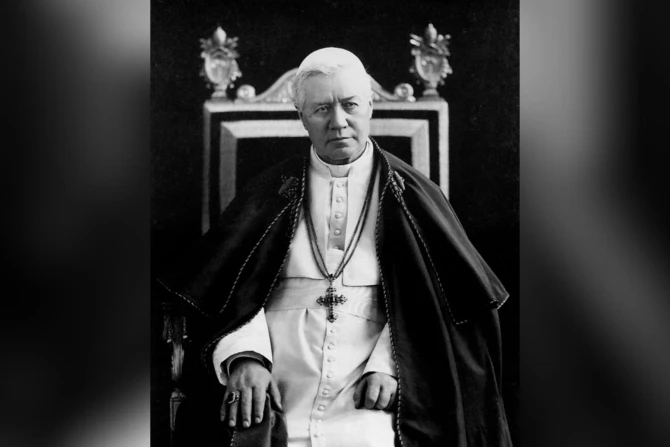
The Catholic Church celebrated the feast of St. Pius X on Aug. 21 — an influential pope at the turn of the 20th century whose warnings about the heresy of “modernism” help shine light on the deterioration of faith in the West today and the disregard of Church teaching, according to one Catholic scholar.
SIGN UP FOR OUR NEWSLETTER HERE
Pius, who reigned as pope from 1903 to 1914 after the death of Pope Leo XIII, took charge of the Church in the aftermath of the Enlightenment era, which had spurred rationalist and liberal movements throughout Europe and the Americas.
Several of Pius’ predecessors combatted certain Enlightenment-era philosophies, which appeared to be a predominantly outside threat to the Church. This included Pope Gregory XVI’s rebuke of liberalism in the 1830s — which he saw as promoting religious indifferentism and secularism — and Blessed Pius IX, who condemned trends toward naturalism and absolute rationalism, which sought answers to philosophical questions absent divine revelation.
Pius X followed in their footsteps, combatting the heresy of “modernism” in his 1907 encyclical Pascendi Dominici Gregis. This heresy, he taught, was the pervasion of “false philosophy” within the Catholic laity and clergy, even within the Catholic university system and the seminaries that threatens the foundations of the faith itself.
“The danger is present almost in the very veins and heart of the Church, whose injury is the more certain, the more intimate is their knowledge of her,” Pius wrote. “Moreover they lay the axe not to the branches and shoots but to the very root; that is, to the faith and its deepest fires.”
Modernism, Pius explained, is essentially a form of agnosticism within the Church, which views human reasoning as confined to “things that are perceptible to the senses.” With agnosticism as their foundation, modernists see human reason as “incapable of lifting itself up to God, and of recognizing his existence, even by means of visible things.”
“It is inferred that God can never be the direct object of science and that, as regards history, he must not be considered as an historical subject,” the Holy Father wrote.
Because modernists hold that God cannot be understood through reason, Pius explained, the heresy reduces one’s relationship with God to an “experience of the individual.” A belief in God, the modernists believe, is rooted in “a kind of intuition of the heart, which puts man in immediate contact with the very reality of God.”
Pius continued to say this position can be used to justify any religion. He wrote: “Modernists do not deny but actually admit, some confusedly, others in the most open manner, that all religions are true.”
Pius called modernism “the synthesis of all heresies” because when one applies this foundation to all facets of the faith — such as the divinity of Christ, miracles, tradition, and Scripture itself — the modernists promote an ever-evolving understanding of dogma “that ruins and destroys all religion.”
“[Modernists believe] dogma is not only able, but ought to evolve and to be changed,” the Holy Father explained. “This is strongly affirmed by the Modernists, and as clearly flows from their principles.”
Ron Bolster, the dean of philosophy and theology at Franciscan University, told CNA that the concern about modernism is primarily rooted in its belief that “you cannot know the things of God” and that “all we can do is look toward our internal religious experience.”
“If you have a religious person convinced by a modernist that you can’t really know these things, it leads to a kind of despair,” he said.
“When people are convinced by that or too lazy to sort it out, they abandon the practice of the faith and they no longer have access to the means of salvation that God made available to them,” Bolster warned.
Modernism’s impact on modern society
Bolster said he believes there is “a very clear connection” between Pius X’s warnings against modernism in the Church and the subsequent decline in religiosity in the Western world, along with the large number of Catholics openly dissenting from Church teaching.
A Pew Research Center survey in January 2024 found that the largest religious category in the United States is the “nones,” which is no religion in particular. These individuals make up about 28% of the American population, but only 17% of people in that category identify as atheist. The majority of the category, 63%, identify as “nothing in particular” and the other 20% are agnostic.
The modernist impact on Catholicism itself is also clear. A 2025 Pew survey found that only about two-thirds of Catholics are certain that God exists. About 86% believe heaven exists, but just 69% believe in hell. A majority of Catholics support legal abortion and homosexual civil marriages.
A 2024 EWTN/RealClear poll found that about 52% of Catholics believe in the real presence of Christ in the Eucharist, while 32% do not and 16% are unsure. Among Catholics, the strongest dissent from teaching appears to consistently be the issue of contraception, with a 2024 survey showing that 90% have used condoms and 60% have used hormonal birth control.
Bolster said the Catholic dissent on contraception, which occurred about 60 years after Pius X published the encyclical, “was the first time that there was kind of a precedent-setting public dissent against Church teaching.”
“That was really your turning point where you see for the first time [a large number of Catholics] publicly dissenting from … Church teaching,” he said.
Bolster noted that “calling into question the teaching of the Church because [of the belief that] we cannot know [the truth]” is a major symptom of modernist trends.
When speaking about Pius X’s warnings about modernism, Bolster said “the language of that document is astoundingly strong” and the pope is “not pulling any punches and the threat is real and the solutions are heavy-handed.”
At the time of the encyclical, Pius X called for ousting clergymen who promote modernism and censoring the promotion of those beliefs, along with establishing diocesan watch committees to find promoters of the heresy.
Pius X also called for a resurgence of the teaching of Scholastic philosophy, for which he said modernists only have “ridicule and contempt.” Many scholastics, such as St. Thomas Aquinas, taught that people can learn about and understand God through the use of reason.
The encyclical also notes that the First Vatican Council anathematizes any person who states that God “cannot be known with certainty by the natural light of human reason by means of the things that are made.”
Bolster noted that Aquinas and other Scholastics point out that Greek pagans like Aristotle and Plato “reasoned to the existence of God” and understood certain limited truths about God that they could gather without specific revelation.
“We can know by natural reason that God exists, that he contains all perfections, that he’s all powerful, and that he’s limitless,” Bolster said.
In spite of the impact that modernism has had on society, Bolster said Catholics should “remain positive.” He said the easy availability of the Catechism of the Catholic Church and “materials that are available for teaching the faith today … [are] reason to hope and reason to give credit to the bishops.”
“We have to get back — double down on the teachings of the Church,” he said.
This article was originally published by CNA.