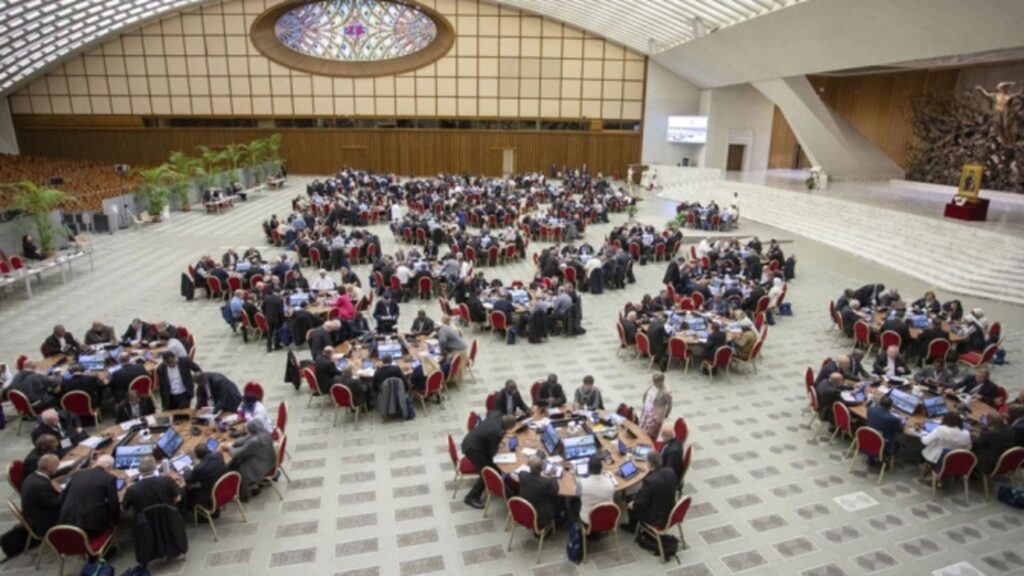
A Vatican synod study group’s final report includes testimony from two men in civil marriages with other men and calls for a listening-based approach to difficult doctrinal and pastoral questions.
The Vatican’s General Secretariat of the Synod published Tuesday the testimonies of two men in civil marriages with other men who describe from personal experience the tensions and wounds that have marked their life of faith within the Church.
It is the first time a Vatican text has given voice to this group in such detail. One testimony is from a man in Portugal who said he suffered a deep wound when a spiritual director suggested he could have been married to a woman to “find peace” and “use my gifts,” minimizing the affective dimension of marriage.
The man said the suggestion was painful because “it was a suggestion to harm a woman by robbing her of the chance to be completely loved and desired, all to fulfill a social expectation.” From that point, he said, he began excluding his relationship and affective life from his prayer.
The Synod also published the testimony of a U.S. Catholic man in a civil marriage with another man, an immigrant, and active in parish life. “My sexuality isn’t a perversion, disorder, or cross; it’s a gift from God,” he wrote. “I have a happy, healthy marriage and am flourishing as an openly gay Catholic.”
Both testimonies are written in English and are published on the Synod website as annexes to the final report of Study Group 9, titled “Theological Criteria and Synodal Methodologies for Shared Discernment of Emerging Doctrinal, Pastoral, and Ethical Issues.”
One of the testimonies recalls the author’s experience with Courage, a Catholic apostolate that supports people with same-sex attraction who seek to live chastely according to Church teaching. Pope Leo XIV received members of Courage at the Vatican on Feb. 6.
The man wrote that he went to the group at the suggestion of a therapist he had met to deal with his “condition.” He added: “I tried in vain to date a Catholic woman, but our relationship failed when my family faced a crisis. The time had come to be honest with myself, God, and others.”
What the Catholic Church teaches about homosexuality
Catholic teaching on homosexuality is summarized in three articles of the Catechism of the Catholic Church: Nos. 2357, 2358, and 2359.
In these articles, the Church teaches that homosexual persons “must be accepted with respect, compassion, and sensitivity. Every sign of unjust discrimination in their regard should be avoided.”
Homosexuality as a tendency is “intrinsically disordered” and “constitutes for most of them [homosexuals] a trial.”
Grounded in Scripture, tradition has always taught that “homosexual acts are intrinsically disordered” and “do not proceed from a genuine affective and sexual complementarity” and therefore “under no circumstances can they be approved.”
“Homosexual persons are called to chastity,” and through “the support of disinterested friendship, by prayer and sacramental grace, they can and should gradually and resolutely approach Christian perfection.”
Presented to Pope Leo for study
The 32-page report, published first in Italian and presented in English as a working translation, is not a definitive doctrinal proposal. Rather, it outlines a methodological shift and will now be presented to Pope Leo XIV for study.
Drawing from the testimonies, the Synod study group says the first account describes “the devastating effects of reparative therapies aimed at recovering heterosexuality” and “contradictory advice” such as suggestions to marry a woman in order to “find peace.”
The report proposes a new approach based on listening and dialogue for addressing “emerging doctrinal, pastoral, and ethical issues,” including the experience of “people of faith with same-sex attractions.”
The text is rooted in what it calls the “principle of pastorality,” which stresses that Christian proclamation must take into account concrete persons and their lived experience. It proposes a change in approach to some of the most delicate questions in the life of the Church.
The report does not seek to offer total solutions but to open a path of discernment. Instead of speaking of “controversial” issues, as the subject of the report was originally announced, it proposes calling them “emerging” issues, understood as experiences that prompt the Church to rethink how to live and transmit the Gospel in diverse contexts.
The document explicitly recognizes the difficulty of harmonizing doctrine and pastoral practice. It says testimonies received by the study group show “how arduous it is for individuals and Christian communities to reconcile ‘doctrinal firmness’ with ‘pastoral welcome.’” It adds that polarized positions often result in “profound suffering, personal lacerations, and experiences of marginalization or ‘double lives’” for believers with same-sex attraction.
In this context, the report proposes a method based on three steps within what it calls “conversation in the Spirit”: listening to ourselves, paying attention to reality, and summoning various forms of expertise.
The text says this dynamic of listening seeks to foster a synodal Church in which the people of God actively participate in discernment.
The report also stresses the importance of paying attention to those living on existential, social, and cultural “peripheries.” It cites other examples of “emerging issues,” including the rise of adult catechumens in some local Churches, which it says calls for rethinking pastoral structures.
In addition to the testimonies of two homosexual persons, Study Group 9 includes an experience of active nonviolence, as witnessed by a Serbian youth movement that helped bring about the peaceful fall of President Slobodan Milošević on Oct. 5, 2000, drawing inspiration in part from the first Christians.
The Synod also published the final report of another study group, Study Group 7, on criteria for selecting candidates for bishop.
That report says bishops should be evaluated not only for moral integrity, doctrinal orthodoxy, pastoral sensitivity, leadership ability, and capacity to administer Church goods but also for “synodal competencies.” It quotes Pope Leo XIV as saying that a bishop’s duty is “to build communion among its members and with the universal Church by fostering the variety of gifts and ministries given for its own growth and for the spread of the Gospel.”
The report also asks the dicasteries of the Roman Curia to review their procedures in a more synodal spirit and proposes regular independent evaluation of the processes for selecting bishops.
This story was updated at 5:56 p.m. ET on May 6, 2026, to include the teachings of the Catechism of the Catholic Church regarding homosexuality and homosexual tendencies.
This story was first published by ACI Prensa, the Spanish-language sister service of EWTN News. It has been translated and adapted by EWTN News English.