Like all popes since the Second Vatican Council, Pope Francis made a point of reaching out to non-Catholics, building bridges and engaging in dialogue. His consistent efforts toward Christian unity over his 12-year pontificate produced several historic moments in ecumenical relations.
While his interreligious achievements — like the 2019 Abu Dhabi declaration on human fraternity, signed by Pope Francis and the grand imam of Al-Azhar, Ahmed Al-Tayeb — have often garnered greater attention, the pope’s ecumenical initiatives with other Christian communities have also left a meaningful mark on his legacy.
SIGN UP FOR OUR NEWSLETTER HERE
First pope to meet head of Russian Orthodox Church
During his 12-year pontificate, Francis took important, even historical, ecumenical initiatives. In 2016, he became the first pope ever to meet the head of the Russian Orthodox Church.
Early on, in November 2014, the pope had already told Moscow Patriarch Kirill: “I’ll go wherever you want. You call me and I’ll go.” The meeting eventually took place, after months of secret planning, on Feb. 12, 2016, at José Martí International Airport near Havana, Cuba. The public was only notified a week in advance.
The meeting lasted roughly two hours, after which a joint declaration was signed and gifts were exchanged. The joint declaration focused on anti-Christian persecution, especially in the Middle East and North Africa.
It also lamented the hostilities in Ukraine, which were already underway for several years, although the full Russian invasion would not take place until 2022. In addition, the text voiced concern about the threat of secularism to religious freedom and the Christian roots of Europe.
Other topics of discussion included poverty, the crisis in the family, abortion, and euthanasia. Together, the pope and the patriarch exhorted young Christians to live their faith in the world.
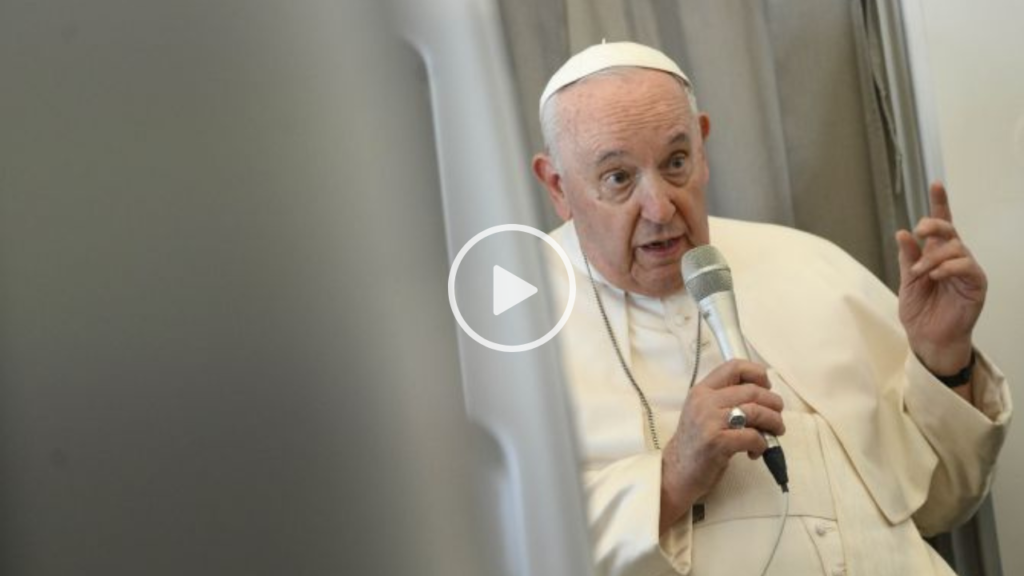
In a brief speech after signing the declaration, Pope Francis said: “We speak as brothers, we have the same baptism, we are bishops. We speak of our churches, and we agree that unity is achieved by walking forward. We speak clearly, without ambiguity, and I must say I felt the presence of the Holy Spirit in our conversation.”
Finally, the pope expressed his wish that “all this” may be “for the glory of God the Father, the Son, and the Holy Spirit, for the good of the whole faithful people of God, under the mantle of the holy Mother of God.”
In the following years, another meeting with Patriarch Kirill was planned but never became a reality after Russia launched a full-scale invasion of Ukraine in February 2022. Kirill explicitly and outspokenly sided with Russian President Vladimir Putin in justifying the invasion.
On March 16, 2022, just weeks after the start of the war in Ukraine, the pope and the patriarch spoke via video call. “The conversation centered on the war in Ukraine and the role of Christians and their pastors in doing everything to ensure that peace prevails,” the Vatican press office said at the time.
The Vatican noted that the pope thanked Patriarch Kirill for the meeting and agreed with him that “the Church must not use the language of politics but the language of Jesus.”
“We are shepherds of the same holy people who believe in God, in the Holy Trinity, in the holy Mother of God: that is why we must unite in the effort to help peace, to help those who suffer, to seek ways of peace, to stop the shooting,” the press office quoted Pope Francis as saying.
In April 2022, the pope told Argentine newspaper La Nación that “the Vatican has had to cancel a second meeting with Patriarch Kirill.”
At the time, Francis said his relationship with Kirill was “very good,” but “our diplomacy understood that a meeting of the two of us at this time could cause a lot of confusion.”
Lutheran dialogue
Another important ecumenical initiative of Pope Francis was his trip to Sweden on Oct. 31 and Nov. 1, 2016, to commemorate the 500th anniversary of the Protestant revolt, which began in Germany with Martin Luther but also swept through Sweden.
“We remember this anniversary with a renewed spirit and in the recognition that Christian unity is a priority, because we realize that much more unites us than separates us,” Francis said at the time.
In a joint statement with the president of the Lutheran World Federation, Munib Yunan, the pope declared: “Fifty years of sustained and fruitful ecumenical dialogue between Catholics and Lutherans have helped us to overcome many differences and have deepened our mutual understanding and trust. At the same time, we have drawn closer to one another through joint service to our neighbors — often in circumstances of suffering and persecution.”
“Through dialogue and shared witness we are no longer strangers,” the statement added. “Rather, we have learned that what unites us is greater than what divides us.”
“By drawing close in faith to Christ, by praying together, by listening to one another, by living Christ’s love in our relationships, we, Catholics and Lutherans, open ourselves to the power of the Triune God,” Pope Francis and Yunan stated. “Rooted in Christ and witnessing to him, we renew our determination to be faithful heralds of God’s boundless love for all humanity.”
Building on work of predecessors
Most of Pope Francis’ ecumenical efforts consisted of continuing and building upon the work of his predecessors. Like them, he received many ecumenical delegations in the Vatican, took part in ecumenical gatherings, and sent special messages for certain occasions.
Theological breakthroughs uniting major groups of Christians to the Catholic Church were not made, although a study document titled “The Bishop of Rome: Primacy and Synodality in Ecumenical Dialogue and Responses to the Encyclical Ut Unum Sint” was published by the Dicastery for Promoting Christian Unity “with the agreement of His Holiness Pope Francis” in 2024.
The text was intended to outline the entire ecumenical debate on papal primacy and provide suggestions “for a ministry of unity in a reunited Church,” including “a differentiated exercise of the primacy of the bishop of Rome.”
This article by Martin Bürger was originally published on Catholic News Agency.