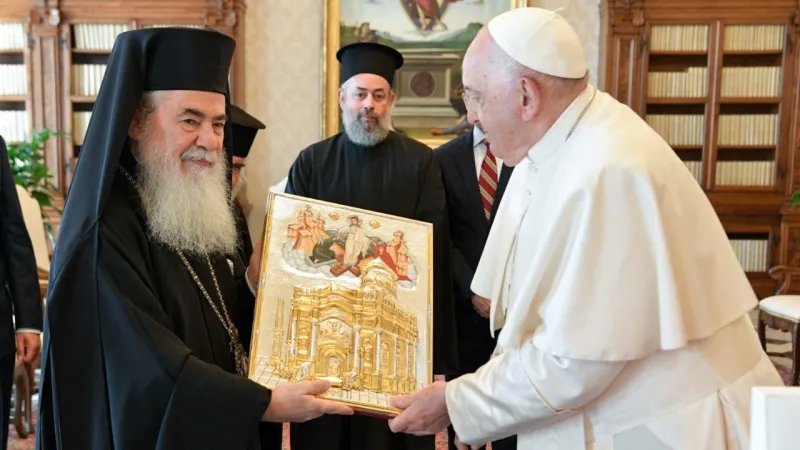
There was supposed to be a “meeting of primates” of the Orthodox in Amman in February 2020. It didn’t work out. Now, the Patriarch Theophilos of Jerusalem is proposing a new plan to address the war in Ukraine. A plan to “address the current conflict between Russia and Ukraine and the threat of a schism within the body of the Orthodox Church” has been outlined by the Greek Orthodox Patriarch Theophilos of Jerusalem, who also discussed the initiative with Pope Francis during a private audience on September 29th.
After what in the Orthodox world was called the “Amman fiasco,” that is, the meeting of all the Orthodox primates planned for February 2020, which became a fraternal meeting of a minority of primates, the Patriarchate of Jerusalem is now preparing a new solution.
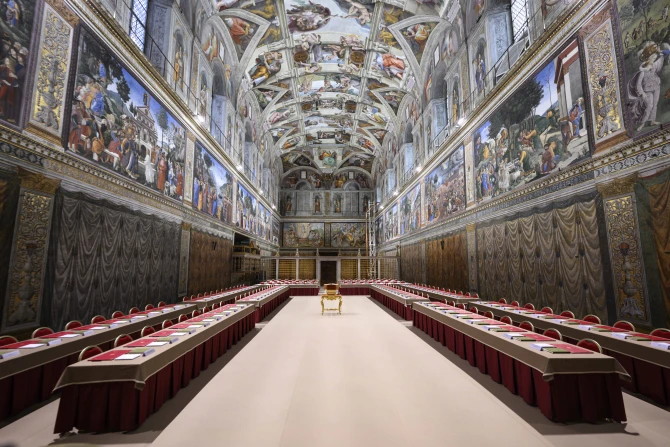
Theophilos III was in the Vatican on September 29th, arriving to participate in the Consistory on September 30th, during which His Beatitude Pierbattista Pizzaballa, Latin Patriarch of Jerusalem, was made a cardinal.
On this occasion, Theophilos III also delivered a speech, in which he emphasized the “profound challenges and difficulties” faced in the Holy Land because “while the majority of Jews, Christians, and Muslims” living there recognize the “multi-ethnic, multicultural, and multi-religious reality of the region,” in recent years “we have seen the growth of radical Israeli groups systematically working to undermine the legitimate status quo and reshape communal life,” leading to “hate crimes, illegal and under-the-table acquisition of historically Christian properties in strategic locations, vandalism and desecration of religious buildings and holy sites, and increasing pressure at various levels.”
Patriarch Theophilos praised the work of Patriarch Pizzaballa and appreciated the “continued support for a vital and vibrant presence in the Middle East,” and then highlighted that the Orthodox Patriarchate of Jerusalem, as the “mother of all Churches,” has “a special concern for the unity of Christians in general, and especially of the Orthodox Churches in the world,” and for this reason, “the current conflict in Russia and Ukraine and the threat of schism within the body of the Orthodox Church are subjects of deep concern not only for us Orthodox Christians but for the entire Christian world and for people of good will.”
In Ukraine, indeed, an Orthodox Church of Ukraine has been created, autocephalous, authorized by Patriarch Bartholomew and contested by Moscow, which until then had held Ukraine as its canonical territory. The war has only exacerbated the division, and in response, the Moscow Patriarchate has withdrawn its delegations from dialogue tables chaired or co-chaired by Constantinople.
Theophilos told Pope Francis that “over the centuries we have come to understand that dialogue is the only way to effective reconciliation and lasting peace,” and for this reason, “we extend the hand and effort of the Patriarchate of Jerusalem to our brothers and sisters in Ukraine and Russia, to mediate and do all we can to start a dialogue that can lead to an end to suffering and healing in the Orthodox family.”
It is not, the patriarch admitted, “an easy task” because “the divisions that have occurred over the decades are deep,” and “the wounds of the conflict will need time to heal,” while trust, “once broken, is difficult to restore.”
The Patriarchate of Jerusalem, Theophilos added, is “ready to understand it,” and “the journey in dialogue towards reconciliation is our spiritual mission, and it is what we desire for the Church and the people of Russia and Ukraine.”
As mentioned, Theophilos took a similar initiative in February 2020, a “meeting of primates,” which the majority of the hierarchs refused to attend. In the end, there were only Patriarch Kirill of Moscow, the now-deceased Patriarch of Serbia Irinej, and Metropolitan Rastislav of the Czech Republic, while the Orthodox Church of Romania sent Metropolitan Niphon of Targoviste. There was also Metropolitan Onufry, the head of the Orthodox Church of Ukraine, who sat to the right of the Patriarch of Moscow.
Theophilos’s initiative was not well-received in the Orthodox synaxis, also because such initiatives fall under the responsibility of the Ecumenical Patriarch of Constantinople, which had caused the decision not to participate in the meeting by the Churches of Greece, Cyprus, and Albania, as well as the Patriarchates of Georgia, Bulgaria, Alexandria, and Antioch.