In October, the Pontifical Gregorian University hosted a conference at the Casina Pio IV in the Vatican to discuss the role of artificial intelligence (AI) in society and its implications for the Church. The event brought together experts from various fields to address the ethical, educational, and evangelization challenges posed by AI, as well as the opportunities it presents.
The Church’s Ethical Framework for AI
“A.I. is such an emerging technology,” remarked Sean Graber, EWTN’s Chief Digital Officer. “It’s really changing almost week to week, and media companies are grappling, including us, with how to best leverage this technology.”
The Vatican conference emphasized the importance of grounding discussions on AI in ethics and morality. Alexis Houghey, Co-Founder of the Catholic Institute of Technology, noted, “The Church has a perspective on ethics, morality, things like that. It’s really grounded in something that’s real and true, and that’s the foundation for any real good discourse about technology.”
Aaron Dominguez, Provost of the Catholic University of America, highlighted the transformative potential of AI in education and research:“It’s a new, very powerful tool for both students and faculty to teach and also for research. At an educational level, it’s informing the landscape of this technology’s impact on the culture.”
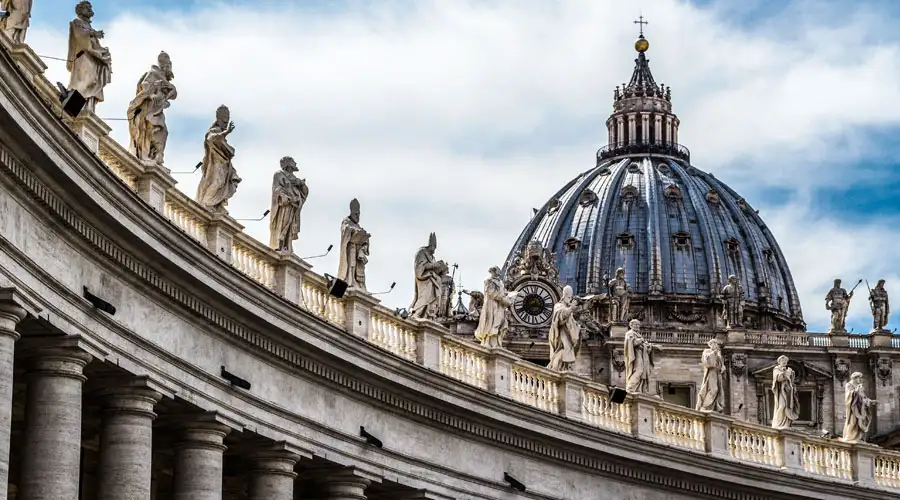
Hidden away, deep inside the Vatican Gardens, there is a beautiful old palazzo with a sophisticated meeting space. A perfect place to convene the brightest minds to discuss the scientific trends shaping tomorrow. For the conference on artificial intelligence, Matthew Sanders and Cardinal Turkson invited experts from a variety of fields to discuss the impact A.I. and other new technologies will have on the Church and society.
Matthew Sanders, Founder of Longbeard and Organizer of Builder Forum A.I., noted, “One thing that we’re really trying to encourage is, as a new generation of philosopher and theologian who understands emerging technology like A.I., its impact on the world, and how it should be effectively used and not used. What I’m hoping to do is create more of an active dialogue where we can figure out what are the pain points for Catholics right now, and how could AI and emerging technology help address those. I think that the Holy See in particular has surrounded itself with incredible advisors in A.I.”
AI’s Impact on Communication, Education, and Evangelization
The conference delved into three main areas where AI intersects with the Church: communication, education, and evangelization.
A.I. will change the way we communicate and provide information to a global audience.
“As the Church and as a news organization,” Sean Graber said, “we have a responsibility to go and share the good news, to share what’s going on in the Church, what’s going on in the Church around the world, and A.I. really can accelerate that. Now, they are also applications of A.I. that we can use that might not be positive.”
In the field of education, there is a growing concern that students will increasingly rely on A.I.-generated texts instead of writing their own essays.
Thonhauser asked Aaron Dominguez, “Do you see a lot of opportunity in this? Today, even at the conference there was a discussion, what about plagiarism? What about providing your own thought and not just artificial intelligence? How do you respond to that?”
“It’s certainly true and you have to change the way you think about pedagogy and education so that you’re not setting yourself up for failure or temptation so that people respond with that type of behavior,” Dominguez responded.
“How do you think it will impact the Church and also the teachings, not the teachings in its core, but to also bring the teachings out there into the world?” asked Thonhauser.
“There’s just again a whole new set of tools that we could use for evangelization,” Dominguez noted, “to use this as a resource for people to come in and ask questions and also for us to transmit the information with the new medium like we did with the printing press.”
Evangelization can also benefit from artificial intelligence but how ready is the Church for the abilities of this new technology?
“I think the church is ready,” Houghey emphasized, “but it certainly has a way to go before it’s where I would like to see it. I think we need more people who are both deeply technically trained in the sciences and technology, but who also have formal training in ethics, philosophy, and theology to give them that strong moral foundation.”
“You really also have to know what you’re talking about, right? That’s why it’s important to have a degree in technology or some other field,” noted Thonhauser.
“I think that’s one of the key challenges for the Church,” responded Houghey. “We want people who we see as peers. It’s not always easy. You know, any of the priests to walk into a room and be seen as someone other than ‘Oh, that priest wants to enforce his ideas,’ but when they see you as peers, I think it opens up a level of conversation.”
But there are not only positive aspects to this new technology. Some aspects of A.I. give reason for pause.
Sean Graber warned, “I think you have to be careful. You know, applying human judgment. A.I. can seemingly do really magical things, but at the end of the day, it’s really just feigning the kind of logic and understanding of the world that we as humans have as part of our minds and as part of our just humanity.”
Graber asked, “So how do we use this as Catholics? What are the ethical uses? How can this impact the future of work? These are all questions that need answers, and I think the Church has an opportunity to provide this kind of leadership on these questions, regardless of whether or not the Church itself is leveraging these tools, because we’re all struggling.”
Looking Ahead: AI and the Church
The new efficiency that A.I. technologies promise can not only help to reach more people with relevant Church teachings and inspire them in their faith; it can also be applied within the Church to carry out daily tasks more effectively.
It seems unclear how and when the Church will truly benefit from the new possibilities of technology. But experts agree that the Church needs to engage with these developments in order to do what she does best—advise and guide.
Adapted by Jacob Stein