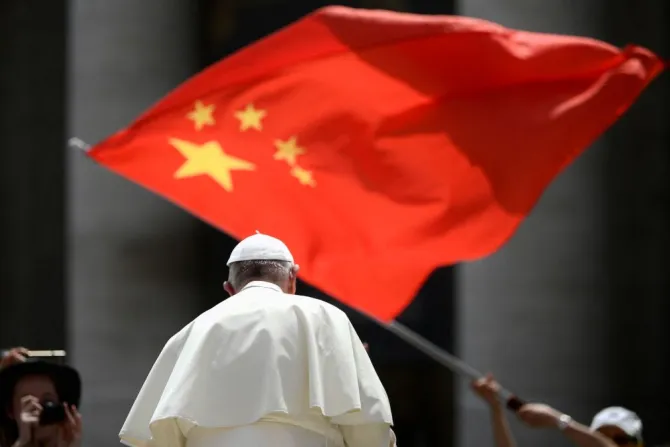
The Vatican announced Tuesday that it has renewed its agreement with China on the appointment of Catholic bishops for an additional four years.
The renewal comes days after a report from the Hudson Institute detailed how seven Catholic bishops in China have been detained without due process, while other bishops have experienced intense pressure, surveillance, and police investigations since the Sino-Vatican agreement was initially signed six years ago.
With the extension, the Sino-Vatican agreement will now remain in effect until Oct. 22, 2028.
The English translation of the official statement from the Holy See said that “the Vatican party remains dedicated to furthering the respectful and constructive dialogue with the Chinese party, in view of the further development of bilateral relations for the benefit of the Catholic Church in China and the Chinese people as a whole.”
The statement added that both sides agreed to extend the provisional agreement after “appropriate consultation and assessment.”
China’s foreign ministry spokesperson Lin Jian also confirmed the extension, saying that the two sides would maintain “contact and dialogue following a constructive spirit,” according to the Associated Press.
Originally signed in September 2018, the provisional agreement was previously renewed for a two-year period in 2020 and again in October 2022.
The terms of the agreement have not been made public, though Pope Francis has said it includes a joint commission between the Chinese government and the Vatican on the appointment of Catholic bishops, overseen by Vatican Secretary of State Cardinal Pietro Parolin.
The Vatican’s dialogue with China has not always been smooth. The Holy See has acknowledged that China violated the terms of the agreement by unilaterally appointing Catholic bishops in Shanghaiand the “diocese of Jiangxi,” a large diocese created by the Chinese government that is not recognized by the Vatican.
Pope Francis expressed satisfaction with the ongoing dialogue with China during a press conference in September. However, the Vatican’s foreign minister, Archbishop Paul Richard Gallagher, has been more cautious, calling the agreement “not the best deal possible” and noting ongoing efforts to improve its implementation.
Since 2018, “about 10 bishops” have been appointed and consecrated under the terms of the Sino-Vatican agreement, according to Vatican News.
A new coadjutor bishop of Beijing is expected to be installed this Friday in agreement with the Vatican, according to Asia News. The coadjutor bishop would be just five years younger than Beijing’s current Archbishop Joseph Li Shan, who is still more than a decade away from the typical retirement age for Catholic bishops.
In August, the Chinese government officially recognized 95-year-old Bishop Melchior Shi Hongzhen, a former underground bishop. The Vatican called this recognition a “positive fruit of the dialogue” with Beijing.
Human rights advocates have criticized the Vatican’s silence on China’s religious freedom violations during its negotiations, including the internment of Uyghur Muslims and the imprisonment of democracy advocates like Catholic Jimmy Lai in Hong Kong.
Chinese officials have reportedly ordered the removal of crosses from churches and have replaced images of Christ and the Virgin Mary with images of President Xi Jinping, according to a recent report from the United States Commission on International Religious Freedom (USCIRF).
USCIRF also reports that the Chinese Communist Party’s (CCP) “sinicization of religion” campaign has led to censored religious texts, forced clergy to preach CCP ideology, and required the display of CCP slogans in churches.
“While some Catholics choose to worship legally within the state-controlled Chinese Catholic Patriotic Association, they are certainly not free as they must comply with the CCP’s harsh mechanisms of control and interference,” USCIRF Commissioner Asif Mahmood told CNA earlier this month.
“Ultimately, the Chinese government is solely interested in instilling unwavering obedience and devotion to the CCP, its political agenda, and its vision for religion, not protecting the religious freedom rights of Catholics,” he said.
This article was originally published on Catholic News Agency.