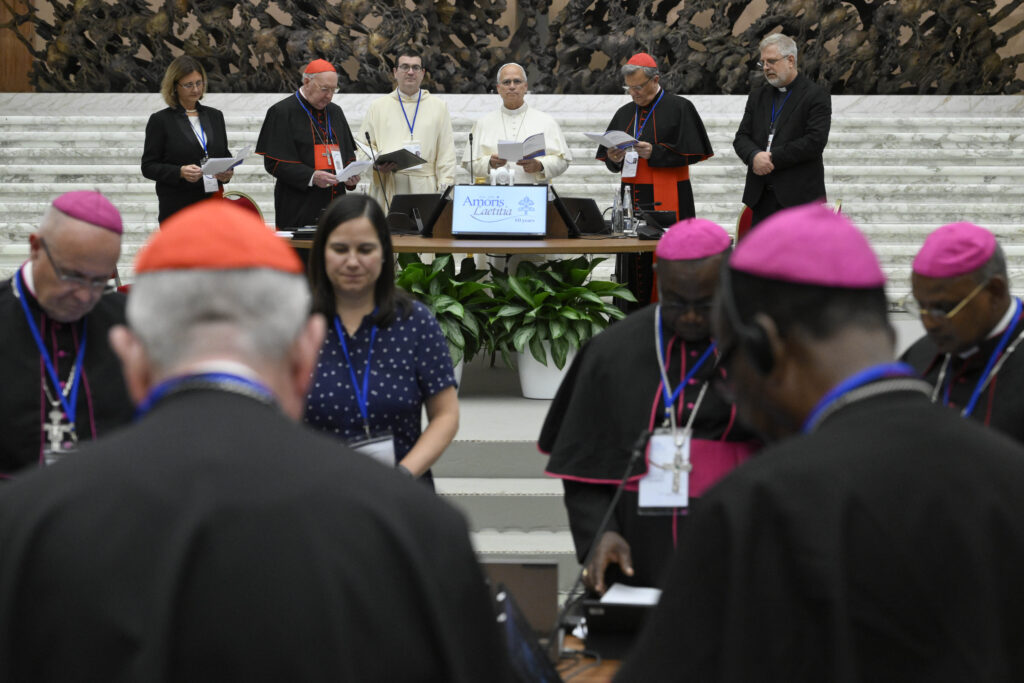
At a gathering marking the 10th anniversary of Amoris Laetitia, Church leaders point to changing attitudes toward sexuality, widespread divorce, and economic insecurity as obstacles to marriage.
VATICAN CITY — Why are fewer young people choosing to marry in the Catholic Church, and how does contemporary society understand the relationship between sexuality, procreation, and the sacrament of marriage?
Those are among the questions being addressed at an international gathering on the family at the Vatican, taking place behind closed doors through Oct. 14 with the participation of presidents of bishops’ conferences from around the world.
Archbishop Timothy Costelloe, president of the Australian Catholic Bishops’ Conference, said in his presentation Friday, Oct. 9, that in his country, and possibly many others, “the concept of a necessary link between sexual activity and procreation, and the importance of this in Christian marriage is no longer widely understood or accepted.”
To illustrate the problem, he cited the observations of a religious education director in Western Australia who is married and has teenage children.
“Many of our young people have inherited cultural assumptions about sexuality that differ substantially from those of the Church — they may understand the Church’s position, but they do not find it easy to embrace,” the educator told him.
Costelloe said this reflects a tension between Church teaching and prevailing cultural attitudes, reinforced by social media, entertainment, peer culture, and online influencers, which frequently promote relationships that prioritize “personal fulfillment, autonomy, and immediate happiness over permanence, sacrifice, and covenant.”
Moral failures of Church leaders
Compounding the problem, Costelloe said, many young people have experienced painful circumstances, including broken marriages in their own families, domestic violence, inequality between men and women, and the moral failures of Church leaders whose credibility has been damaged.
“We are competing with many other approaches to the meaning of marriage,” he acknowledged.
Despite these difficulties, the archbishop emphasized that many young people continue to seek lasting relationships that bring out their best qualities and provide a solid foundation for a meaningful future.
He called for supporting these aspirations and accompanying young people as they seek to build stable relationships.
At the same time, Costelloe observed, the prevalence of divorce and failed relationships has led many young people to question “whether lifelong commitment is possible or even desirable.”
In this context, he emphasized the importance of the example provided by stable marriages and families.
As one married couple told him: “The most persuasive argument for Christian marriage is often a married couple living it well.”
Costelloe suggested that parishes and dioceses should find ways to make such examples more visible, including through marriage preparation programs and Catholic schools.
He also advocated presenting the Churchʼs teaching on marital intimacy positively, as an ideal worth pursuing rather than merely a set of rules and prohibitions.
Understanding why young people reject marriage
Cardinal Kevin Farrell, prefect of the Dicastery for the Laity, the Family, and Life, warned participants that marriage rates are declining worldwide, both for civil marriages and those celebrated in the Church.
“We cannot ignore the fact that the number of marriages is currently declining throughout the world, both civil marriages and marriages celebrated in the Church,” he said. “We will seek to interpret this phenomenon, taking into account whether its causes are the same everywhere.”
The gathering marks the 10th anniversary of Amoris Laetitia, the apostolic exhortation published by Pope Francis in 2016 following two synods marked by intense debate over the Churchʼs pastoral approach to families.
The documentʼs proposals for accompanying newlyweds and couples experiencing marital difficulties were partly overshadowed by controversy over its implications for divorced and civilly remarried Catholics.
Bishops from the Buenos Aires pastoral region interpreted the document as permitting some divorced and civilly remarried Catholics to receive the sacraments of reconciliation and the Eucharist following a process of accompanied pastoral discernment, including in circumstances in which a person believes that abstaining from sexual relations would cause further harm to children of the new union.
In 2023, the Dicastery for the Doctrine of the Faith confirmed that this interpretation forms part of the authentic magisterium, having been published in the Acta Apostolicae Sedis, the Holy Seeʼs official record.
Farrell noted that priests are not alone in worrying about young peopleʼs reluctance to marry. Many Christian parents share that concern as they watch their children struggle with loneliness and uncertainty about lifelong commitments.
“Pastors are not alone in facing this concern. It is felt first and foremost by the many Christian parents whose children suffer from loneliness, remain hesitant to make a lasting commitment, or categorically reject the path that their parents themselves had embraced with joy,” he said.
Among the factors contributing to this trend, Farrell cited divorce, different forms of cohabitation, and prevailing cultural attitudes.
“But at a deeper level, we might ask whether God has perhaps ceased to speak to the hearts of young people, stirring in them a desire for marriage,” he said.
The cardinal said participants would look for signs of hope and consider initiatives, individuals, and circumstances that could open new paths toward marriage.
“We will also consider how attentive our communities are to the witness of those who, despite everything, choose marriage — whether early in life or later on — and how their experience can help us understand and present the vocation to marriage more effectively.”
What are young people seeking when they speak of love?
Auxiliary Bishop Stephen Fernandes of Bombay, India, argued that the Churchʼs central challenge is not simply to ask why young people are reluctant to marry but to understand what they are seeking in relationships.
“The challenge before the Church, therefore, is not to begin by asking why young people are failing to accept marriage, but rather what are they seeking when they speak about love, freedom, dignity, and their future,” he said.
Fernandes explained that young people experience relationships in a cultural environment very different from that of previous generations.
“The culture of immediacy and continual choice can enter their experience of intimacy, while marriage requires patience, presence, forgiveness, and perseverance,” he observed.
He also pointed to economic insecurity as a significant obstacle to marriage, citing employment difficulties, housing costs, migration, and social instability.
“For some, therefore, postponing marriage is not simply a rejection of marriage. It can reflect a crisis of confidence in the possibility of building a stable and enduring life with another person,” he said.
Fernandes stressed that many young people have not abandoned the desire for lasting love, even if they increasingly doubt that it is attainable.
“Young people have not ceased to thirst for love. What has weakened for many is confidence that love can endure,” he said.
He urged the Church to listen more carefully to young peopleʼs experiences and to present marriage not simply as an obligation or social institution but as a vocation grounded in freedom, fidelity, and mutual self-giving.
This story was first published by ACI Prensa, the Spanish-language sister service of EWTN News. It has been translated and adapted by EWTN News English.