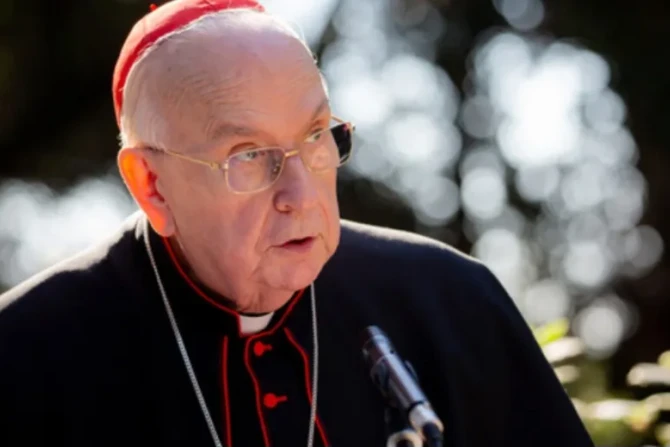
The criticism was made in a judicial decision on defamation by the Tribunal of the Roman Rota, roughly the equivalent of the Church’s Supreme Court.
The Catholic Church’s highest appeals court has strongly condemned the practice of publishing online lists of priests “credibly accused” of sexual abuse of minors in a judicial decision published in a law journal last month.
The June 2025 decision — on an action for defamation — was made available in English in October through the canon law journal of St. Paul University in Ottawa and first reported by Catholic World Report.
It has become increasingly common for Catholic dioceses and religious orders, especially in the United States, to publish lists of clerics accused of the abuse of minors, apart from judicial processes to determine guilt. In some cases, the names of deceased clerics have also been included.
The Tribunal of the Roman Rota criticized this practice in a June 26, 2025, decision on a defamation suit.
We “cannot believe … that there is nothing illegitimate in a powerful institution announcing to the whole world that a determined private person has committed a grave delict of which that person has never been convicted nor even accused in a trial,” the Roman Rota wrote.
“For if such an act were not illegitimate,” the court continued, “the good name of all persons would be simply deprived of every protection of law and all would lie open to the snares of extortionists of every kind.”
In the sentence, the Roman Rota found a Catholic religious congregation in the United States guilty of the defamation of a person, identified as Mr. X, for having made public on its website in 2015 that it “deemed credible” allegations by two people that Mr. X had sexually abused them when he was their formator in the 1980s. The religious order also published a press release stating that Mr. X had “abused” students and that the accusations were “substantiated.” (The head of the religious order, when interrogated by the court, said the accusations had been deemed substantiated after they were investigated by a private investigation firm decades after their alleged occurrence.)
Mr. X has never been convicted or charged of a delict (crime) by the Church or by the state, according to the religious congregation. And at the time the religious congregation published the accusations against Mr. X, he was no longer under its jurisdiction, since in 2002, he received permission from the Holy See to return to the lay state and be dispensed from religious vows. He later married and worked in a secular career.
The man, who has insisted on his innocence, asked repeatedly for the notice to be taken down, but the religious congregation refused, and Mr. X subsequently lost his job and his marriage ended. He brought an action against his former religious order within the Church’s legal system claiming that the religious order’s decision to publish his name in connection with the serious crime of abuse caused him unjustifiable harm. He also sought repair for damages.
The Roman Rota in its decision quoted canon 220 of the Code of Canon Law: “No one is permitted to harm illegitimately the good reputation which a person possesses nor to injure the right of any person to protect his or her own privacy.”
“The right to good reputation, because it is ordered to protecting each one’s friendly intercourse in society, is founded upon the natural law itself and is explained in moral theology under the rubric of the eighth precept of the Decalogue. For the Catechism of the Catholic Church teaches under No. 2477: ‘Respect for the reputation of persons forbids every attitude and every word which may cause unjust harm to them,’” the decision said.
The court said it considered the harm caused by online publications of lists of alleged crimes “infinitely” greater than publication in a book or physical document “since this publication is made to the whole world at once, namely to all human beings dwelling everywhere in all regions of the world.”
The Rota said such a practice is “not in conformity with the principles and norms of the Church’s juridic order” and that some Church institutions have already been informed of this but have “persisted despite the warnings.”
It also disagreed with the argument that such lists are necessary to counter the harm done by years of improper responses to the sexual abuse of children by Church members.
“Reparation for evil deeds cannot be had by doing evil to others,” the court wrote. “Past injustice towards little ones cannot be repaired by committing injustice towards adults, the elderly, the deceased,” who have never been convicted or had charges brought against them in a Church or civil court.
“The Tribunal of the Roman Rota ordinarily acts as an appellate court of higher instance at the Apostolic See, with the purpose of safeguarding rights within the Church; it fosters unity of jurisprudence and, by virtue of its decisions, provides assistance to lower tribunals,” according to the Vatican website.
This article was originally published by EWTN News English.