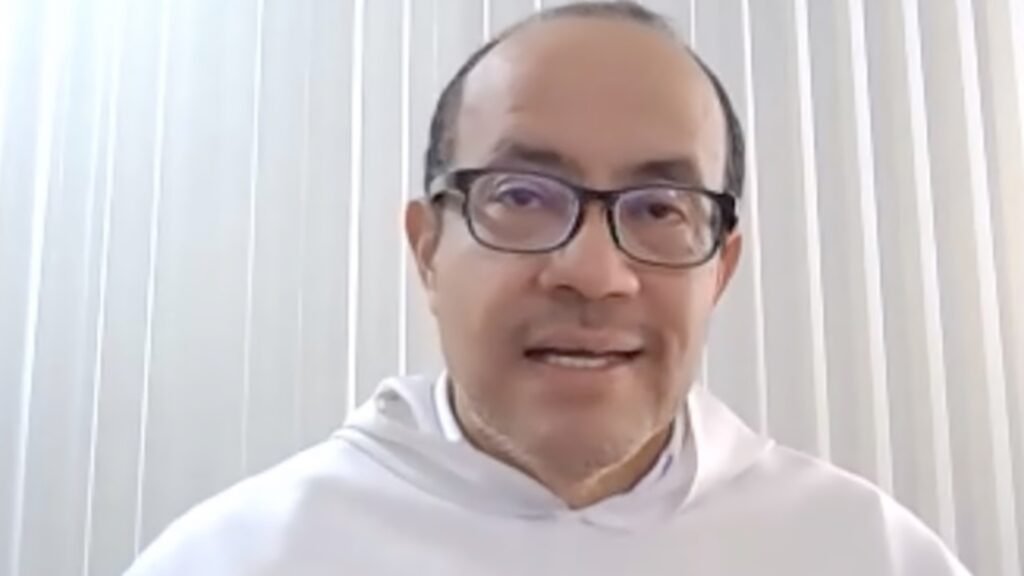
Dominican Father Nelson Medina explains the purpose of the Week of Prayer for Christian Unity, Jan. 18–25, as well as the goal and parameters of ecumenism.
Friar Nelson Medina, a Colombian Dominican priest who holds a doctorate in fundamental theology, explained why it is important for the Catholic Church to celebrate and promote a Week of Prayer for Christian Unity (Jan. 18–25), which in 2026 has the theme “One Body, One Spirit.”
“There are two reasons, one theological and one biblical, both extremely important. The theological reason is that the fruit of sin is always division, and therefore the victory over sin is always unity around the truth and love in Christ,” the priest emphasized in an interview with “EWTN Noticias,” the Spanish-language broadcast edition of EWTN News.
“Then we have a biblical reason, which is that Christ Our Lord, as appears in chapter 17 of the Gospel according to St. John, prayed precisely for this intention. It is clear that it was from the depths of his heart, precisely in the hours leading up to his sorrowful passion and therefore to our redemption,” Medina emphasized.
“So it is something that God wants, it is a common objective for the Church, and it is an initiative to which we should all unite.”
Regarding the theme of this year’s week of prayer — “One Body, One Spirit” — the friar emphasized that “it is very interesting to see the Church from this dual perspective … When we speak of unity in the Spirit, we are talking about that working [of the Spirit] which is interior, because the Spirit precisely comes into our hearts, as Romans 5:5 says.”
“But then the unity of the body is also necessary, that is, a unity that is visible. It’s not just that we have general charity towards other people; it’s that it is visibly evident that we believe in the same God, that we believe in the same Scripture, and that we celebrate the same sacraments with a common understanding and truth,” the Dominican priest pointed out.
What is the aim of Christian unity?
On this point, Medina emphasized “the ecumenism of theology; serious theological study is truly indispensable, especially to avoid superficiality. Sometimes people think that for there to be ecumenism, it’s enough for us to simply get together, share a meal, and take a nice picture with people smiling. That’s not the case.”
The Dominican priest explained that this unity helps address serious issues such as “gender ideology, the disregard for the dignity of human life with euthanasia, and all pro-life issues. It is necessary that, together with other Christians, and even with people of other religious beliefs, when appropriate, we understand that we are on the same side.”
“And we shouldn’t underestimate this effort for the causes of defending life, ecology, and justice because in this collaborative work, prejudices are often broken down and doors are opened,” he emphasized.
Regarding the work of priests, Medina continued, this unity among Christians is also important, because “we priests have quite a lot of work to do, because I think we move between two extremes … on the one hand, parishes where nothing is done [for Christian unity], apart from perhaps putting up a poster on the parish bulletin board; nothing else is done. And others where a lot is done, but sometimes causing confusion.”
“And this, too, we must warn against as a danger. For example, I learned of a case where some religious invited Anglicans to attend, and then everyone started receiving Communion, as if full Eucharistic unity had already been achieved,” he recalled.
That, the Dominican priest lamented, “which should have been a very beautiful ceremony, ended up being a source of scandal for many people.”
Medina noted that “formation is needed. It is a noble ideal, a pressing and unavoidable task for the Church, but it must, of course, have very clear parameters and guidelines from our pastors so that it does not end up being a fleeting enthusiasm, but also so that it does not produce this type of doctrinal or liturgical confusion.”
This story was first published by ACI Prensa, the Spanish-language sister service of EWTN News English. It has been translated and adapted.
Nathalí Paredes contributed to this report.