The Good Friday Reproaches are a series of antiphons, known also as “Popule Meus” (“My People”), and come from the opening lines of the Latin text of the recitation.
The Good Friday Reproaches are a series of antiphons, known also as the “Improperia” or “Popule Meus” (“My People”), coming from the opening lines of the Latin text of the recitation.
Dating back to the ninth century, though not gaining a permanent place in the Roman orders until the 14th century, the Good Friday Reproaches have long been an essential part of the Roman liturgy. But they largely disappeared from many parishes following the liturgical reforms of the Second Vatican Council.
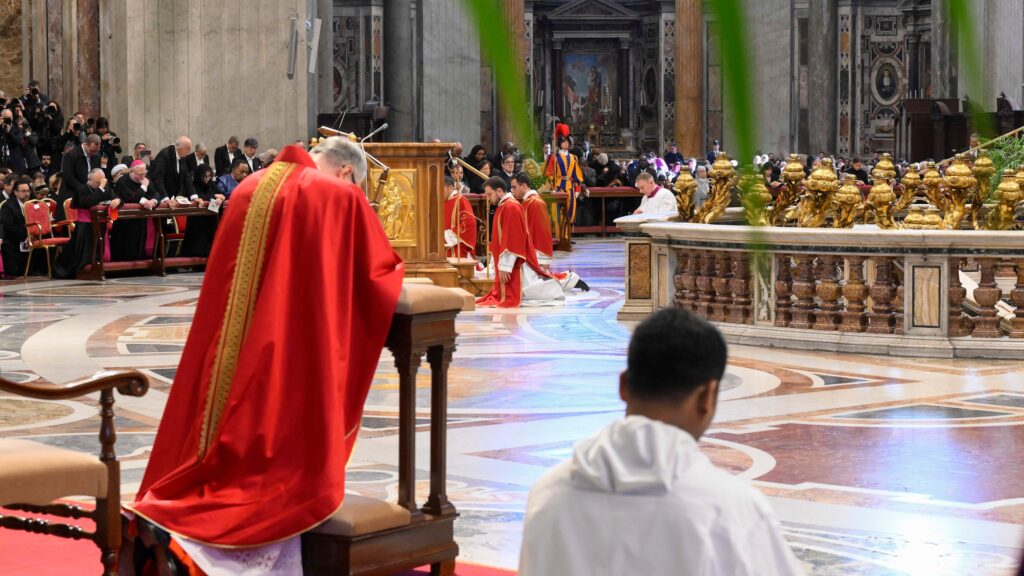
The antiphons have, however, retained their prominence at the Vatican — and are normally chanted by the Sistine Chapel Choir during the Good Friday service in St. Peter’s Basilica.
In the moment leading up to the dramatic recitation, the priest chants three times, in an increasing pitch, “Ecce lignum crucis,” or “Behold the wood of the cross,” each time gradually unveiling the cross that hitherto has been covered in a purple veil.
Once the crucifix is placed in a central location at the edge of the sanctuary, cast against a bare altar, the faithful are invited to kneel before — and kiss — it, a powerful remembrance of Christ’s passion but also a recognition of the cross as an instrument of salvation.
During the adoration of the cross, the Good Friday Reproaches are chanted in an alternating manner between a cantor and choir. It opens: “Popule meus, quid feci tibi? Aut in quo contristavi te? Responde mihi” (“My people, what have I done to you? How have I offended you? Answer me”).
This hauntingly sorrowful and beautiful text is followed by the first reproach: “Quia eduxi te de terra Aegypti: parasti crucem Salvatori tuo” (“Because I led thee out of the land of Egypt: thou hast prepared a cross for thy Savior”), showcasing the world’s fatal rejection of Christ despite his love and saving acts.
The following is the full text of the reproaches:
Popule meus, quid feci tibi?
Aut in quo contristavi te?
Responde mihi.
(O my people, what have I done to thee?
Or how have I offended you?
Answer me.)
Quia eduxi te de terra Aegypti:
parasti crucem Salvatori tuo.
(Because I led thee out of the land of Egypt:
thou hast prepared a cross for thy Savior.)
Hagios o Theos.
Sanctus Deus.
Hagios Ischyros.
Sanctus fortis.
Hagios Athanatos, eleison himas.
Sanctus immortalis, miserere nobis.
(O holy God!
O holy God!
O holy strong One!
O holy strong One!
O holy and immortal, have mercy upon us.
O holy and immortal, have mercy upon us.)
Quia eduxi te per desertum quadraginta annis:
et manna cibavi te, et introduxi te in terram satis bonam:
parasti crucem Salvatori tuo.
Hagios …
(Because I led thee through the desert for 40 years:
and fed thee with manna, and brought thee into a land exceeding good:
Thou hast prepared a cross for thy Savior.
O holy God! …)
Quid ultra debui facere tibi, et non feci?
Ego quidem plantavi te vineam meam speciosissimam:
et tu facta es mihi nimis amara:
aceto namque sitim meam potasti:
et lancea perforasti latus Salvatori tuo.
Hagios …
(What more ought I to have done for thee, that I have not done?
I planted thee, indeed, my most beautiful vineyard:
and thou hast become exceeding bitter to me:
for in my thirst thou gavest me vinegar to drink:
and with a spear thou hast pierced the side of thy Savior.
O holy God! …)
Ego propter te flagellavi Aegyptum cum primogenitis suis:
et tu me flagellatum tradidisti.
Popule meus …
(For thy sake I scourged the firstborn of Egypt:
Thou hast given me up to be scourged.
O my people …)
Ego te eduxi de Aegypto, demerso Pharone in mare Rubrum:
et tu me tradidisti principibus sacerdotum.
Popule meus …
(I led thee out of Egypt, having drowned Pharaoh in the Red Sea:
and thou hast delivered me to the chief priests.
O my people …)
Ego ante te aperui mare:
et tu aperuisti lancea latus meum.
Popule meus …
(I opened the sea before thee:
and thou hast opened my side with a spear.
O my people …)
Ego ante te praeivi in columna nubis:
et tu me duxisti ad praetorium Pilati.
Popule meus …
(I went before thee in a pillar of cloud:
and thou hast led me to the judgment hall of Pilate.
O my people …)
Ego te pavi manna in desertum:
et tu me cedisti alapis et flagellis.
Popule meus . . .
(I fed thee with manna in the desert:
and thou hast assaulted me with blows and scourges.
O my people …)
Ego te potavi aqua salutis de petra:
et tu me potasti felle et aceto.
Popule meus …
(I gave thee the water of salvation from the rock:
and thou hast given me gall and vinegar to drink.
O my people …)
Ego propter te Chananeorum reges percussi:
et tu percussisti arundine caput meum.
Popule meus . . .
(For thy sake I struck the kings of the Canaanites:
and thou hast struck my head with a reed.
O my people …)
Ego dedi tibi sceptrum regale:
et tu dedisti capiti meo spineam coronam.
Popule meus …
(I gave thee a royal scepter:
and thou hast given a crown of thorns for my head.
O my people …)
Ego te exaltavi magna virtute:
et tu me suspendisti in patibulo crucis.
Popule meus …
(I exalted thee with great strength:
and thou hast hanged me on the gibbet of the cross.
O my people …)
This story was first published on Good Friday 2024 and has been updated by EWTN News English.