COMMENTARY: The first witnesses to the messianic birth are not the great and the good but the lowly shepherds.
The Roman Missal provides four distinct Mass texts for the celebration of the Nativity of the Lord: the “Vigil Mass,” the “Mass During the Night,” the “Mass at Dawn,” and the “Mass During the Day.” The Gospel readings for these Christmas Masses teach important lessons at Christmas 2025.
The Vigil Mass Gospel, Matthew 1:1-25, includes the evangelist’s “genealogy of Jesus Christ, the son of David, the son of Abraham” and concludes with the story of Joseph’s angelic vision and his decision to bend his will to the divine plan and accept the pregnant Mary as his wife, “for it is through the Holy Spirit that this child has been conceived in her” — the child “who will save his people from their sins.”
By naming Jesus as “the Christ” and by firmly locating Jesus within the history of the Jewish people — “… the total number of generations from Abraham to David is fourteen generations; from David to the Babylonian exile, fourteen generations; from the Babylonian exile to the Christ, fourteen generations” — the evangelist underscores that Jesus of Nazareth makes no sense unless he is understood as what he understood himself to be and what his first followers understood him to be: the fulfillment of the messianic hope borne by the Jewish people throughout the first stages of salvation history.
Today, when the toxic fumes of antisemitism are poisoning public life and seem to be influencing far too many young Catholics (especially young men), the Gospel of the Christmas Vigil Mass teaches the crucial lesson understood by faithful Christians since the heresy of Marcion was condemned 1,881 years ago: Jesus was of Abraham’s stock and Christianity cannot be severed from its Jewish roots without fatally compromising the structure of the faith.
The Mass During the Night and the Mass at Dawn draw their gospel readings from Luke’s infancy narrative (Luke 2:1-14 and Luke 2:15-20), which, thanks in part to Georg Friedrich Handel’s Messiah, has become the paradigmatic telling of the Christmas story.
If Matthew’s genealogy locates Jesus within the history of the People of Israel, the Lucan Gospel at the Mass During the Night positions the Jewish Messiah within the broad sweep of world history:
“In those days, a decree went out from Caesar Augustus that the whole world should be enrolled. This was the first enrollment, when Quirinius was governor of Syria. So all went to be enrolled, each to his own town. And Joseph too went up from Galilee from the town of Nazareth to Judea, to the city of David that is called Bethlehem, because he was of the house and family of David, to be enrolled with Mary, his wife, who was with child.”
There are two important lessons here.
The first is that salvation history is unfolding inside world history, and in fact gives world history its true meaning. History is not random; history is going somewhere — toward the fulfillment of the Creator’s purposes. And at the end of history, the Creator is going to get what the Creator intended from the beginning: the New Jerusalem of Revelation 21:2, the eternal fulfillment of the “city of David” in the time beyond time that is life within the light and love of the thrice-holy God.
The second lesson is that God works gently, even mysteriously, through the characters and events of world history to achieve the divine purpose. Tallying up his tax base in this “first enrollment,” Caesar Augustus had no idea that he was arranging for the Promised One to be born, as was prophesied, in the city of David.
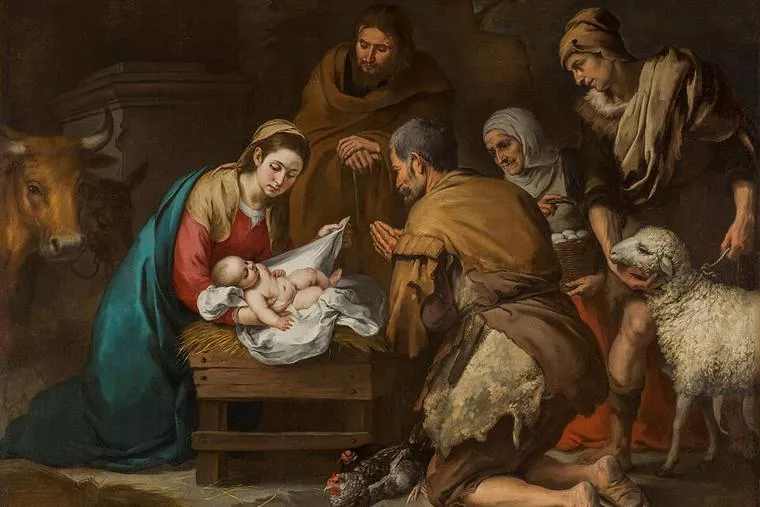
But so it happened: a lesson in the challenge of reading the signs of the times, reiterated during the Mass at Dawn when the first witnesses to the messianic birth are not the great and the good but the lowly shepherds.
The Gospel for the Mass during Christmas Day offers us the densest, yet most lyrical, theology in the New Testament: the Prologue to John’s Gospel (John 1:1-18), in which the Jewish messiah who redeems all of history is identified with the “Word,” the second Person of the Trinity, “through whom “all things came to be.”
The lesson here? In an increasingly irrational world, we must hold fast to the biblical claim that God impressed a rationality into the world and into us: truths that we can know by revelation and reason; truths that map out the path of righteous living; truths that pave the royal road to sanctification and beatitude.
“The Word became flesh and dwelt among us … full of grace and truth.” Therein lies our hope, and the reason for Christmas cheer.
This article was originally published by NCRegister.