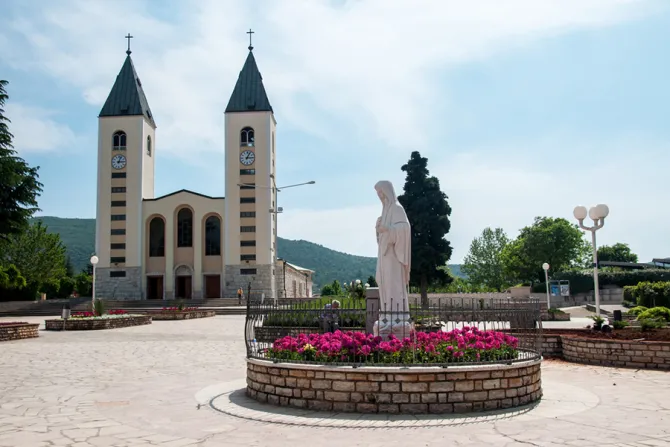
After more than four decades of investigation into alleged Marian apparitions at Medjugorje in Bosnia and Herzegovina, the head of the Vatican’s doctrine office will hold a press conference Thursday about the “spiritual experience” at the Marian site, the Vatican said.
The alleged visions of the Blessed Virgin Mary in Medjugorje occurred to six children starting on June 24, 1981, originally on a hilltop near the town.
Since they began, the alleged events and messages from Mary have been a source of controversy and division, as fame of the phenomena spread despite declarations from local bishops and Vatican authorities that there was no confirmation of their authenticity.
Devotees continued to flock to the area, however, even while Church-organized pilgrimages were banned. They were later allowed after a papal envoy found evidence of spiritual fruits for those who visited.
More than 40 years since they first claimed to have been visited by Mary, the alleged visionaries say they continue to receive messages from Mary conveying a desire for peace for the world, a call to conversion, prayer, and fasting, and certain secrets surrounding events to be fulfilled in the future.
Below is a timeline of the Catholic Church’s investigations into and decisions about Medjugorje.
April 10, 1991: After local bishops formed three different commissions to study the phenomena at Medjugorje starting in January 1982, the bishops’ conference of what was then Yugoslavia rules that “on the basis of studies conducted so far, it cannot be affirmed that supernatural apparitions and revelations are occurring” at Medjugorje.
March 23, 1996: Affirming the indications of the Yugoslavia bishops, the secretary of the Congregation for the Doctrine of the Faith, Archbishop (later Cardinal) Tarcisio Bertone, says in a response to a letter from a French bishop that official pilgrimages to Medjugorje as a site of authentic Marian apparitions, organized at the diocesan or parish level, are not permitted.
March 17, 2010: At the request of the bishops of Bosnia and Herzegovina, Pope Benedict XVI establishes a commission chaired by Cardinal Camillo Ruini to investigate the supernatural character of the events in Medjugorje. The commission includes approximately 20 cardinals, bishops, and experts.
Jan. 17, 2014: After nearly four years of investigations into the doctrinal and disciplinary aspects of the Medjugorje apparitions, the commission formed in 2010 completes its work and submits a document, the so-called “Ruini report,” to the then-Congregation for the Doctrine of the Faith.
June 6, 2015: Pope Francis visits Bosnia and Herzegovina but declines to stop at Medjugorje. During the in-flight press conference on the papal plane returning to Rome, the pope says the Vatican’s investigation into the apparitions is nearly complete.
Sometime in 2016: The Congregation for the Doctrine of the Faith, under the leadership of Cardinal Gerhard Ludwig Müller, reads and discusses the findings of the “Ruini report.” The opinions of the congregation’s members are then sent to Pope Francis.
Feb. 11, 2017: Pope Francis appoints Polish Archbishop Henryk Hoser papal envoy to Medjugorje “with the aim of acquiring a deeper knowledge of the pastoral situation there and above all, of the needs of the faithful who go there on pilgrimage.” A Vatican spokesman clarifies that the archbishop’s mandate is pastoral, and not doctrinal, in nature.
Two months after his appointment as special envoy, Hoser tells members of the press that the site bears many genuine expressions of faith, and many vocations are found there. However, he clarifies that the final determination of the apparitions’ authenticity remains to be seen.
May 13, 2017: Pope Francis speaks about the commission formed by Benedict XVI in 2010 and the so-called “Ruini report” during an in-flight press conference aboard the papal plane returning from Fátima, Portugal. He says he is personally “suspicious” of the apparitions since they appear to him to turn the Blessed Virgin Mary into a “telegraph operator” delivering daily messages.
May 17, 2017: A report in the “Vatican Insider” section of the Italian newspaper La Stampa says that the 2010–2014 commission’s “Ruini report” found a difference between the first seven alleged apparitions of June 24–July 3, 1981, and those that followed. The vote on the first seven alleged visions gave a mostly favorable opinion of supernaturality.
According to La Stampa, the majority of commission members also expressed an opinion that the spiritual fruits of Medjugorje were positive or mostly positive. On the supernatural character of the later alleged visions, the majority of the commission’s members said an opinion could not be expressed and two members voted against.
Dec. 7, 2017: Hoser tells Catholic media outlet Aleteia that while the pope will make a final decision on the authenticity of the alleged visions at Medjugorje, “today, dioceses and other institutions can organize official pilgrimages. It’s no longer a problem.”
May 31, 2018: Pope Francis reappoints Hoser, retired archbishop of Warsaw-Prague, apostolic visitor to Medjugorje, tasked with overseeing the pastoral needs of the site for an undetermined length of time. This nomination follows the archbishop’s earlier role as papal envoy.
May 12, 2019: Pope Francis formally authorizes Catholics to organize pilgrimages to Medjugorje in acknowledgment of the “abundant fruits of grace” that have come from visits to the shrine, though the Church had still not issued a verdict on the authenticity of the alleged apparitions.
Aug. 14, 2021: Hoser dies in a hospital in Warsaw, Poland, after a long and serious illness. He was 78.
Nov. 27, 2021: Pope Francis names Archbishop Aldo Cavalli, a longtime Vatican diplomat, as special apostolic visitor to the parish community of Medjugorje for an indefinite period following Hoser’s death.
This article was originally published on Catholic News Agency.