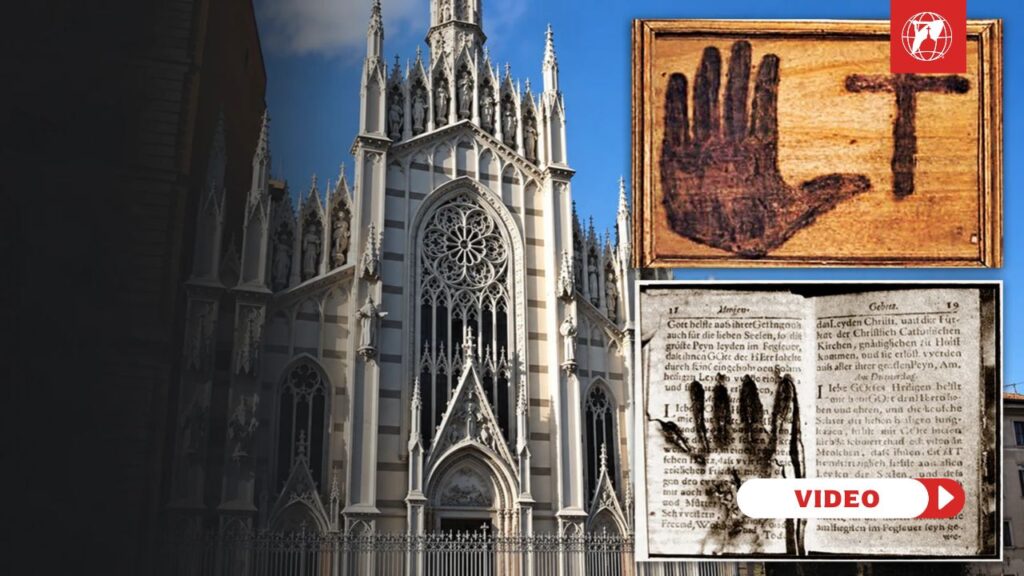
In the heart of Rome, a small museum preserves a collection of objects bearing mysterious marks that were reportedly left by souls from Purgatory. Prayer books, garments, pieces of paper, and wooden tablets with what appear to be scorched fingerprints and handprints form part of a unique collection gathered by a French missionary in the late 19th century.
Known as the Museum of the Holy Souls in Purgatory, the collection is housed at the Church of the Sacred Heart of Suffrage. Beyond the extraordinary stories associated with its artifacts, the museum points to a central teaching of the Catholic faith: the living and the dead remain united through the communion of saints, and the faithful are called to pray for those who have died.
A Fire That Led to the Creation of the Museum
The story of the museum began in 1897, when a devastating fire destroyed a small chapel. Only the altar and one wall survived. On that wall, an image appeared to have been mysteriously imprinted by the smoke.
For Monsignor Victor Jouët, a French missionary, the image had a clear meaning: it represented a soul from Purgatory asking for prayers, both for itself and for all the souls undergoing purification.
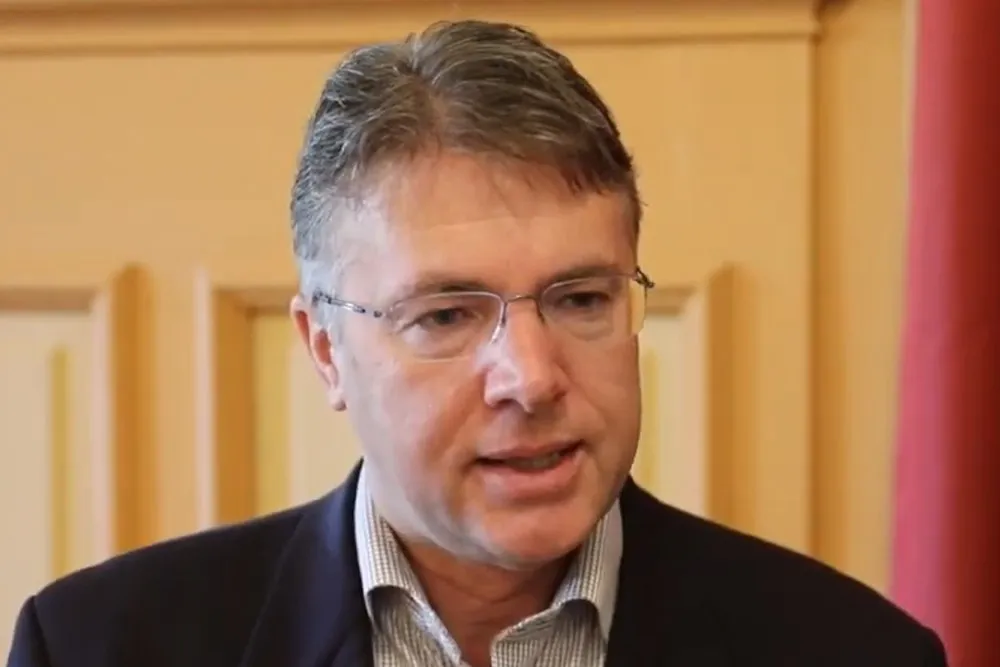
Don Walter Insero, parish assistant at the Church of the Sacred Heart of Suffrage, recounts the event:
“One day in 1897, a devastating fire destroyed the small chapel. Only the altar and one wall survived, on which an image had mysteriously appeared, seemingly imprinted by the smoke. For Monsignor Jouët, the meaning was clear: it was the image of a soul from Purgatory manifesting itself and asking for prayers, both for itself and for all the souls in Purgatory.”
Following the incident, Fr. Jouët began collecting testimonies from across Europe about extraordinary events in which souls from Purgatory were said to have appeared to the living, asking for prayers.
He went on to establish a prayer association dedicated to the souls in Purgatory, which later received official recognition. He also decided to build a church dedicated to the Sacred Heart of Jesus on a small plot of land between the rectory and an existing building. Its particular mission would be to provide a place of prayer for the souls in Purgatory.
Fr. Jouët preserved the objects associated with the accounts he collected, creating what would become the Museum of the Holy Souls in Purgatory — a unique collection of its kind.
The Mysterious Artifacts and the Symbolism of Fire
The museum contains prayer books, breviaries, garments, photographs, sheets of paper, and wooden tablets bearing what appear to be scorched fingerprints and handprints.
According to Don Insero, many of the objects collected by Fr. Jouët bear marks associated with fire, a recurring element in the testimonies.
“Fr. Jouët collected testimonies from across Europe. Among the artifacts are mysterious imprints left on tables, sheets of paper. A recurring theme throughout the collection is fire. Many of the relics bear what are believed to be scorched handprints or fingerprints. In Christian tradition, fire has long served as a symbol of Purgatory, not as a sign of destruction, but of purification, burning away what is imperfect and preparing the soul for the fullness of Heaven.”
Fr. Jouët assembled these objects because he believed God could, in certain extraordinary circumstances, permit souls in Purgatory to manifest themselves to the living as a reminder of the importance of praying for the dead.
The collection invites visitors to consider the meaning of Purgatory not as a place of hopelessness, but as part of the Church’s teaching on purification and the journey toward Heaven.
Purgatory: The Threshold of Heaven
For many Catholics, Purgatory can be a difficult concept to understand. Yet the Church teaches that it is not a second chance at salvation or a form of eternal punishment. Rather, it is the final purification of those who die in God’s grace but still need to be purified before entering Heaven.
Fr. Santiago Sanz, professor of eschatology at the Pontifical University of the Holy Cross, explains how Purgatory fits within the communion of the Church:
“Between the Church triumphant in heaven and the Church here on earth, traditionally known as the Church militant, there has always been said to be a third dimension of the Church: The purgatory, where the souls are being purified after death, awaiting the day when they will enter into the presence of God.”
He emphasizes that Purgatory should not be confused with Hell. Its purpose is purification, and its destination is the presence of God.
“One thing that should be made clear, to put people’s minds at ease, is that Purgatory is not a “light version” of Hell, but rather the threshold of Heaven. That is very important to understand: Purgatory is on the side of Heaven, not on the side of Hell.”
In this sense, Purgatory is a sign of God’s mercy: those who undergo purification are already destined for Heaven, even as they await the fullness of that encounter with God.
The Communion of Saints: Why Catholics Pray for the Dead
The Museum of the Holy Souls in Purgatory is more than a collection of unusual artifacts. It serves as a reminder that the relationship between the living and the dead does not end with death.
Through the communion of saints, the Church teaches that all the faithful — those on earth, those undergoing purification, and those already in Heaven — remain united in Christ.
Don Insero says the museum helps visitors understand this enduring bond:
“It helps us understand that a relationship exists between the living and the dead, that our bond does not end on the day of a funeral when we accompany someone to their final resting place. In the communion of saints, we remain united with those souls who are still on their journey, having not yet reached Heaven.”
This connection takes on particular importance on All Souls’ Day, celebrated on Nov. 2, the day after the Solemnity of All Saints. Catholics remember the faithful departed and pray for those who are undergoing purification in Purgatory.
Don Insero also explains the historical context behind the Church’s emphasis on prayer for the dead:
“The Church was responding to the spread of esotericism and, above all, spiritualism. Its response was clear: Christians do not seek to invoke spirits, but rather pray for the dead and entrust them to God’s mercy.”
The distinction is important: Catholic prayer for the dead is not an attempt to communicate with or summon the departed. It is an act of faith in God’s mercy and an expression of the communion that unites the Church.
Prayer That Transcends Time and Eternity
The Church’s prayer for the faithful departed is not limited to a particular day or moment. Through the liturgy, Catholics entrust the dead to God’s mercy, confident that their prayers are united with the eternal reality of Christ.
Fr. Sanz explains why these prayers matter:
“In the liturgy the boundaries between time and eternity are transcended. Our prayers matter because they are caught up in that eternal reality, allowing us to pray for the faithful departed of every age, from those who died long ago to those who have passed away today.”
The Museum of the Holy Souls in Purgatory offers visitors an opportunity to reflect on this teaching. Whether through the extraordinary stories behind its artifacts or the Church’s enduring practice of praying for the dead, its message is ultimately one of hope.
The faithful departed are not forgotten. Through the communion of saints, Catholics remain united with them, entrusting their souls to God’s mercy and praying that they may one day enter into the fullness of Heaven.
Adapted by Jacob Stein. Produced by Bénédicte Cedergren. Camera by Fabio Gonella, Alberto Basile; Special thanks & Credits to Church of the Sacred Heart of Suffrage, The Little Museum of the Purgatory.