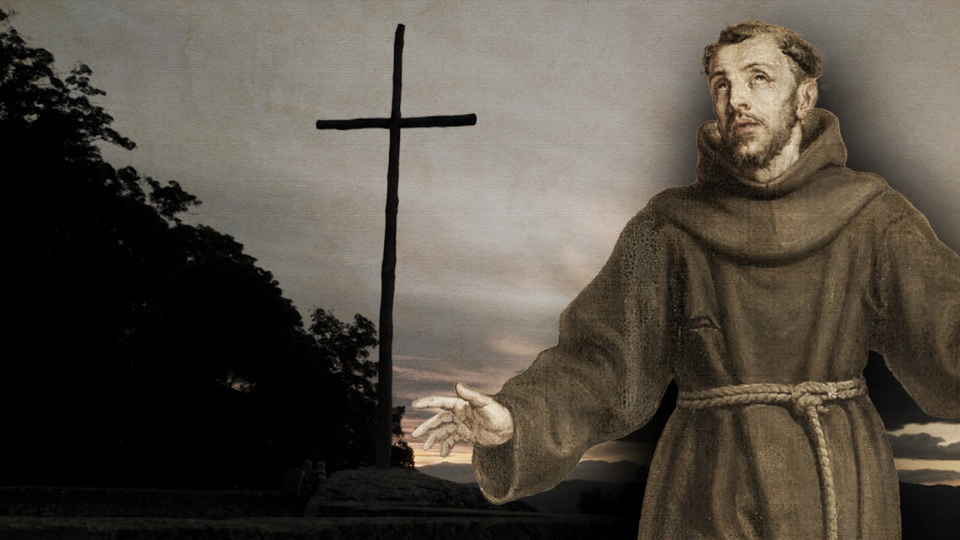
In this journey to the Sanctuary of La Verna, we explore a significant spiritual landmark for Catholics worldwide: the very place where St. Francis of Assisi received the Stigmata, the wounds of Jesus Christ. This Franciscan shrine is steeped in history and devotion, standing on a mountaintop where St. Francis himself prayed. Fr. Matteo Brena, a Franciscan Friar and resident of La Verna, guides us through the sanctuary, sharing the profound moments of St. Francis’s life and his connection to the mountain.
The Piazza de Quinta Orante and the Early Days of La Verna
Fr. Matteo begins the tour at the Piazza de Quinta Orante, the sanctuary’s central and largest space. While the present-day basilica was built in the 14th century, it wasn’t there during St. Francis’s time. As Fr. Matteo explains, St. Francis sought out La Verna’s rugged and natural setting for contemplation:
“At that time of St. Francis, there was no building here. It was a completely naturalistic place, and Francis frequented this place precisely because of the beauty of the panorama and these cracks inside the mountain.”
According to local tradition, the mountain’s cracks were believed to have formed at the moment of Christ’s death. Francis knew of this tradition and was drawn to La Verna to meditate on the mystery of the cross, finding inspiration in the mountain’s natural beauty and symbolism.
Sasso Spicco: A Place of Solitude and Prayer
One of the most cherished spots in the sanctuary is Sasso Spicco, a large rock that seems to defy gravity as it juts from the mountain. Here, St. Francis often withdrew to meditate and pray. Fr. Matteo reflects on St. Francis’s spiritual experience in this place:
“Francis loved to immerse himself and pray… He meditates on the mystery of the cross, immersing himself, making himself small and humble.”
It was on this mountain, within these cracks, that St. Francis sought to understand the mystery of the cross. In 1224, while accompanied by a small group of friars, he found a place of refuge and communion with God. In his later years, as he struggled physically and spiritually, the mountain provided him solace.
The Corridor of the Stigmata and the Chapel of the Stigmata
A critical part of the sanctuary is the Corridor of the Stigmata, which leads pilgrims from the convent to the Chapel of the Stigmata, the most sacred spot in La Verna. This corridor commemorates the exact location where Brother Leo found St. Francis after he had received the Stigmata:
“Thanks to Brother Leo, we know the exact place where Francis prayed and where he received the stigmata.”
Each day, the friars gather here to pray and commemorate the cross. The chapel is a testament to St. Francis’s mystical experience and the transformative power of faith. Visitors are invited to join the friars at 2:00 in the morning for prayer, reflecting on St. Francis’s legacy and the stigmata.
La Verna: A Pilgrimage of Silence and Reflection
La Verna offers pilgrims a chance to experience spiritual renewal through silence and reflection. Standing on the mountain’s precipice, Fr. Matteo shares how silence often reveals God’s presence. He recounts how, after receiving the Stigmata, St. Francis composed the Canticle of the Creatures, a song of praise that celebrates both creation and the divine.
This sanctuary, rooted in the history and faith of St. Francis, continues to inspire those who visit. Pilgrims leave La Verna with a deeper understanding of St. Francis’s journey and his profound connection to the cross and to God’s creation.
Adapted by Jacob Stein