ANALYSIS: Given Pope Leo’s relative youth, the possibilities for travel abound.
SIGN UP FOR OUR NEWSLETTER HERE
On July 11, Pope Leo XIV appointed Father Michel Guillaud as bishop of the Diocese of Constantine in Algeria. The appointment drew little attention, in part because Bishop-elect Guillaud, a French priest, was already serving as the diocesan administrator of Constantine. A graduate of the Pontifical Institute for Arabic and Islamic Studies in Rome, Bishop-elect Guillaud has spent nearly his entire priestly career in the North African country.
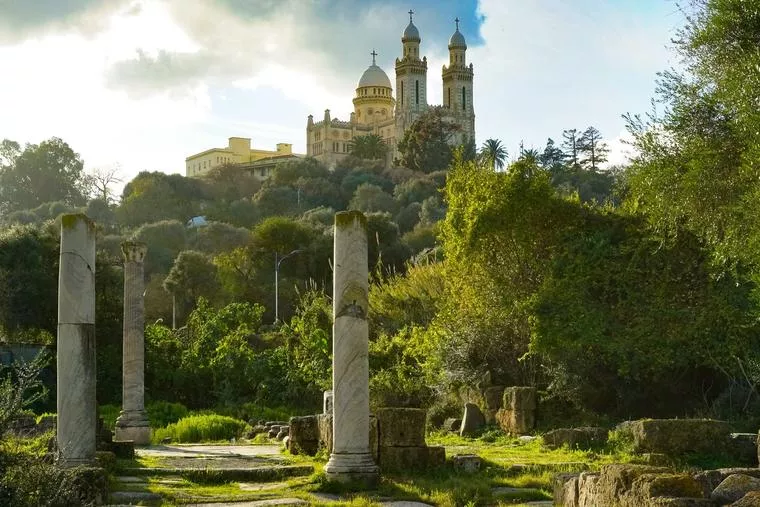
The Diocese of Constantine, however, is not just any diocese. Of the four dioceses in Algeria, it is the one to which the title of the ancient Diocese of Hippo is attached, the diocese of which St. Augustine once was bishop. The Basilica of St. Augustine in Annaba now serves as the pro-cathedral of the diocese because the former cathedral of Constantine, dedicated to Our Lady of the Seven Sorrows, was converted into a mosque in 1964.
However, this is not the only reason the appointment of the bishop of Constantine is significant. First, with this appointment, all four dioceses in Algeria now have bishops. Second, the fact that the Catholic Church has an Augustinian Pope raises the not-so-far-fetched possibility of a papal visit to the country.
Leo XIV is expected to visit Nicaea — located in modern-day İznik in northwestern Turkey — to celebrate the 1,700th anniversary of the First Ecumenical Council. The most likely date for the trip is Nov. 30, St. Andrew’s Day, when a Catholic delegation traditionally visits.
Pope Francis had hoped to travel to Nicaea on May 24. The trip was never officially announced, but that date had been under discussion. The schedule would have been limited to Nicaea due to his health. Pope Francis’ death postponed the trip, but not the idea of a large-scale ecumenical celebration.
Leo XIV need not limit himself to visiting Nicaea. He could go to Ankara to visit the presidential palace and meet with the diplomatic corps. He could stop in Istanbul to visit the Phanar, the see of the Ecumenical Patriarchate of Costantinople, and meet with Catholics in the Turkish capital. He could then continue on to Nicaea for the ecumenical celebration with Patriarch Bartholomew.
But before that trip, Leo XIV might choose to travel to Algeria, following in the footsteps of St. Augustine. This idea has gained traction in the Vatican, and it appears possible itineraries are already being explored. Leo is said to want his first trip to be symbolically linked to his first vocation. He could, therefore, visit Algeria as the first stop on a trip that would also take him to Turkey. His inaugural journey would thus last at least a week, with two stops that are both similar and distinct. It would be not only an ecumenical journey, but also an interreligious one.
If confirmed, the trip would also establish a pattern for Leo XIV’s travels. He is a relatively young pope and therefore able to undertake long journeys.
Potential Visits
Where else to? Rumors abound.
Leo XIV would like to return to Peru, which would be his second trip and could take place between May and June 2026. The visit would include Chiclayo, Lima and other Peruvian destinations with which the Pope is connected.
Then, there’s an open invitation to the United States. The year 2026 marks the 250th anniversary of the nation’s founding, while 2025 marks the 80th anniversary of the founding of the United Nations. Leo XIV is expected to return to his native country, with likely stops in Washington, D.C.; Baltimore, the oldest diocese in the United States; and New York, where he may address the United Nations — possibly in September to coincide with the U.N. General Assembly.
Leo XIV could also revive a little-known plan of Pope Francis: another trip to Africa. Among the stops Pope Francis reportedly considered was Cape Verde, for deeply personal reasons: “Negro Manuel,” the enslaved man entrusted with transporting an image of the Virgin, came from Cape Verde. That image later stopped in Luján, where the most venerated shrine in Argentina was built after the event.
It is difficult to say today whether this trip to Africa will take place, or if it might happen in 2026 or 2027. Still, it remains a possibility.
Of course, there has been no shortage of invitations from around the world. The Pope has already expressed his willingness to visit the Sanctuary of Lourdes, and some are even calling for a visit to Ukraine — though that remains unlikely. It is also hoped that he will be in Barcelona next year for the completion of the Sagrada Família. Next year’s scheduled completion of the massive Spanish basilica — after 144 years of construction — will coincide with the 100th anniversary of the death of its architect, Venerable Antoni Gaudí.
However, Algeria, Peru and the United States — along with Nicaea, of course — appear to be the Pope’s likely first stops.
None of these trips, however, is imminent. In general, papal trips are officially confirmed and announced only about a month before departure, once there’s no longer any doubt the Holy Father will go. For now, they remain working hypotheses, though all appear likely.
This articles was originally published by NCRegister.