In a recent audience to the participants of the Plenary Assembly of the Pontifical Academy of Social Sciences, Pope Francis noted, “There are those who presume to be able to establish, on the basis of utilitarian and functional criteria, when a life has value and is worth being lived. Such a mentality can led to grave violations of the rights of the most vulnerable.”
The Dicastery for the Doctrine of the Faith’s new document, Dignitas infinita or “Infinite Dignity,” was five years in the making and was promulgated on April 2nd, the 19th anniversary of the death of Pope St. John Paul II. It expands upon the papal teachings of the past decade, addressing a range of issues from war and poverty to violence against migrants and women, from abortion and surrogate motherhood to euthanasia, and from gender theory to digital violence.
Fr. Justin Glynn, S.J., commented on the renewed perspective the document provides us. “I think one of the key things that it does,” he said, “its most powerful contribution, is reminding us that we have traditionally employed a throwaway culture and that people with disability are at risk of being excluded and marginalized.”
Pope Francis approved the document on March 25th. Key themes include abortion, euthanasia and surrogate motherhood. They are listed as violations of human dignity alongside war, poverty, and human trafficking.
Within Dignitas infinita, there is an entire section focused on “The Marginalization of People with Disabilities” in which paragraph 53 includes a strong call for people with disabilities to be more broadly included in the life of the Church:
“One criterion for verifying whether real attention is given to the dignity of every individual in society is the help given to the most disadvantaged… Thus, every effort should be made to encourage the inclusion and active participation of those who are affected by frailty or disability in the life of society and of the Church.”
The USCCB is currently in the process of updating its 1978 “Pastoral Statement on Persons with Disabilities.” It can be expected that Dignitas infinita will feature prominently in the new pastoral statement.
The Pontifical Academy of Social Sciences met for a plenary session on disability inclusion at the Vatican. For three days, the conference at the Vatican included discussions on the rights of persons with disabilities, policies for greater economic inclusion, and philosophical perspectives on disability and the human condition.
This Pontifical Academy is made up of academics and professionals in the fields of law, political science, economics, and sociology.
Cristina Gangemi, a Disability Theologian, commented on Dignitas infinita, saying, “When we look at this document, we see actually that it reflects what Jesus did, and, that is, he valued the life of the person with a disability. He presumed nothing about who could image God.”
“So in Jesus’ ministry,” Gangemi continued, “he called everybody to the center. Everybody had a chance to express their story. And I think that that’s what disability is. It’s about a retelling of the story through a different experience. Also, one of the things I think it’s really important to say is this document Dignitas infinita reminds the church that it can’t just speak about dignity, but it must act. And dignity, Pope Francis says, isn’t bestowed. It’s something that’s inherent, exists at the very core and value of the human person, and [the] person has to be part of that.”
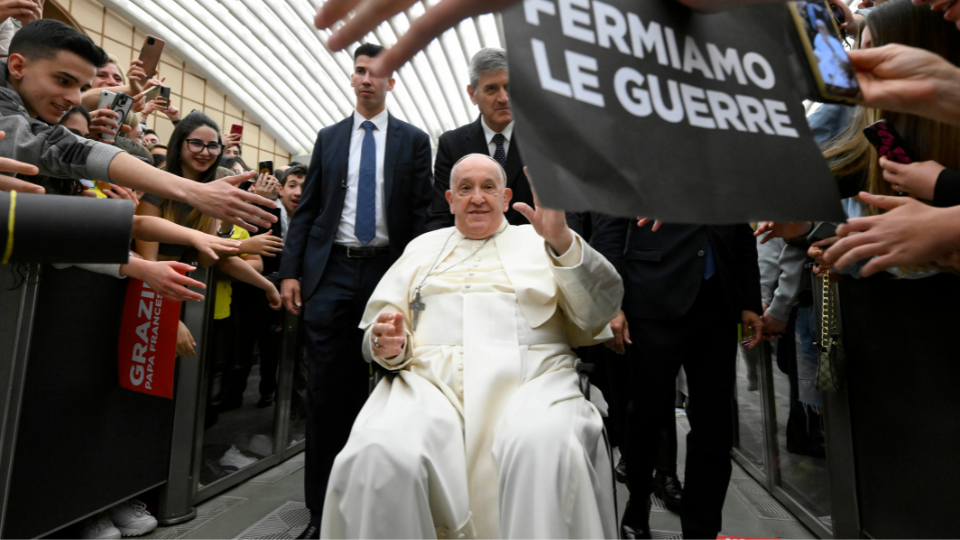
In his audience with the Pontifical Academy of Social Sciences, the Pope said, “There is also present, in today’s throwaway culture, a less visible but extremely insidious factor that erodes the value of the disabled in the eyes of society and in their own eyes. It is the tendency to make individuals view their life as a burden both for themselves and for their loved ones. The spread of this mentality turns the throwaway culture into a culture of death.”
The new text helps bridge the gap between those who solely prioritize issues at the beginning and end of life, neglecting other attacks on human dignity, and those who solely advocate for the poor and migrants, overlooking the need to defend life from conception to its natural end.
One of the participants at the plenary assembly was Professor Tom Shakespeare, professor of disability research at the London School of Hygiene and Tropical Medicine.
“It’s been a very good three days,” Shakespeare shared. “We’ve explored disability education, and today I was talking about disability identity. The whole theme is that we must treat disabled people with dignity, with respect, and include people in a society of the future. Pope Francis himself had said that. It was a great humbling opportunity to see him this morning in a wheelchair. Now he is the same. He is full of vigor. He’s just different and we are all the same. We all God’s children.”
In his speech to the pontifical academy, Pope Francis underlined that, “vulnerability and frailty are part of the human condition and not something proper only to persons with disabilities.”
As is clearly mentioned in the introduction to the Declaration:
“This dignity of every human being can be understood as ‘infinite,’ as Pope St. John Paul II affirmed in a meeting for people living with various limitations or disabilities. He said this to show how human dignity transcends all outward appearances and specific aspects of people’s lives.”
“So, we were reminded today,” Shakespeare continued, “that the church, probably in its institutions, has more disabled people anywhere than any other entity in the world. It seems to me very important that we support people to have good lives included in their communities, that we move away from an individual idea that you, I, anybody are separate and we have a connected idea, a relational idea, because not only disabled people, but all people will flourish better if they’re part of their community, their family, their neighbors.”
According to the Pontifical Academy for Social Sciences, there is no exact number for the amount of people with disabilities worldwide, but international organizations estimate that 16% of the world’s population experience significant disabling conditions.
In the Concept Note for the plenary session, the academy recognized the strong solidarity found in family associations that support and accompany families who care for disabled individuals, noting that this solidarity takes on a social significance.
Fr. Justin Glynn, S.J., commenting on this Concept Note, said, “I think it would have been nice to hear a bit more on the question of the fact that relationship with disability is not fundamentally a relationship of charity, of reaching down. But it is, as the Declaration does mention, that it is about co-participation, but it would have been good to hear it. Talk a little bit more about what that co-participation looks like in practice, how we are in fact all together rather than a privileged us helping an underprivileged.”
Dignitas Infinita is unequivocal in its condemnation of abortion, noting that “the acceptance of abortion in the popular mind, in behavior, and even in law itself is a telling sign of an extremely dangerous crisis of the moral sense.” The document also addresses a range of new issues, including surrogacy, which “violates” the dignity of both the mother and the child who “becomes a mere object,” as well as “gender theory,” which it describes as “extremely dangerous.”
“What is needed, then,” Pope Francis noted, “is the development of a culture of integral inclusion. The bonds of belonging become even stronger when persons with disabilities are not simply passive receivers but take an active part in the life of society as agents of change. Subsidiarity and participation are the two pillars of effective inclusion. In this regard, we can appreciate the importance of associations and movements of disabled persons that work to promote their participation in society.”
The Declaration, nearly 12,000 words in length, begins with and affirms the “ontological dignity” of each human being:
“In the light of Revelation, the Church resolutely reiterates and confirms the ontological dignity of the human person, created in the image and likeness of God and redeemed in Jesus Christ. From this truth, the Church draws the reasons for her commitment to the weak and those less endowed with power, always insisting on ‘the primacy of the human person and the defense of his or her dignity beyond every circumstance.’”
Adapted by Jacob Stein
Sign up for our newsletter here: https://mailchi.mp/ewtn/vatican