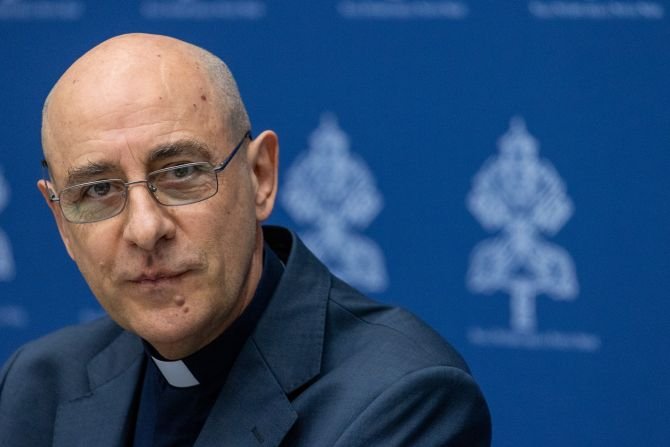
Cardinal Víctor Manuel Fernández, the Vatican’s top doctrinal watchdog, said Monday that the Vatican’s new document on human dignity is as much a reflection of Pope Francis’ pastoral thinking on issues such as abortion, euthanasia, surrogacy, and gender ideology as it is a summary of the Church’s magisterial teaching.
This document is “about gathering here and consolidating what the last pontiffs have said on this great topic and to summarize the innovation offered by the current pope,” Fernández, the prefect of the Dicastery for the Doctrine of the Faith, said during a press conference at the Vatican coinciding with the release of the new document, titled Dignitas Infinita.
“The Church has also learned the hard way, going through difficult phases,” he added. “It has also learned to talk to the world by listening to society.”
The new document states that “the Church’s magisterium progressively developed an ever-greater understanding of the meaning of human dignity, along with its demands and consequences, until it arrived at the recognition that the dignity of every human being prevails beyond all circumstances.”
At the same time, Fernández explained, the document reflects Pope Francis’ pastoral priorities, noting that the theme of human dignity is “so present in the thought of Pope Francis” as well as “in his attitudes, in his way of treating the sick, the criminals, the forgotten, in the way he listens.”
Fernández began the midday press conference with a lengthy defense of last December’s controversial document Fiducia Supplicans, which has become a source of division within the Church. He noted that the document had garnered more than “7 billion views on the internet,” suggesting that it was the Vatican’s most-viewed document. He then pointed to an Italian survey, unnamed and unpublished, where “75% of people” under age 35 support the document, which allows for the “spontaneous” (nonliturgical) blessing of same-sex couples as well as those in “irregular” situations.

Asked why he began by discussing Fiducia Supplicans, Fernández said that in “recent days I have received from many people from within and outside the Vatican who told me [the speech] cannot be done as if nothing had happened. And then I accepted what they told me to do there and I extended the speech with this.”
Dignitas Infinita (“Infinite Dignity”) has been in the works for the past five years but was significantly reworked following the input of “various experts” who met at a “consulta ristretta” held on Oct. 4, 2021. Pope Francis approved the document on March 25 and subsequently ordered its publication.
The document is unequivocal in its condemnation of abortion, noting that “the acceptance of abortion in the popular mind, in behavior, and even in law itself is a telling sign of an extremely dangerous crisis of the moral sense.”
The document also addresses a range of new issues, including surrogacy, which “violates” the dignity of both the mother and the child, who “becomes a mere object,” as well as “gender theory,” which it describes as “extremely dangerous.”
On the question of gender theory it states: “Desiring a personal self-determination, as gender theory prescribes, apart from this fundamental truth that human life is a gift amounts to a concession to the age-old temptation to make oneself God, entering into competition with the true God of love revealed to us in the Gospel.”
With respect to sex change, the document notes: “It follows that any sex-change intervention, as a rule, risks threatening the unique dignity the person has received from the moment of conception.”
Fernández reiterated this point during the press conference, noting that the document addresses the topic of sex change, reflecting on the importance of “accepting the truth as it is.” He noted the socially pervasive belief that man is “omnipotent” and “thinks that with his intelligence, and his will, he is capable of building everything as if there was nothing that came before him, as if there was no reality that was given to him.”
But on the question of sex change, he noted that while there is “a deeper issue” that is not “seen,” there are “pastoral consequences, the principle of welcoming everyone, which is clear in the words of Pope Francis, he always says it: everyone, everyone.”