The Order of St. George of the House of Habsburg-Lorraine brings together faith, service, and Christian witness in a living community. Rooted in the legacy of Saint George, it was established in the 15th century as a military order to advocate the Christian faith and combat threats to Christendom.
To this day, it continues to highlight a spiritual life shaped by courage, charity, and fidelity to Christian values — but also speed!
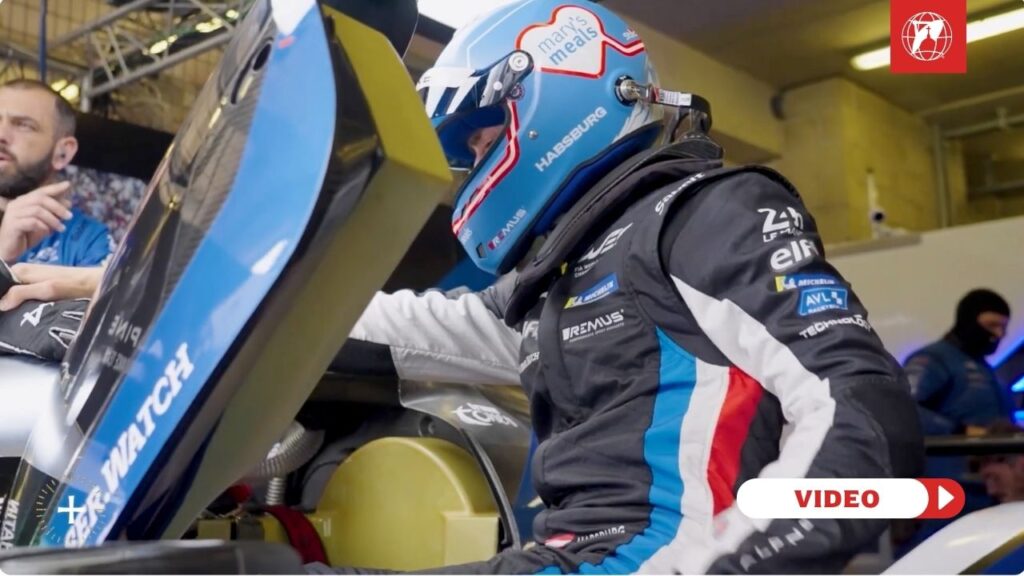
Ferdinand Habsburg-Lothringen is a motor racing driver for the Alpine Endurance Team, and over the course of his career he has won several major titles, including the 24 Hours of Le Mans in 2021.
He has never hidden his faith, which, throughout his life and career, has remained a constant source of strength and support.
In conversation with Andreas Thonhauser, EWTN Chief Global Officer, Ferdinand shares what it means to live as a Catholic in a world where religion is not often taken into account, proving that while racing is all about speed, faith is what keeps him grounded.
I think faith is the most versatile thing you can have because it applies to everything. Whether I am racing, preparing for a competition, or trying to perform at the highest level, God is at the center of it all.
Motorsport is a wonderful world to be part of, but it can also be deeply frustrating. Like many things at the highest level, so much is outside your control. I cannot control the weather. I cannot control how long the tires will last, whether the engine will hold, or whether a team of 60 or 70 people will all make the right decisions while competing against the best in the world.
All I can do is give everything I have, trust that God will do the rest, and then go out and try to win every race.
Do you have any personal routines or moments of prayer before you get into that race car?
Yes, I try to pray the Rosary before I get into the car. In a way, it’s the perfect prayer for racing because it helps bring me into a kind of flow state. The rhythm and repetition of the Rosary create a sense of calm, while also drawing me closer to Our Lady, whom I trust to protect me. It settles my nerves and helps me focus.
What I also find fascinating is living in an environment where faith is largely absent. Motorsport is not a world where people openly talk about God. In fact, there are times when I am mocked for my faith. That can be difficult, but I think it’s also a gift.
I am blessed to belong to communities like the Order of St. George, where faith is vibrant and deeply lived. In those settings, you feel safe. You’re surrounded by people who share the same values and are striving toward the same goal. But then, the next day, I’m back at the racetrack in a completely different environment.
And honestly, I think that’s important. We are not called to remain comfortable. Christ certainly wasn’t. I’m not comparing my experience to His, but I do believe that if we want to make a difference, we have to be willing to step outside our comfort zones. Growth happens when we’re challenged, and faith becomes real when it is lived where it is least expected.
I know that once you had, or maybe you had several crashes, but one crash was really bad. Could you talk to us a little bit about that when you crashed into a wall with more than 200 kilometers per hour? How did you recover from that?
We were preparing for the 24 Hours of Le Mans. At the time, I was racing for Alpine, the French car manufacturer. As teammates, we were doing everything we could to develop the car, and that meant pushing every system to its limits, including the brakes.
During development, we carried out a 30-hour continuous test to measure the endurance of the vehicle. In the final hour, the brakes failed while I was in the car. If it had happened just 400 or 500 meters later, I would have been traveling at more than 300 kilometers per hour, and I very likely would not be walking today.
Over the course of a 4,000-kilometer test, a few hundred meters made the difference between a much worse outcome and being able to walk away relatively unscathed. I did break my back, which was unpleasant, and I had to spend three months recovering. That period forced me to confront myself in a very real way.
But from the moment they cut me out of the car, which was buried deep in the wall, and as I was being taken to the hospital, I felt an intense gratitude that I could still feel my legs. I am confident, and deeply grateful to Our Lady, that she intervened there. I believe she allows us to face our fears, but also makes sure they are not beyond what we can overcome.
It was difficult to accept missing races at the very beginning of the year, but I was able to return. And I think that, because of it, I am now a better racing driver.
But it seems hard to me to first of all accept it, to cope with it, but then also be ready again to get into a race car where any moment that could happen again.
Yes, it requires much more faith than it did before. Now, whenever fear starts to creep in, I remind myself that I am safe—that I am in God’s hands.
Ironically, it has almost made me a better driver. Before, I never really thought about what could go wrong. I just drove. When you’re 11 years old and starting out, fear isn’t something you think about. Throughout my career, nothing truly serious had happened. I had the occasional accident and a few broken bones, but never anything that genuinely frightened me.
This crash was different. It was the first time I was confronted with the possibility of not walking again. That image—of not being able to walk, not being able to dance—was terrifying. And, of course, in motorsport there is always the risk of losing your life. The experience shook something inside me and set off alarms that had never been there before.
Now, whenever that fear arises, I remind myself that I am protected, that I am in God’s care, and that the battle has already been won. Strangely enough, that brings a sense of freedom. It allows me to focus on what I need to do—and, as a racing driver, it even makes me want to brake a little later.