Today, the Tiber River offers one of Rome’s most picturesque views. Tourists stroll along its banks, and locals pass by without a second thought. But in the Middle Ages, its waters carried a darker story.
At the end of the 12th century, Pope Innocent III learned that newborn babies—especially those born into poverty or to women facing unwanted pregnancies—were being thrown into the Tiber when abandoned. Infant abandonment was tragically common, particularly among poor families and prostitutes who had no means to care for a child.
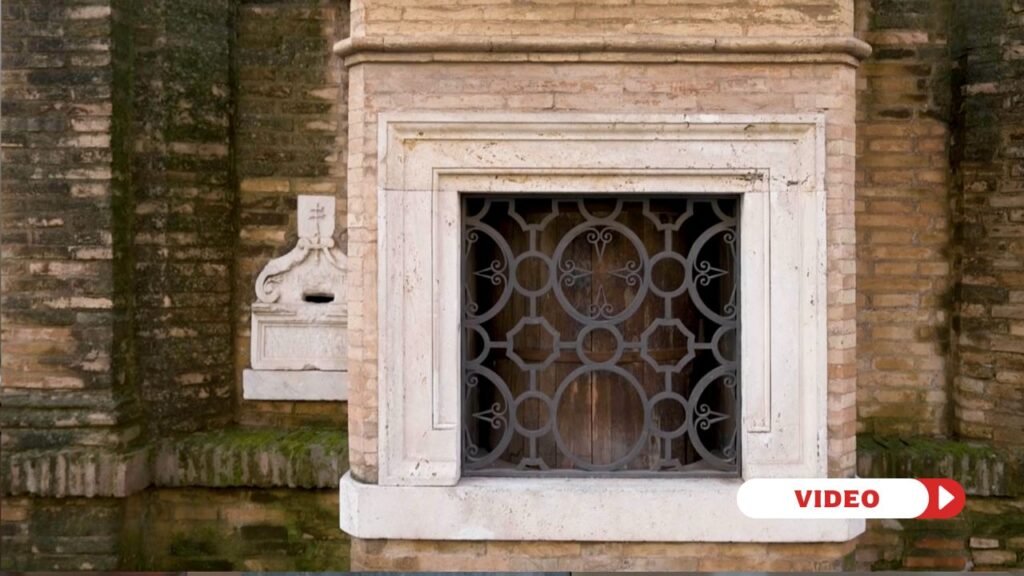
Determined to stop the practice, the pope ordered the construction of what would become the first “foundling wheel” in 1198. It was built beside the Tiber at Santo Spirito in Sassia, the oldest hospital in Europe.
The First Foundling Wheel
The original wheel still exists today.
“This is the foundling wheel that saved thousands of babies. It was the very first one ever built. If you’ve been to Rome, chances are you walked right past it without even noticing. It sits on the Borgo Santo Spirito right around the corner from Vatican City.”
Installed in the wall of the hospital, the rotating wooden drum allowed mothers to place a baby inside anonymously. Once the wheel was turned, the child would be safely received by caregivers on the other side.
Foundling wheels soon spread throughout Italy—more than in any other European country. “Foundling wheels became widespread in Italy more than any other European country. This one here, continued operating until 1870, due to changing social policy. But this wheel, started a network of infant nurseries around the continent. Hospitals and Churches around Europe, not only took abandoned children in but also helped them get to foster families around the country.”
What began as a local solution became a continent-wide system of protection.
A Modern “Baby Box”
While the original wheel at Santo Spirito ceased operation in the 19th century, the idea behind it did not disappear. Today, modern hospitals continue the mission through updated versions known as baby hatches or “baby boxes.”
At Rome’s Policlinico Casilino hospital, a contemporary version operates with advanced medical safeguards.
Dr. Simonetta Costa, Head of the Neonatology Unit, explained how it works: “The baby box, as our founding wheel is called, was built in 2006, about 20 years ago. It was created to help mothers in difficulty unable to take their child with them and so to save newborn life. Since the baby box was created, only one infant has been entrusted to our founding wheel. And this occurred in 2007, and the baby was three months old.”
She described the process in detail: “And when a mother decides to leave their child, she can place her baby in a cot located in our baby box room, which is kept at a constant temperature throughout the year. An alarm activated by a contact sensor alerts the staff of the emergency room. And a camera focuses only on the cot where the baby is lying, and without capturing the face of the person who placed the baby on the cot.”
The system guarantees complete privacy. No hidden cameras record the entrance. Within seconds of the alarm, a neonatologist and nurse arrive to retrieve the child, who is immediately taken for medical evaluation and care.
Dr. Costa continued, “Thanks to a transport incubator already present in the baby box, the infant is carried to the neonatal pathology ward or to the neonatal intensive care unit depending on the clinical conditions. However, the baby box is equipped to provide emergency care if necessary. During the hospital stay, the infant receives tests to evaluate health status, several tests, and subsequently social services are activated to report the event to the juvenile court so that the baby can be entrusted to a protected facility or to an adoptive family.”
A Sign of Hope
Though today’s baby boxes differ from their medieval predecessors—with temperature control, alarms, and neonatal units—the underlying purpose remains unchanged: to save lives and offer children a future.
For Dr. Costa, their existence is deeply meaningful. “Without any doubt, this is a sign of hope because abandoning newborn infants often means depriving them of their chance to survive. Tragic events may occur when infants are abandoned, for example, in the garbage bins shortly after birth. With a foundling wheel, a mother can give her baby the possibility to live and to be entrusted to a family.”
She pointed to the hospital’s guiding message: “In fact, our Baby Box slogan is, ‘Don’t abandon your baby, but entrust him or her to us.’ That’s beautiful.”
From a wooden wheel built beside the Tiber in 1198 to modern neonatal units in Rome today, the message remains the same: even in moments of desperation, there is another way.
Adapted by Jacob Stein. Produced by Alexey Gotovskiy; Camera by Andrea Gallo, Fabio Gonnella; Video Edited by Ilaria Chimenti.