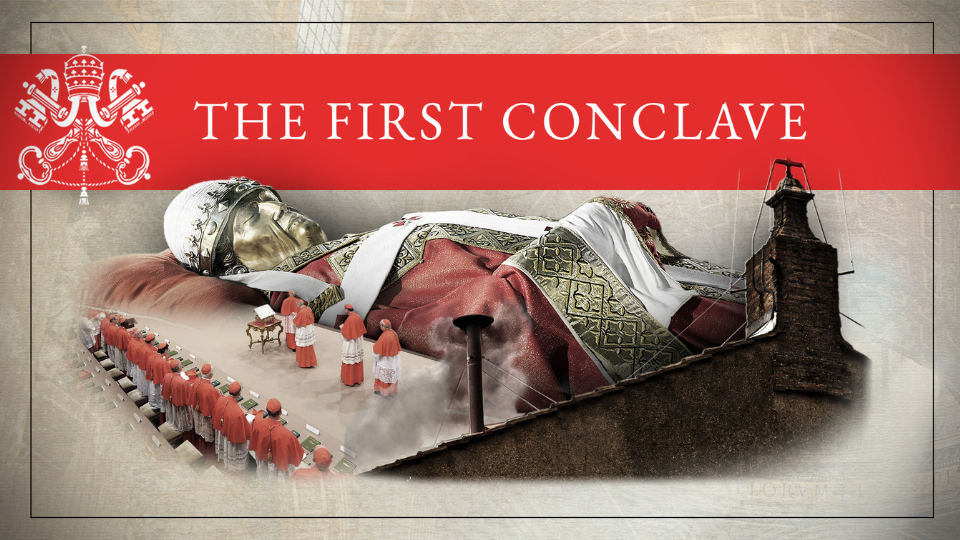
The word conclave, from the Latin cum clave, which means closed with a key, evokes in our minds images of an orphan church that expectantly awaits the name of who will be the next successor of St. Peter. It makes us think of the cardinal electors gathered behind closed doors in the Sistine Chapel, where Michelangelo’s Universal Judgment reminds us that they will have to give an account to God at the end of their days.
SIGN UP FOR OUR NEWSLETTER HERE
But the word conclave also brings to mind the city of Rome, St. Peter’s Square, packed with the faithful who stare without blinking at the roof of the Sistine Chapel, waiting to see the colour of the smoke from a chimney that will announce to the world the result of the votes.
Well, throughout the history of the Church, the election of pontiffs hasn’t always been this way. In fact, until Pope Gregory X, successor of Peter number 184, the conclave as we know it today didn’t exist.
Some analogous form of enclosing the cardinals to elect the pope had happened on some preceding occasions, always because the kings and emperors in Europe tried to apply pressure so that their favorites or those who favored them would be elected.
The most striking case was in Viterbo, where it took three years—from 1268 to 1271—to elect Tedaldo Visconti, Gregory X. On that occasion, after two years of indecision from the cardinals, the population locked them in with a key. Then, they opened up the roof and left them bread and water to see if they would decide.
Given the situation that was created, Pope Gregory X promulgated this bull Ubi Periculum, with which he formalized a series of rules to respect for the election of the pope, thus formally instituting the conclave. It established that within a few days, the cardinals must gather in the place of the death of the pope, locking themselves in a place out of contact with the outside world. And then, an entire series of restrictions, also material ones, precisely to induce them to keep the time brief for the decision.
But who was Tedaldi Visconti from Piacenza, and how did he become Pope Gregory X?
Gregory X, then Tedaldi Visconti di Piacenza, was elected in 1271, which we could call the proto-conclave in Viterbo. His body is buried inside the cathedral. The cardinals who elected him in Viterbo agreed on this name after three years of sede vacante, also known as the empty seat. Tedaldo Visconti wasn’t a bishop or a priest but simply a deacon. But they chose him for his diplomatic skills. At the moment of the election, he was in the Holy Land, and from there, he was called to return to Rome, but his mind remained forever tied to the Holy Land, so much so that the main climax of his papacy was the organization of a crusade to liberate the holy places.
Gregory X was returning from the Council of Lyon to Rome, and during the trip, he decided to spend the Christmas festivities in Arezzo, which at that time was an important theological center between the Apennines and Rome. Gregory X knew many people in Arezzo. He was welcomed by Bishop Gubolino Deio Retini in December of 1275. Unfortunately, he was already sick with a fever, and surely his condition worsened.
On January 10th, 1276, Gregory X died. Before dying, though, he left the city 30,000 gold florins, the sum that allowed for the construction of a new great cathedral and the center of the city.
Historians have two hypotheses about which was the precise place that the first conclave was celebrated, but what they have no doubt about is that it was in the city of Arezzo, and that Blessed Gregory X had the idea for this institution.
One hypothesis is this placement here, where there already was a settlement of Dominicans, where the current basilica now is. Another hypothesis is the church of St. Gregory, where today the cathedral and the bishop’s residence are located, which are successive.
Today the body of Blessed Gregory X lies in the Cathedral of Arezzo, built thanks to the generosity of the very same pontiff, who, from simple deacon in the Holy Land, was called to Rome to occupy the Petrine See as the successor to St. Peter and head of the universal Church.
Adapted by Jacob Stein