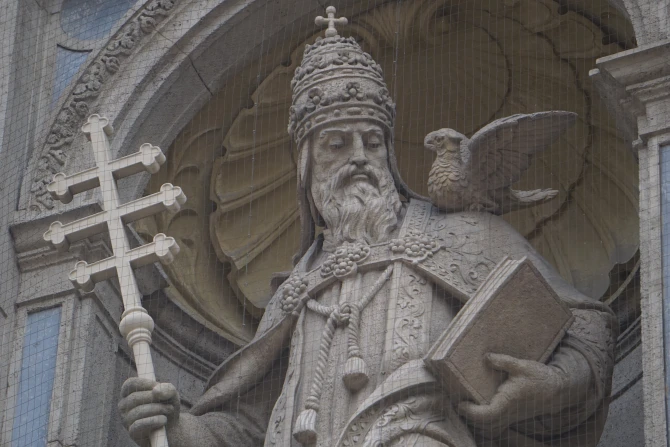
St. Gregory the Great, a central figure of the medieval western Church and one of the most admired popes in history, is commemorated in the Ordinary Form of the Roman Catholic liturgy on September 3. He was the first of the bishops of Rome to popularize the now-traditional papal title “servant of the servants of God,” which referred to Christ’s command that those in the highest position of leadership should be “the last of all and the servant of all.”
Born near the middle of the sixth century into a noble Roman family, the future St. Gregory the Great received a classical education in liberal arts and the law. He also had strong religious formation from his devout family, particularly from his mother, Silvia, also a canonized saint.
By around age 30, Gregory had advanced to high political office in Rome, during what was nevertheless a period of marked decline for the city.
Some time after becoming the prefect of the former imperial capital, Gregory chose to leave the civil administration to become a monk during the rise of the Benedictine order. In reality, however, the new monk’s great career in public life was yet to come.
After three years of strict monastic life, he was called personally by the pope to assume the office of a deacon in Rome. From Rome, he was dispatched to Constantinople, to seek aid from the emperor for Rome’s civic troubles, and to aid in resolving the Eastern church’s theological controversies. He returned to Rome in 586, after six years of service as the papal representative to the eastern Church and empire.
Rome faced a series of disasters caused by flooding in 589, followed by the death of Pope Pelagius II the next year. Gregory, then serving as abbot in a monastery, reluctantly accepted his election to replace him as the Bishop of Rome.
Despite this initial reluctance, however, Pope Gregory began working tirelessly to reform and solidify the Roman liturgy, the disciplines of the Church, the military and economic security of Rome, and the Church’s spreading influence in western Europe.
As pope, Gregory brought his political experience in Rome and Constantinople to bear, in the task of preventing the Catholic Church from becoming subservient to any of the various groups struggling for control of the former imperial capital. As the former abbot of a monastery, he strongly supported the Benedictine movement as a bedrock of the western Church. He sent missionaries to England, and is given much of the credit for the nation’s conversion.
Even as he undertook to consolidate papal power and shore up the crumbling Roman west, St. Gregory the Great maintained a humble sense of his mission as a servant and pastor of souls, from the time of his election until his death in 604.
SIGN UP FOR OUR NEWSLETTER HERE
This CNA article was first published on Aug. 19, 2010, and has been updated.