The Vatican’s Pontifical Commission for the Protection of Minors on Thursday released its second annual report on the Church’s safeguarding policies and procedures, urging heightened awareness of abuse and the need to offer reparations to victims.
The second annual report launched by the commission, instituted by Pope Francis in 2014 for the protection of minors and vulnerable adults, promotes “conversional justice” — founded on the pillars of truth, justice, reparations, and institutional reforms — to be adopted by the Church across the globe and at all levels of governance.
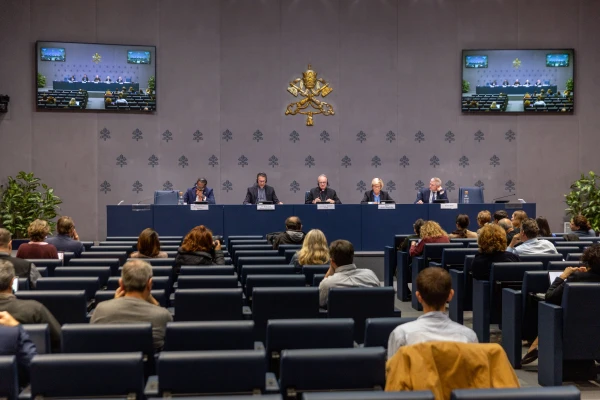
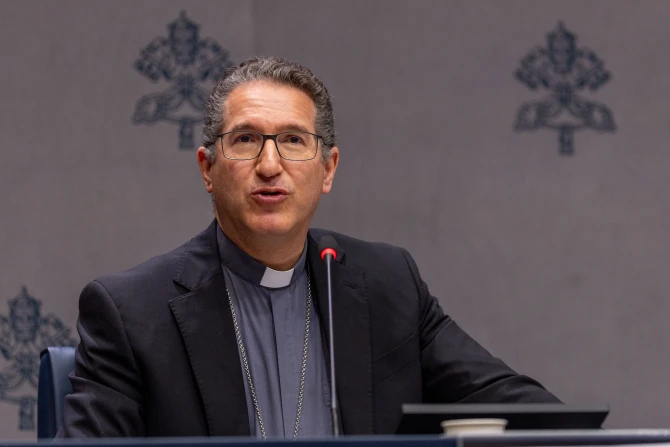
Archbishop Thibault Verny of Chambéry, who was appointed by Pope Leo XIV in July to head the commission, spoke of the report’s efforts to emphasize the significance of “walking alongside victims and survivors” and including their voices in promoting positive change and institutional reform within the Church.
“We have acquired the profound conviction that the road leading to a culture of protection is not simply for victims and survivors but with them,” Chambéry said at an Oct. 16 press conference.
“This path of conversion requires that we be reached by what we hear,” he said.
The 200-page report provides a snapshot of safeguarding challenges and recommendations in 18 episcopal conferences, mainly in Africa and Europe, and the positive trends and challenges on a regional level in Africa, the Americas, Asia/Oceania, and Europe.
It also offers a review of the safeguarding policies, challenges, and recommendations of two religious institutions, the Missionary Sisters of Our Lady of Africa and the Brothers of Christian Instruction of St. Gabriel.
Data for the report was collected from focus group consultations with 40 abuse survivors from Africa, the Americas, Asia/Oceania, and Europe, the commission’s Memorare Initiative centers in Global South countries, and questionnaires distributed to episcopal conferences and religious congregations.
Information was also gathered from consultations with apostolic nuncios and bishops during ad limina visits and data published by external organizations, including U.N. agencies.
In order to make reparations to abuse victims and their families, the report outlines six key recommendations for Church institutions to form the basis of their “operational vademecum,” including welcoming, listening, and caring for survivors; public and private communications and apologies; and spiritual and psychotherapeutic support.
The report also urges financial support, institutional and disciplinary reforms, and safeguarding initiatives across the ecclesial community.
The second annual report released by the pontifical commission also includes a brief section outlining the role and activities of the Roman Curia in supporting local Churches’ safeguarding activities, in line with Pope Francis’ “all-of-government” approach to promote an “ongoing conversion toward a culture of safeguarding.”
According to Maud de Boer-Buquicchio, a jurist and member of the Pontifical Commission for the Protection of Minors since 2022, the annual report is a handbook that can be used within the Church to address the “global data gap” on sexual violence and abuse against children.
Noting the “alarming” gap in numerical abuse report data worldwide and further improvements for the commission’s future work, Boer-Buquicchio said the report emphasizes the significance of “listening” in the Church’s safeguarding ministries.
“I want to highlight one of the most consistent points that emerged: Victims/survivors want to feel heard and validated in their experiences,” she said at the Thursday press conference.
“Amidst these positive developments in our methodology, we recommit ourselves to continuous improvement, knowing that we still fall short of a fully mature reporting instrument,” she added.
This article was originally published by CNA.