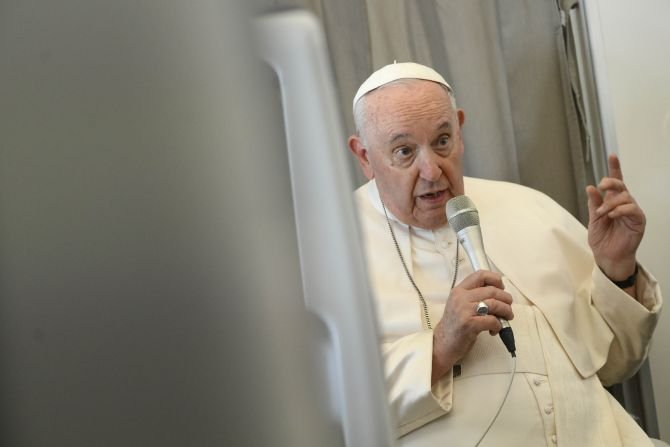

Both Christians and Muslims have been slaughtered in Nigeria, where there is terrorist activity over economic questions, Pope Leo XIV told journalists as he left his Castel Gandolfo residence on Tuesday evening.
“I think in Nigeria, in certain areas, there is certainly a danger for Christians, but for all people. Christians and Muslims have been slaughtered,” he said, addressing a question from EWTN News about the safety of Nigerian Christians on Nov. 18.
“There’s a question of terrorism. There’s a question that has to do a lot with economics, if you will, and control of the lands that they have,” the pope continued. “Unfortunately, many Christians have died, and I think it’s very, it’s important to seek a way for the government, with all peoples, to promote authentic religious freedom.”
Leo answered questions from journalists as he left his Castel Gandolfo residence, Villa Barberini, to return to the Vatican after spending the day at the papal retreat, located 18 miles south of Rome.
As he left his residence, Leo was greeted to enthusiastic cheers from a small group of people, including several engaged couples participating in a marriage preparation course at the local parish. The young people, together with their pastor, Father Tadeusz Rozmus, gave the pope a framed photo of their group.
U.S. President Donald Trump made Nigeria a country of particular concern on Nov. 3. The U.S. government gives the designation to countries identified as having or tolerating particularly severe religious freedom violations.
In the wake of the designation, Nigeria’s government denied that ongoing violence in the country is based on religious affiliation or that Christians are being targeted in particular.
“Portraying Nigeria’s security challenges as a targeted campaign against a single religious group is a gross misrepresentation of reality,” authorities said in a statement posted on X on Sept. 28.
“Terrorists attack all who reject their murderous ideology — Muslims, Christians, and those of no faith alike,” the statement continued. “Christianity is neither endangered nor marginalized in Nigeria.”
Cardinal Pietro Parolin, Vatican secretary of state, drew criticism last month after telling journalists that violence in Nigeria was “not a religious conflict, but rather a social conflict, for example, between herders and farmers.”
Parolin’s remarks were made on the sidelines of a conference for the release of the Catholic charity Aid to the Church in Need’s 2025 Religious Freedom Report.
“Let’s keep in mind that many Muslims who come to Nigeria are victims of this intolerance,” he continued.” So, these extremist groups, these groups that make no distinctions to advance their goals, their objectives, use violence against anyone they perceive as an opponent.”
Parolin’s comments repeat “the Nigerian government’s talking points that obfuscate and downplay the persecution of the Catholic faithful and other Christians in Nigeria’s Middle Belt,” Nina Shea, a commissioner of the U.S. Commission on Religious Freedom, told the National Catholic Register, CNA’s sister news partner.
The religious freedom report from Aid to the Church in Need found “a severe and escalating wave of violence, largely driven by extremist Islamist groups such as Boko Haram and the Islamic State West Africa Province (ISWAP)” during the two-year reporting period.
The report affirms that religious affiliation plays an important role in the ongoing violence in Nigeria, alongside other social causes, including poverty, preexisting ethnic and intercommunal violence, and conflict over land and water disputes between Fulani herders and non-Fulani farmers.
“Although exact figures are difficult to assess, Christians have been the target of extrajudicial killings and abductions by insurgent groups and criminal gangs,” the report states.
“It is also important to note that, although Christians suffer the brunt of extremist violence, the fact that the terrorist groups operate in states with a predominantly Muslim population means that the violence has not only affected Christians but also Muslims,” it continues.
This article was originally published by CNA.